Fonseca Erica L, Andrade Bruno G N, Vicente Ana C P
Laboratório de Genética Molecular de Microrganismos, Instituto Oswaldo Cruz, Fundação Oswaldo Cruz, Rio de Janeiro, Brazil.
Front Microbiol. 2018 Apr 5;9:677. doi: 10.3389/fmicb.2018.00677. eCollection 2018.
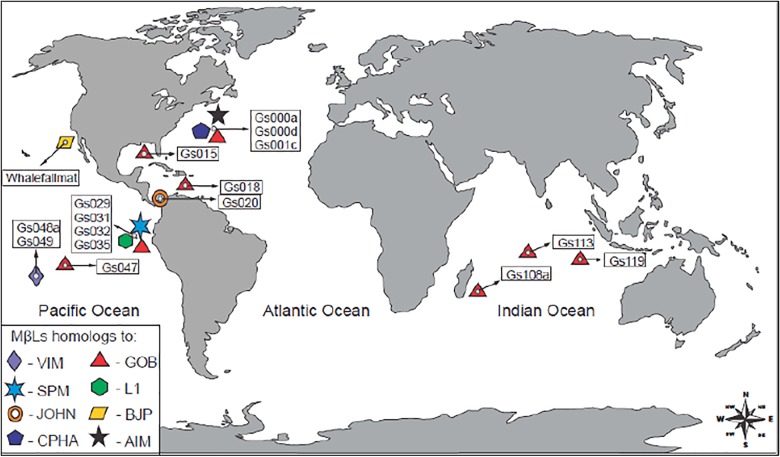
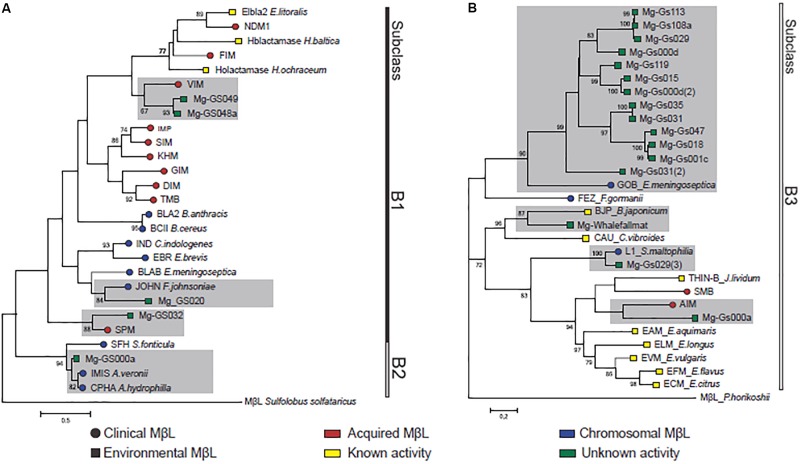
The worldwide dispersion and sudden emergence of new antibiotic resistance genes (ARGs) determined the need in uncovering which environment participate most as their source and reservoir. ARGs closely related to those currently found in human pathogens occur in the resistome of anthropogenic impacted environments. However, the role of pristine environment as the origin and source of ARGs remains underexplored and controversy, particularly, the marine environments represented by the oceans. Here, due to the ocean nature, we hypothesized that the resistome of this pristine/low-impacted marine environment is represented by distant ARG homologs. To test this hypothesis we performed an analysis on the Global Ocean Sampling (GOS) metagenomic project dataset focusing on the metallo-β-lactamases (MβLs) as the ARG model. MβLs have been a challenge to public health, since they hydrolyze the carbapenems, one of the last therapeutic choice in clinics. Using Hidden Markov Model (HMM) profiles, we were successful in identifying a high diversity of distant MβL homologs, related to the B1, B2, and B3 subclasses. The majority of them were distributed across the Atlantic, Indian, and Pacific Oceans being related to the chromosomally encoded MβL GOB present in genus. It was observed only a reduced number of metagenomic sequence homologs related to the acquired MβL enzymes (VIM, SPM-1, and AIM-1) that currently have impact in clinics. Therefore, low antibiotic impacted marine environment, as the ocean, are unlikely the source of ARGs that have been causing enormous threat to the public health.
新抗生素抗性基因(ARGs)在全球范围内的扩散和突然出现,决定了有必要弄清楚哪些环境作为其来源和储存库发挥的作用最大。与目前在人类病原体中发现的那些密切相关的ARGs存在于受人为影响环境的抗性组中。然而,原始环境作为ARGs的起源和来源的作用仍未得到充分探索且存在争议,特别是以海洋为代表的海洋环境。在此,鉴于海洋的性质,我们假设这种原始/低影响海洋环境的抗性组由远距离的ARGs同源物代表。为了验证这一假设,我们对全球海洋采样(GOS)宏基因组项目数据集进行了分析,重点关注金属β-内酰胺酶(MβLs)作为ARGs模型。MβLs一直是公共卫生面临的一个挑战,因为它们能水解碳青霉烯类药物,而碳青霉烯类药物是临床上最后的治疗选择之一。使用隐马尔可夫模型(HMM)图谱,我们成功地鉴定出了与B1、B2和B3亚类相关的远距离MβL同源物的高度多样性。其中大多数分布在大西洋、印度洋和太平洋,与该属中存在的染色体编码MβL GOB相关。仅观察到与目前在临床上有影响的获得性MβL酶(VIM、SPM-1和AIM-1)相关的宏基因组序列同源物数量减少。因此,像海洋这样受抗生素影响较小的海洋环境不太可能是对公共卫生造成巨大威胁的ARGs的来源。