Kim Byung Eui, Leung Donald Y M
Department of Pediatrics, National Jewish Health, Denver, CO, USA.
Allergy Asthma Immunol Res. 2018 May;10(3):207-215. doi: 10.4168/aair.2018.10.3.207.
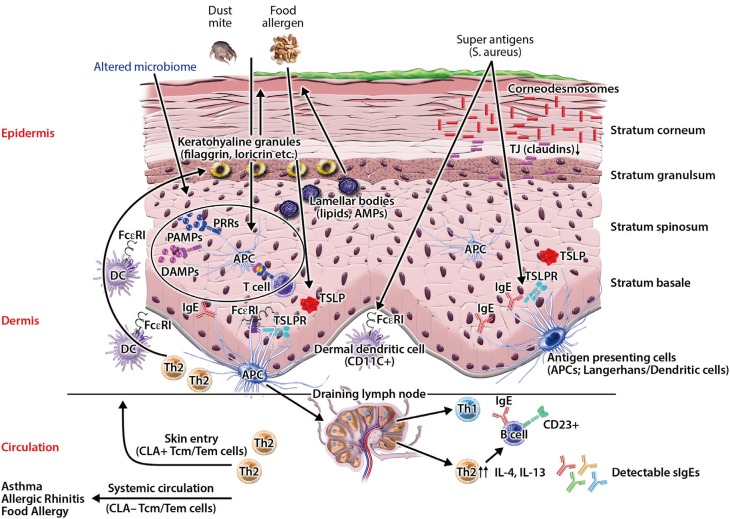
The epidermis contains epithelial cells, immune cells, and microbes which provides a physical and functional barrier to the protection of human skin. It plays critical roles in preventing environmental allergen penetration into the human body and responsing to microbial pathogens. Atopic dermatitis (AD) is the most common, complex chronic inflammatory skin disease. Skin barrier dysfunction is the initial step in the development of AD. Multiple factors, including immune dysregulation, filaggrin mutations, deficiency of antimicrobial peptides, and skin dysbiosis contribute to skin barrier defects. In the initial phase of AD, treatment with moisturizers improves skin barrier function and prevents the development of AD. With the progression of AD, effective topical and systemic therapies are needed to reduce immune pathway activation and general inflammation. Targeted microbiome therapy is also being developed to correct skin dysbiosis associated with AD. Improved identification and characterization of AD phenotypes and endotypes are required to optimize the precision medicine approach to AD.
表皮包含上皮细胞、免疫细胞和微生物,它们为保护人类皮肤提供了物理和功能屏障。它在防止环境过敏原侵入人体以及对微生物病原体作出反应方面发挥着关键作用。特应性皮炎(AD)是最常见、复杂的慢性炎症性皮肤病。皮肤屏障功能障碍是AD发病的初始步骤。多种因素,包括免疫失调、丝聚合蛋白突变、抗菌肽缺乏和皮肤微生物群失调,都导致皮肤屏障缺陷。在AD的初始阶段,使用保湿剂进行治疗可改善皮肤屏障功能并预防AD的发生。随着AD的进展,需要有效的局部和全身治疗来减少免疫途径激活和全身炎症。靶向微生物群疗法也正在开发中,以纠正与AD相关的皮肤微生物群失调。需要改进对AD表型和内型的识别和表征,以优化AD的精准医学方法。