Aliashkevich Alena, Alvarez Laura, Cava Felipe
The Laboratory for Molecular Infection Medicine Sweden (MIMS), Department of Molecular Biology, Umeå University, Umeå, Sweden.
Front Microbiol. 2018 Apr 6;9:683. doi: 10.3389/fmicb.2018.00683. eCollection 2018.
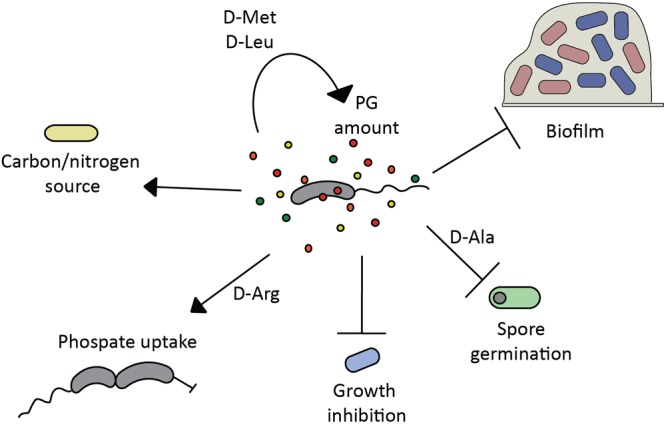
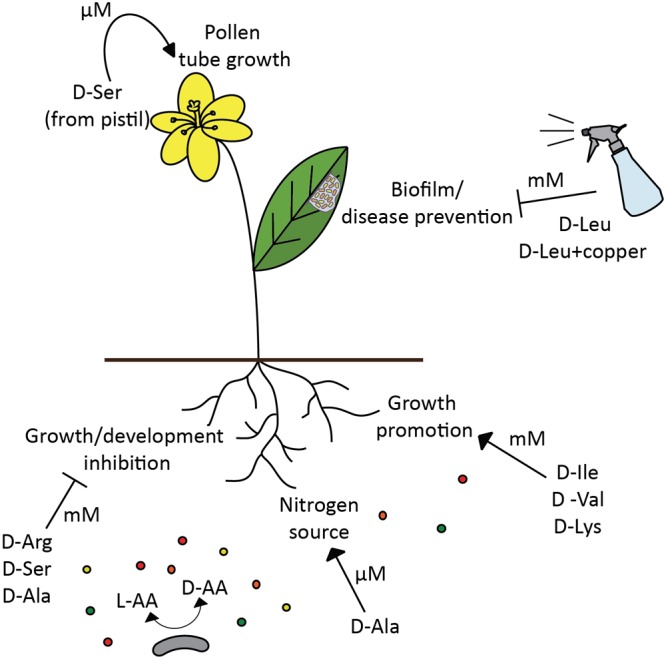
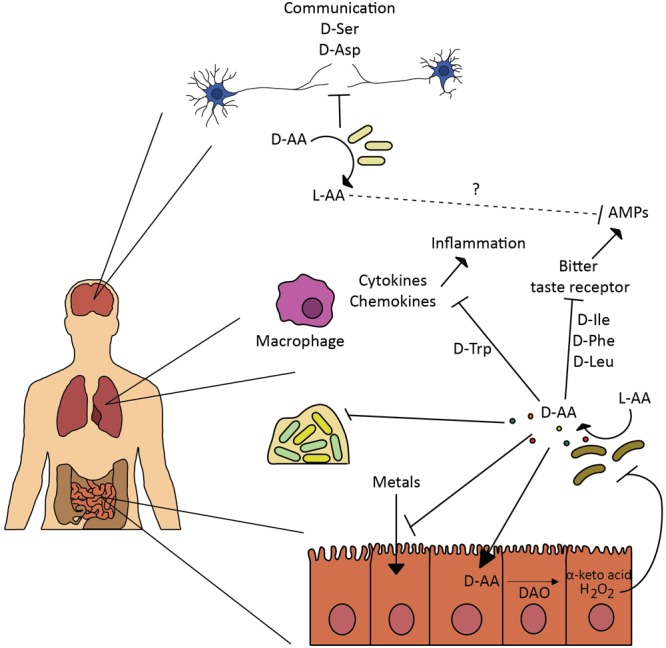
In the environment bacteria share their habitat with a great diversity of organisms, from microbes to humans, animals and plants. In these complex communities, the production of extracellular effectors is a common strategy to control the biodiversity by interfering with the growth and/or viability of nearby microbes. One of such effectors relies on the production and release of extracellular D-amino acids which regulate diverse cellular processes such as cell wall biogenesis, biofilm integrity, and spore germination. Non-canonical D-amino acids are mainly produced by broad spectrum racemases (Bsr). Bsr's promiscuity allows it to generate high concentrations of D-amino acids in environments with variable compositions of L-amino acids. However, it was not clear until recent whether these molecules exhibit divergent functions. Here we review the distinctive biological roles of D-amino acids, their mechanisms of action and their modulatory properties of the biodiversity of complex eco-systems.
在环境中,细菌与从微生物到人类、动物和植物等多种多样的生物共享其栖息地。在这些复杂的群落中,产生细胞外效应物是通过干扰附近微生物的生长和/或活力来控制生物多样性的常见策略。其中一种效应物依赖于细胞外D-氨基酸的产生和释放,这些D-氨基酸调节多种细胞过程,如细胞壁生物合成、生物膜完整性和孢子萌发。非经典D-氨基酸主要由广谱消旋酶(Bsr)产生。Bsr的混杂性使其能够在L-氨基酸组成可变的环境中产生高浓度的D-氨基酸。然而,直到最近还不清楚这些分子是否具有不同的功能。在这里,我们综述了D-氨基酸独特的生物学作用、它们的作用机制以及它们对复杂生态系统生物多样性的调节特性。