Dekkers Tessa, Melles Marijke, Groeneveld Bob Sander, de Ridder Huib
Faculty of Industrial Design Engineering, Delft University of Technology, Delft, Netherlands.
J Med Internet Res. 2018 Apr 23;20(4):e143. doi: 10.2196/jmir.9013.
Patients with orthopedic conditions frequently use the internet to find health information. Patient education that is distributed online may form an easily accessible, time- and cost-effective alternative to education delivered through traditional channels such as one-on-one consultations or booklets. However, no systematic evidence for the comparative effectiveness of Web-based educational interventions exists.
The objective of this systematic review was to examine the effects of Web-based patient education interventions for adult orthopedic patients and to compare its effectiveness with generic health information websites and traditional forms of patient education.
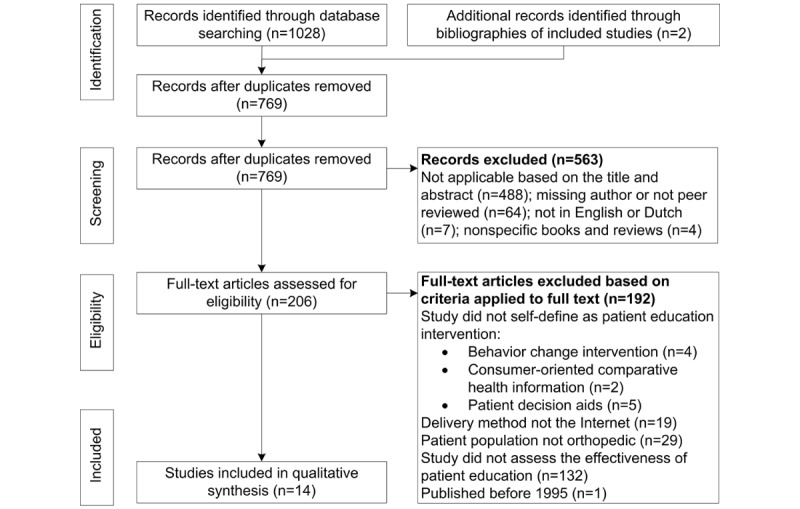
CINAHL, the Cochrane Library, EMBASE, MEDLINE, PsycINFO, PUBMED, ScienceDirect, Scopus, and Web of Science were searched covering the period from 1995 to 2016. Peer-reviewed English and Dutch studies were included if they delivered patient education via the internet to the adult orthopedic population and assessed its effects in a controlled or observational trial.
A total of 10 trials reported in 14 studies involving 4172 patients were identified. Nine trials provided evidence for increased patients' knowledge after Web-based patient education. Seven trials reported increased satisfaction and good evaluations of Web-based patient education. No compelling evidence exists for an effect of Web-based patient education on anxiety, health attitudes and behavior, or clinical outcomes.
Web-based patient education may be offered as a time- and cost-effective alternative to current educational interventions when the objective is to improve patients' knowledge and satisfaction. However, these findings may not be representative for the whole orthopedic patient population as most trials included considerably younger, higher-educated, and internet-savvy participants only.
患有骨科疾病的患者经常通过互联网查找健康信息。在线发布的患者教育可能是一种易于获取、省时且经济高效的选择,可替代通过传统渠道(如一对一咨询或手册)提供的教育。然而,目前尚无基于网络的教育干预措施比较效果的系统证据。
本系统评价的目的是研究基于网络的患者教育干预措施对成年骨科患者的影响,并将其效果与一般健康信息网站及传统形式的患者教育进行比较。
检索了CINAHL、Cochrane图书馆、EMBASE、MEDLINE、PsycINFO、PUBMED、ScienceDirect、Scopus和科学网,检索时间范围为1995年至2016年。纳入经同行评审的英文和荷兰语研究,这些研究通过互联网向成年骨科人群提供患者教育,并在对照试验或观察性试验中评估其效果。
共识别出14项研究中报告的10项试验,涉及4172名患者。9项试验提供了证据,表明基于网络的患者教育后患者知识增加。7项试验报告了基于网络的患者教育满意度提高且评价良好。没有令人信服的证据表明基于网络的患者教育对焦虑、健康态度和行为或临床结局有影响。
当目标是提高患者知识和满意度时,基于网络的患者教育可作为一种省时且经济高效的替代方案,替代当前的教育干预措施。然而,这些发现可能不代表整个骨科患者群体,因为大多数试验仅纳入了年龄相当小、受教育程度高且精通互联网的参与者。