1M.Sc. Program in Clinical Biochemistry and Molecular Medicine, Department of Clinical Chemistry, Faculty of Allied Health Sciences, Chulalongkorn University, Bangkok, Thailand.
2Maximizing Thai Children's Developmental Potential Research Unit, Department of Pediatrics, Faculty of Medicine, Chulalongkorn University and King Chulalongkorn Memorial Hospital, the Thai Red Cross Society, Bangkok, Thailand.
Mol Autism. 2018 Apr 16;9:27. doi: 10.1186/s13229-018-0213-9. eCollection 2018.
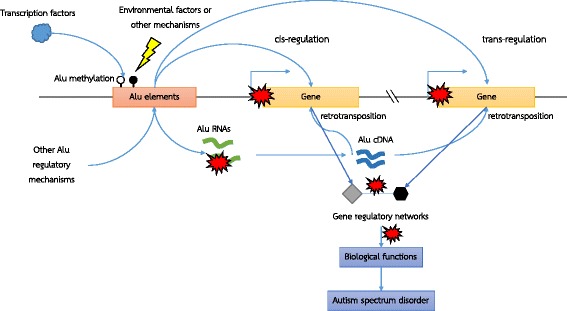
Alu elements are a group of repetitive elements that can influence gene expression through CpG residues and transcription factor binding. Altered gene expression and methylation profiles have been reported in various tissues and cell lines from individuals with autism spectrum disorder (ASD). However, the role of Alu elements in ASD remains unclear. We thus investigated whether Alu elements are associated with altered gene expression profiles in ASD.
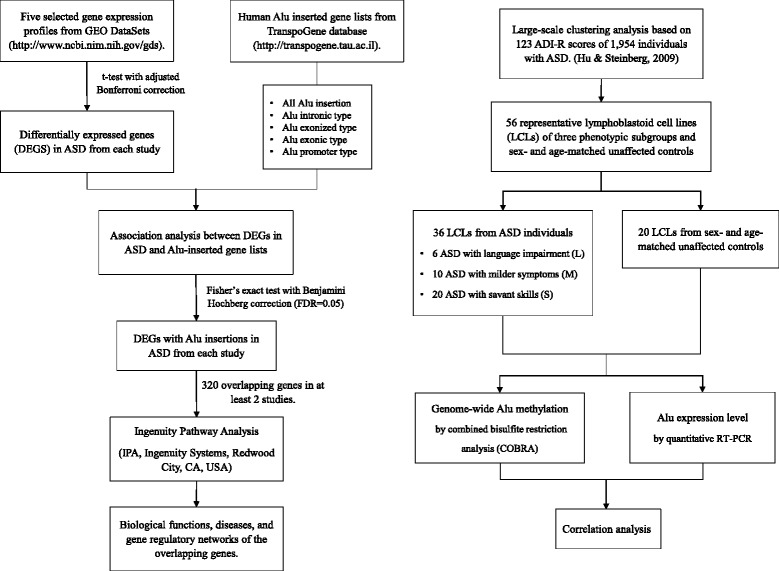
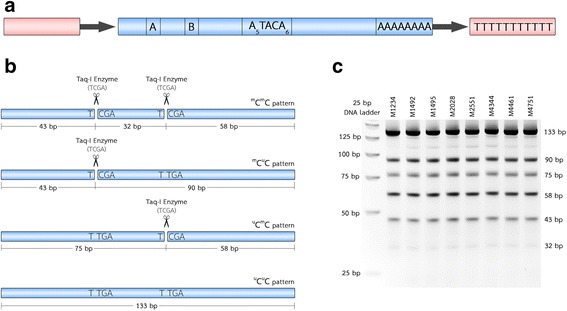
We obtained five blood-based gene expression profiles from the Gene Expression Omnibus database and human Alu-inserted gene lists from the TranspoGene database. Differentially expressed genes (DEGs) in ASD were identified from each study and overlapped with the human Alu-inserted genes. The biological functions and networks of Alu-inserted DEGs were then predicted by Ingenuity Pathway Analysis (IPA). A combined bisulfite restriction analysis of lymphoblastoid cell lines (LCLs) derived from 36 ASD and 20 sex- and age-matched unaffected individuals was performed to assess the global DNA methylation levels within Alu elements, and the Alu expression levels were determined by quantitative RT-PCR.
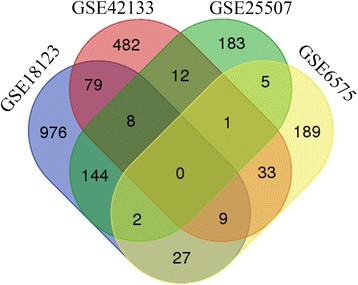
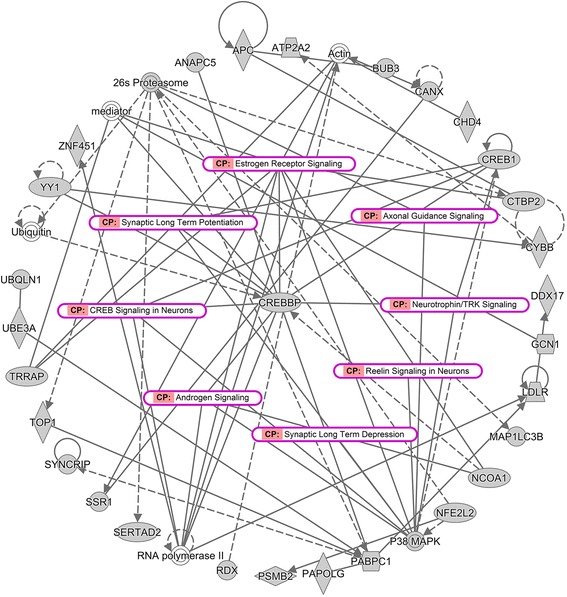
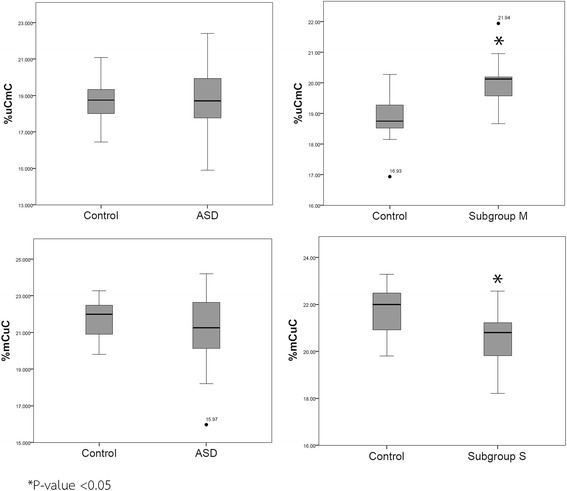
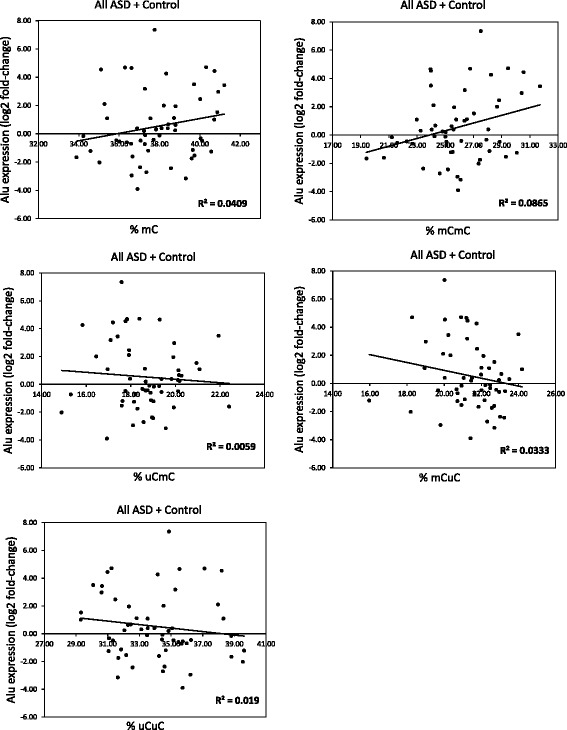
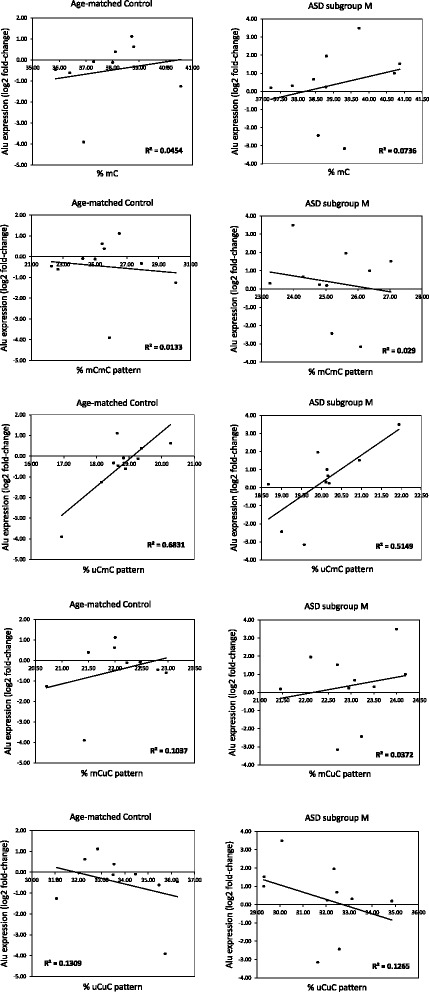
In ASD blood or blood-derived cells, 320 Alu-inserted genes were reproducibly differentially expressed. Biological function and pathway analysis showed that these genes were significantly associated with neurodevelopmental disorders and neurological functions involved in ASD etiology. Interestingly, estrogen receptor and androgen signaling pathways implicated in the sex bias of ASD, as well as IL-6 signaling and neuroinflammation signaling pathways, were also highlighted. Alu methylation was not significantly different between the ASD and sex- and age-matched control groups. However, significantly altered Alu methylation patterns were observed in ASD cases sub-grouped based on Autism Diagnostic Interview-Revised scores compared with matched controls. Quantitative RT-PCR analysis of Alu expression also showed significant differences between ASD subgroups. Interestingly, Alu expression was correlated with methylation status in one phenotypic ASD subgroup.
Alu methylation and expression were altered in LCLs from ASD subgroups. Our findings highlight the association of Alu elements with gene dysregulation in ASD blood samples and warrant further investigation. Moreover, the classification of ASD individuals into subgroups based on phenotypes may be beneficial and could provide insights into the still unknown etiology and the underlying mechanisms of ASD.
Alu 元件是一组重复元件,可通过 CpG 残基和转录因子结合影响基因表达。已在自闭症谱系障碍 (ASD) 个体的各种组织和细胞系中报道了基因表达和甲基化谱的改变。然而,Alu 元件在 ASD 中的作用仍不清楚。因此,我们研究了 Alu 元件是否与 ASD 中改变的基因表达谱有关。
我们从基因表达综合数据库中获得了五个基于血液的基因表达谱,从 TranspoGene 数据库中获得了人类 Alu 插入基因列表。从每项研究中鉴定出 ASD 中的差异表达基因 (DEGs),并与人类 Alu 插入基因重叠。然后通过 IPA(Ingenuity Pathway Analysis)预测 Alu 插入 DEG 的生物学功能和网络。对来自 36 名 ASD 和 20 名性别和年龄匹配的无影响个体的淋巴母细胞系 (LCL) 进行联合亚硫酸氢盐限制性分析,以评估 Alu 元件内的全基因组甲基化水平,并通过定量 RT-PCR 测定 Alu 表达水平。
在 ASD 血液或血液衍生细胞中,320 个 Alu 插入基因可重复地差异表达。生物学功能和途径分析表明,这些基因与神经发育障碍以及与 ASD 病因学相关的神经功能显著相关。有趣的是,涉及 ASD 性别偏倚的雌激素受体和雄激素信号通路以及 IL-6 信号和神经炎症信号通路也被强调。ASD 组与性别和年龄匹配的对照组之间的 Alu 甲基化无显著差异。然而,在根据自闭症诊断访谈修订版评分对 ASD 病例进行亚组化后,观察到 Alu 甲基化模式发生了显著改变。定量 RT-PCR 分析 Alu 表达也显示了 ASD 亚组之间的显著差异。有趣的是,Alu 表达与一个表型 ASD 亚组的甲基化状态相关。
ASD 亚组的 LCL 中存在 Alu 甲基化和表达改变。我们的发现强调了 Alu 元件与 ASD 血液样本中基因失调的关联,并需要进一步研究。此外,根据表型将 ASD 个体分为亚组可能是有益的,并可以深入了解 ASD 的未知病因和潜在机制。