Division of Neurobiology, Freie Universität Berlin, Germany.
Division of Neurobiology, Freie Universität Berlin, Germany; Graduate School of Biomedical Sciences, UT Southwestern Medical Center, Dallas, USA.
Curr Biol. 2018 Apr 23;28(8):R471-R486. doi: 10.1016/j.cub.2018.02.010.
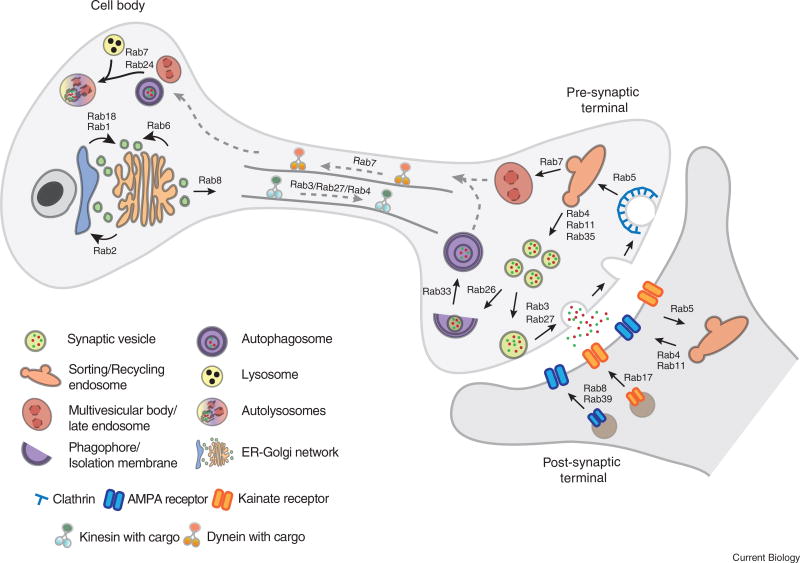
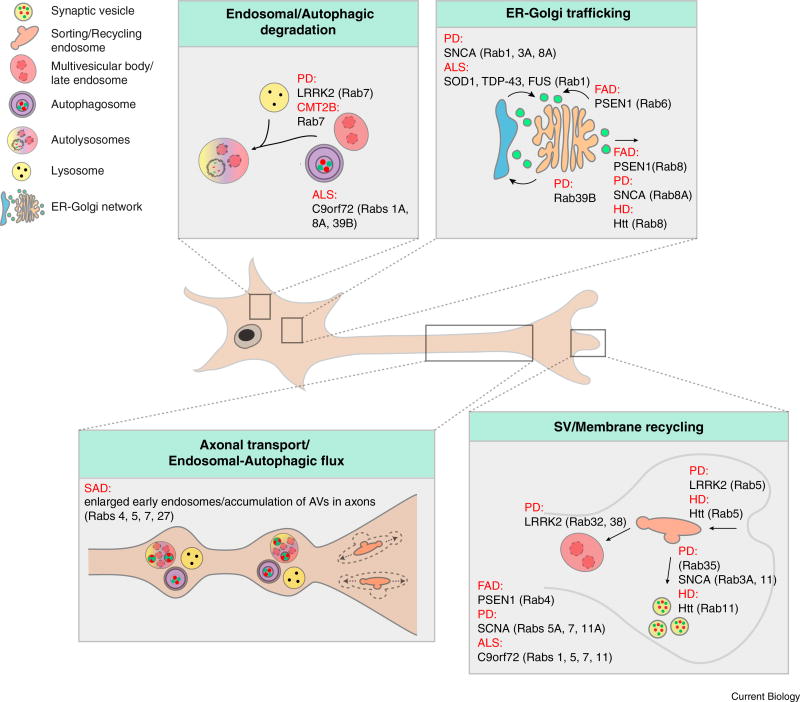
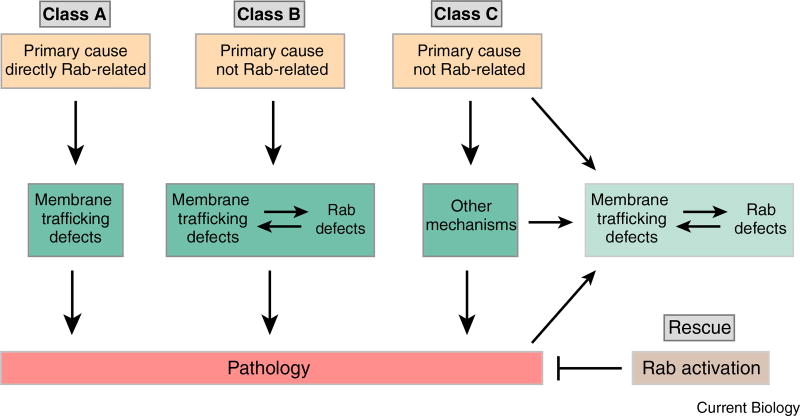
Defects in membrane trafficking are hallmarks of neurodegeneration. Rab GTPases are key regulators of membrane trafficking. Alterations of Rab GTPases, or the membrane compartments they regulate, are associated with virtually all neuronal activities in health and disease. The observation that many Rab GTPases are associated with neurodegeneration has proven a challenge in the quest for cause and effect. Neurodegeneration can be a direct consequence of a defect in membrane trafficking. Alternatively, changes in membrane trafficking may be secondary consequences or cellular responses. The secondary consequences and cellular responses, in turn, may protect, represent inconsequential correlates or function as drivers of pathology. Here, we attempt to disentangle the different roles of membrane trafficking in neurodegeneration by focusing on selected associations with Alzheimer's disease, Parkinson's disease, Huntington's disease and selected neuropathies. We provide an overview of current knowledge on Rab GTPase functions in neurons and review the associations of Rab GTPases with neurodegeneration with respect to the following classifications: primary cause, secondary cause driving pathology or secondary correlate. This analysis is devised to aid the interpretation of frequently observed membrane trafficking defects in neurodegeneration and facilitate the identification of true causes of pathology.
膜运输缺陷是神经退行性变的标志。Rab GTPases 是膜运输的关键调节剂。Rab GTPases 或它们调节的膜隔室的改变与健康和疾病中几乎所有神经元活动都有关。许多 Rab GTPases 与神经退行性变有关,这一观察结果给寻找因果关系带来了挑战。膜运输缺陷可能是神经退行性变的直接后果。或者,膜运输的变化可能是次要后果或细胞反应。反过来,次要后果和细胞反应可能具有保护作用、代表无足轻重的相关因素或作为病理学的驱动因素。在这里,我们通过关注与阿尔茨海默病、帕金森病、亨廷顿病和某些神经病变的选定关联,尝试通过分离膜运输在神经退行性变中的不同作用来解决这个问题。我们提供了 Rab GTPase 在神经元中的功能的最新知识概述,并根据以下分类回顾了 Rab GTPase 与神经退行性变的关联:主要原因、驱动病理学的次要原因或次要相关因素。这种分析旨在帮助解释神经退行性变中经常观察到的膜运输缺陷,并促进真正病理学原因的识别。