Department of Neuropediatrics and Muscle Disorders, Medical Center - University of Freiburg, Faculty of Medicine, University of Freiburg, Germany.
Department of Neuropediatrics, Children's Hospital 1, University of Duisburg-Essen, Essen, Germany.
J Neuromuscul Dis. 2018;5(2):135-143. doi: 10.3233/JND-180315.
Spinal muscular atrophy (SMA) is a neuromuscular disorder characterized by muscle weakness and muscle atrophy. Nusinersen acts as a splicing modifier and has recently been approved for intrathecal treatment of SMA.
Prior to approval, nusinersen was provided to patients with SMA type 1 in Germany within an Expanded Access Program (EAP). In contrast to previous clinical trials, children of different age groups and different stages of the disease were treated with nusinersen.
We conducted a prospective, longitudinal data collection of patients treated with nusinersen within the EAP in seven neuromuscular centers in Germany. Standardized assessments including CHOP-INTEND and HINE-2 motor milestones were performed at baseline and 60 and 180 days after start of treatment.
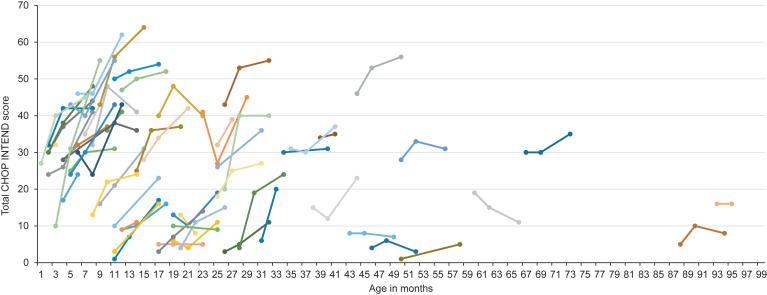
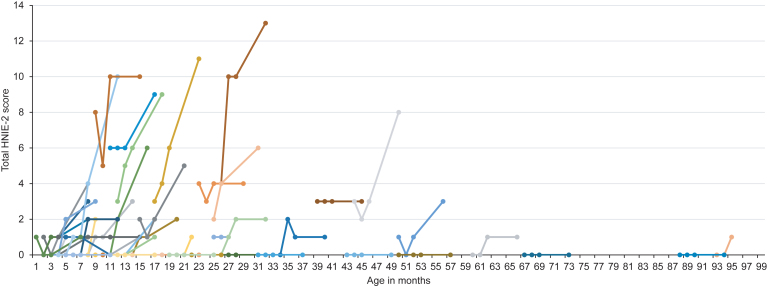
Data from 61 SMA type 1 patients (mean age 21.08 months, range 1-93) were available for analysis. After six months of treatment, 47 children (77.0%) improved by ≥4 points in CHOP INTEND score. Mean change in CHOP INTEND score was 9.0±8.0 points. Nineteen patients (31.1%) improved by ≥2 points in HINE-2 motor milestones. Regression analysis revealed age at onset of treatment as major determinant of change in CHOP INTEND from baseline.
When analyzing a broad spectrum of SMA type 1 patients, many children showed an improvement of motor function after six months of treatment with nusinersen, which is generally not expected within the natural course of the disease. Long-term observation and follow-up of patients with later onset types of SMA are crucial to understand the clinical impact of treatment with nusinersen.
脊髓性肌萎缩症(SMA)是一种以肌肉无力和肌肉萎缩为特征的神经肌肉疾病。诺西那生钠作为一种剪接修饰物,最近已被批准用于治疗 SMA 的鞘内治疗。
在获得批准之前,在德国的一项扩大准入计划(EAP)中,向患有 1 型 SMA 的患者提供了诺西那生钠。与之前的临床试验不同,不同年龄组和疾病不同阶段的儿童都接受了诺西那生钠治疗。
我们对德国 7 个神经肌肉中心内接受 EAP 治疗的患者进行了前瞻性、纵向数据收集。在基线和治疗开始后 60 和 180 天,进行了包括 CHOP-INTEND 和 HINE-2 运动里程碑在内的标准化评估。
61 名 1 型 SMA 患者(平均年龄 21.08 个月,范围 1-93)的数据可用于分析。治疗 6 个月后,47 名儿童(77.0%)CHOP INTEND 评分提高≥4 分。CHOP INTEND 评分的平均变化为 9.0±8.0 分。19 名患者(31.1%)在 HINE-2 运动里程碑上提高≥2 分。回归分析显示,治疗时的发病年龄是 CHOP INTEND 从基线开始变化的主要决定因素。
在分析广泛的 1 型 SMA 患者时,许多儿童在接受诺西那生钠治疗 6 个月后运动功能得到改善,而这在疾病的自然病程中通常是不会出现的。对发病较晚的 SMA 患者进行长期观察和随访对于了解诺西那生钠治疗的临床影响至关重要。