Geisinger Obesity Research Institute, Geisinger Clinic, Danville, PA, 17822, USA.
Lewis Katz School of Medicine at Temple University, Philadelphia, PA, 19140, USA.
J Transl Med. 2018 Apr 24;16(1):108. doi: 10.1186/s12967-018-1490-y.
Nonalcoholic fatty liver disease (NAFLD) is a prevalent complication of extreme obesity. Loading of the liver with fat can progress to inflammation and fibrosis including cirrhosis. The molecular factors involved in the progression from simple steatosis to fibrosis remain poorly understood.
Gene expression profiling using microarray, PCR array, and RNA sequencing was performed on RNA from liver biopsy tissue from patients with extreme obesity. Patients were grouped based on histological findings including normal liver histology with no steatosis, lobular inflammation, or fibrosis, and grades 1, 2, 3, and 4 fibrosis with coexistent steatosis and lobular inflammation. Validation of expression was conducted using quantitative PCR. Serum analysis was performed using ELISA. Expression analysis of hepatocytes and hepatic stellate cells in response to lipid loading were conducted in vitro using quantitative PCR and ELISA.
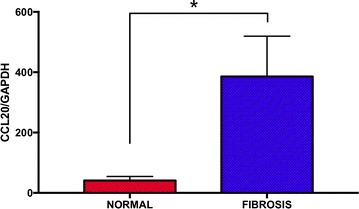
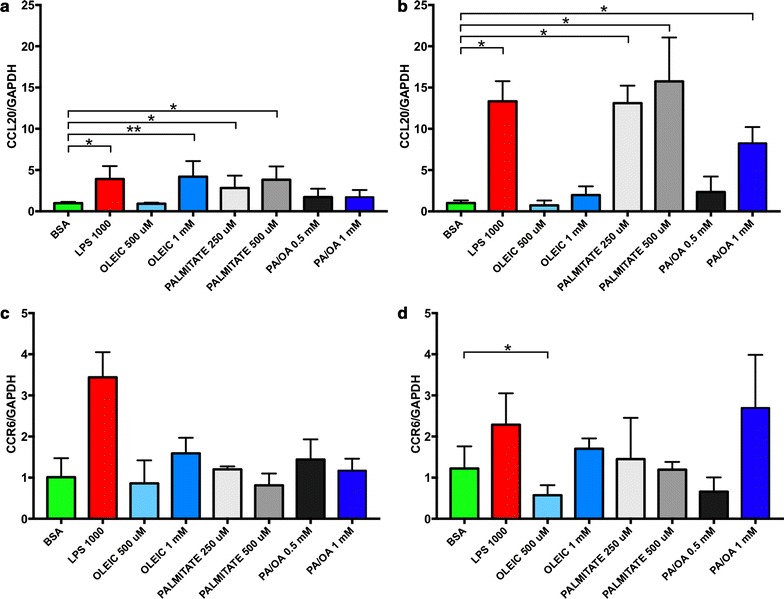
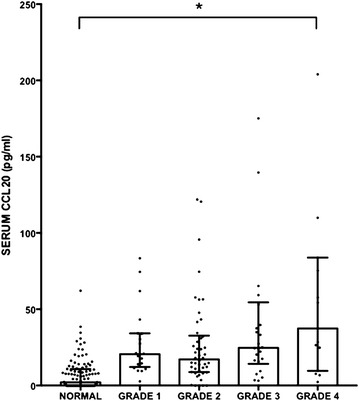
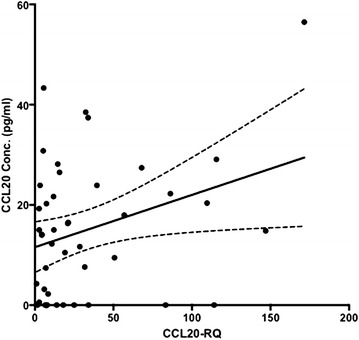
Three orthogonal methods to profile human liver biopsy RNA each identified the chemokine CCL20 (CC chemokine ligand 20 or MIP-3 alpha) gene as one of the most up-regulated transcripts in NAFLD fibrosis relative to normal histology, validated in a replication group. CCL20 protein levels in serum measured in 224 NAFLD patients were increased in severe fibrosis (p < 0.001), with moderate correlation of hepatic transcript levels and serum levels. Expression of CCL20, but not its cognate receptor CC chemokine receptor 6, was significantly (p < 0.001) increased in response to fatty acid loading in LX-2 hepatic stellate cells, with relative increases greater than those in HepG2 hepatocyte cells.
These results suggest that expression of CCL20, an important inflammatory mediator, is increased in NAFLD fibrosis. CCL20 serves as a chemoattractant molecule for immature dendritic cells, which have been shown to produce many of the inflammatory molecules that mediate liver fibrosis. These data also point to hepatic stellate cells as a key cell type that may respond to lipid loading of the liver.
非酒精性脂肪性肝病(NAFLD)是极度肥胖的常见并发症。肝脏脂肪堆积可进展为炎症和纤维化,包括肝硬化。从单纯性脂肪变性进展为纤维化的分子因素仍知之甚少。
使用微阵列、PCR 阵列和 RNA 测序对来自极度肥胖患者肝活检组织的 RNA 进行基因表达谱分析。根据组织学发现将患者分组,包括无脂肪变性、小叶炎症或纤维化的正常肝组织,以及伴有脂肪变性和小叶炎症的纤维化 1、2、3 和 4 级。使用定量 PCR 进行表达验证。使用 ELISA 进行血清分析。使用定量 PCR 和 ELISA 体外分析肝细胞和肝星状细胞对脂质加载的反应。
三种正交方法对人肝活检 RNA 进行分析,每种方法均鉴定趋化因子 CCL20(CC 趋化因子配体 20 或 MIP-3α)基因在非酒精性脂肪性肝病纤维化相对于正常组织学中是上调最明显的转录物之一,在复制组中得到验证。在 224 例非酒精性脂肪性肝病患者中,CCL20 蛋白水平在严重纤维化时升高(p<0.001),肝转录水平与血清水平中度相关。在 LX-2 肝星状细胞中,脂肪酸加载后 CCL20 的表达(而不是其同源受体 CC 趋化因子受体 6)显著增加(p<0.001),相对增加大于 HepG2 肝细胞。
这些结果表明,CCL20 的表达在非酒精性脂肪性肝病纤维化中增加。CCL20 是一种重要的炎症介质,作为未成熟树突状细胞的趋化因子分子,已显示出可产生许多介导肝纤维化的炎症分子。这些数据还表明肝星状细胞可能是对肝脏脂质加载做出反应的关键细胞类型。