Webb Marianne Julie, Wadley Greg, Sanci Lena Amanda
Department of General Practice, Melbourne Medical School, University of Melbourne, Parkville, Australia.
School of Computing and Information Systems, University of Melbourne, Parkville, Australia.
JMIR Mhealth Uhealth. 2018 Apr 24;6(4):e105. doi: 10.2196/mhealth.8778.
Technology-based screening of young people for mental health disorders and health compromising behaviors in general practice increases the disclosure of sensitive health issues and improves patient-centered care. However, few studies investigate how general practitioners (GPs) and practice support staff (receptionists and practice managers) integrate screening technology into their routine work, including the problems that arise and how the staff surmount them.
The aim of this study was to investigate the implementation of a health and lifestyle screening app, Check Up GP, for young people aged 14 to 25 years attending an Australian general practice.
We conducted an in-depth implementation case study of Check Up GP in one general practice clinic, with methodology informed by action research. Semistructured interviews and focus groups were conducted with GPs and support staff at the end of the implementation period. Data were thematically analyzed and mapped to normalization process theory constructs. We also analyzed the number of times we supported staff, the location where young people completed Check Up GP, and whether they felt they had sufficient privacy and received a text messaging (short message service, SMS) link at the time of taking their appointment.
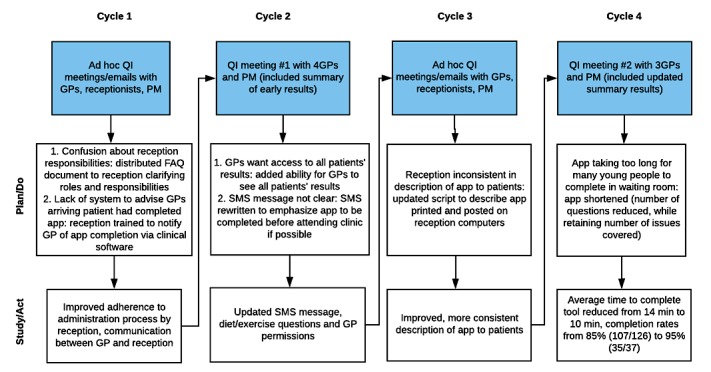
A total of 4 GPs and 10 support staff at the clinic participated in the study, with all except 3 receptionists participating in the final interviews and focus groups. During the 2-month implementation period, the technology and administration of Check Up GP was iterated through 4 major quality improvement cycles in response to the needs of the staff. This resulted in a reduction in the average time taken to complete Check Up GP from 14 min to 10 min, improved SMS text messaging for young people, and a more consistent description of the app by receptionists to young people. In the first weeks of implementation, researchers needed to regularly support staff with the app's administration; however, this support decreased over time, even as usage rose slightly. The majority of young people (73/87, 84%) completed Check Up GP in the waiting room, with less than half (35/80, 44%) having received an SMS from the clinic with a link to the tool. Participating staff valued Check Up GP, particularly its facilitation of youth-friendly practice. However, there was at first a lack of organizational systems and capacity to implement the app and also initially a reliance on researchers to facilitate the process.
The implementation of a screening app in the dynamic and time-restricted general practice setting presents a range of technical and administrative challenges. Successful implementation of a screening app is possible but requires adequate time and intensive facilitation. More resources, external to staff, are needed to drive and support sustainable technology innovation and implementation in general practice settings.
在全科医疗中,基于技术对年轻人进行心理健康障碍和危害健康行为的筛查,能增加敏感健康问题的披露,并改善以患者为中心的护理。然而,很少有研究调查全科医生(GP)和诊所支持人员(接待员和诊所经理)如何将筛查技术融入日常工作,包括出现的问题以及工作人员如何克服这些问题。
本研究旨在调查一款针对14至25岁澳大利亚全科医疗就诊年轻人的健康与生活方式筛查应用程序Check Up GP的实施情况。
我们在一家全科医疗诊所对Check Up GP进行了深入的实施案例研究,采用行动研究法提供方法指导。在实施期结束时,对全科医生和支持人员进行了半结构化访谈和焦点小组讨论。对数据进行了主题分析,并映射到正常化过程理论结构。我们还分析了支持工作人员的次数、年轻人完成Check Up GP的地点,以及他们在预约时是否觉得有足够的隐私并收到短信链接。
该诊所共有4名全科医生和10名支持人员参与了研究,除3名接待员外,其他人都参与了最终访谈和焦点小组讨论。在为期2个月的实施期内,根据工作人员的需求,Check Up GP的技术和管理经过了4个主要的质量改进周期。这使得完成Check Up GP的平均时间从14分钟减少到10分钟,改善了对年轻人的短信服务,接待员对该应用程序向年轻人的描述也更加一致。在实施的最初几周,研究人员需要定期为工作人员提供该应用程序管理方面的支持;然而,随着时间的推移,这种支持减少了,尽管使用率略有上升。大多数年轻人(87人中的73人,84%)在候诊室完成了Check Up GP,只有不到一半(80人中的35人,44%)收到过诊所发送的带有该工具链接的短信。参与的工作人员重视Check Up GP,特别是它有助于开展对年轻人友好的医疗服务。然而,起初缺乏实施该应用程序的组织系统和能力,而且最初依赖研究人员来推动这一过程。
在动态且时间有限的全科医疗环境中实施筛查应用程序会带来一系列技术和管理挑战。成功实施筛查应用程序是可能的,但需要足够的时间和大力推动。需要更多外部于工作人员的资源,以推动和支持全科医疗环境中的可持续技术创新与实施。
