Department of Blood Cell Research, Sanquin Research, Amsterdam, The Netherlands.
Landsteiner Laboratory, Academic Medical Center, University of Amsterdam, Amsterdam, The Netherlands.
Blood Adv. 2018 Apr 24;2(8):941-953. doi: 10.1182/bloodadvances.2017015008.
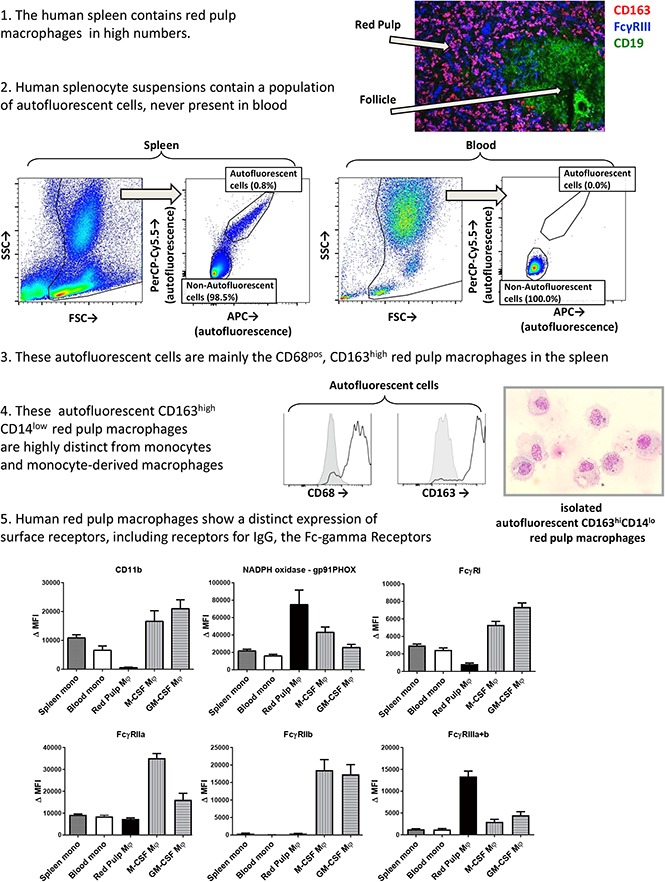
Tissue-resident macrophages in the spleen play a major role in the clearance of immunoglobulin G (IgG)-opsonized blood cells, as occurs in immune thrombocytopenia (ITP) and autoimmune hemolytic anemia (AIHA). Blood cells are phagocytosed via the Fc-γ receptors (FcγRs), but little is known about the FcγR expression on splenic red pulp macrophages in humans, with only a few previous studies that showed conflicting results. We developed a novel method to specifically isolate red pulp macrophages from 82 human spleens. Surface expression of various receptors and phagocytic capacity was analyzed by flow cytometry and immunofluorescence of tissue sections. Red pulp macrophages were distinct from splenic monocytes and blood monocyte-derived macrophages on various surface markers. Human red pulp macrophages predominantly expressed the low-affinity receptors FcγRIIa and FcγRIIIa. In contrast to blood monocyte-derived macrophages, red pulp macrophages did not express the inhibitory FcγRIIb. Red pulp macrophages expressed very low levels of the high-affinity receptor FcγRI. Messenger RNA transcript analysis confirmed this expression pattern. Unexpectedly and despite these differences in FcγR expression, phagocytosis of IgG-opsonized blood cells by red pulp macrophages was dependent on the same FcγRs as phagocytosis by blood monocyte-derived macrophages, especially in regarding the response to IV immunoglobulin. Concluding, we show the distinct nature of splenic red pulp macrophages in human subjects. Knowledge on the FcγR expression and usage of these cells is important for understanding and improving treatment strategies for autoimmune diseases such as ITP and AIHA.
脾脏组织驻留巨噬细胞在清除免疫球蛋白 G(IgG)调理的血细胞中起主要作用,如在免疫性血小板减少症(ITP)和自身免疫性溶血性贫血(AIHA)中发生的情况。血细胞通过 Fcγ 受体(FcγR)被吞噬,但关于人类脾脏红髓巨噬细胞上的 FcγR 表达知之甚少,仅有少数先前的研究显示出相互矛盾的结果。我们开发了一种从 82 个人脾脏中特异性分离红髓巨噬细胞的新方法。通过流式细胞术和组织切片的免疫荧光分析,研究了各种受体的表面表达和吞噬能力。红髓巨噬细胞与脾脏单核细胞和血液单核细胞衍生的巨噬细胞在各种表面标志物上明显不同。人类红髓巨噬细胞主要表达低亲和力受体 FcγRIIa 和 FcγRIIIa。与血液单核细胞衍生的巨噬细胞不同,红髓巨噬细胞不表达抑制性 FcγRIIb。红髓巨噬细胞表达极低水平的高亲和力受体 FcγRI。信使 RNA 转录分析证实了这种表达模式。出乎意料的是,尽管 FcγR 表达存在这些差异,但 IgG 调理的血细胞被红髓巨噬细胞吞噬仍然依赖于与血液单核细胞衍生的巨噬细胞相同的 FcγR,尤其是在对 IV 免疫球蛋白的反应方面。总之,我们展示了人类脾脏红髓巨噬细胞的独特性质。了解这些细胞的 FcγR 表达和用途对于理解和改善 ITP 和 AIHA 等自身免疫性疾病的治疗策略非常重要。