Lo Chun-Yu, Huang Hung-Yu, He Jung-Ru, Huang Tzu-Ting, Heh Chih-Chen, Sheng Te-Fang, Chung Kian Fan, Kuo Han-Pin, Wang Chun-Hua
Department of Thoracic Medicine, Chang Gung Medical Foundation, College of Medicine, Chang Gung University, Taipei, Taiwan.
Airways Disease Section, National Heart and Lung Institute, Imperial College London, London, UK.
Int J Chron Obstruct Pulmon Dis. 2018 Apr 11;13:1135-1144. doi: 10.2147/COPD.S161257. eCollection 2018.
Airway hyperresponsiveness (AHR) is associated with airway inflammation and a rapid decline in lung function and is a predictor of future risk of COPD among smokers. Alveolar macrophages (AMs) from patients with COPD release a greater amount of matrix metalloproteinase (MMP)-9. We hypothesized that the imbalance between MMP-9 and tissue inhibitor of metalloproteinase-1 (TIMP-1) is related to AHR in smokers.
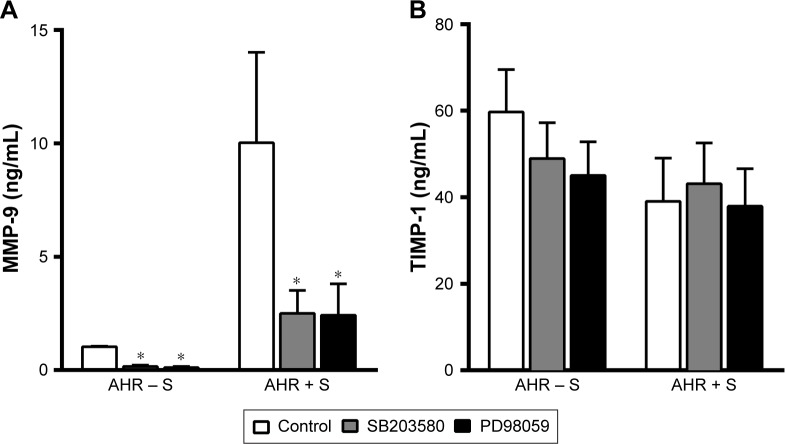
Healthy smokers with AHR (AHR + S) or smokers without AHR (AHR - S; divided according to a methacholine challenge test) and nonsmokers without AHR (AHR - NS) were enrolled. Spirometry was performed during enrollment and repeated after 5 years. Initially, AMs recovered from bronchoalveolar lavage (BAL) fluid were cultured in the presence of p38 mitogen-activated protein kinase (MAPK) inhibitor (SB203580), MAPK kinase (MEK) 1/2 (the MEK of extracellular signal-regulated kinase [ERK] inhibitor, PD98059), or medium alone for 24 h. The release of MMP-9 and TIMP-1 in culture supernatants was measured by enzyme-linked immunosorbent assay.
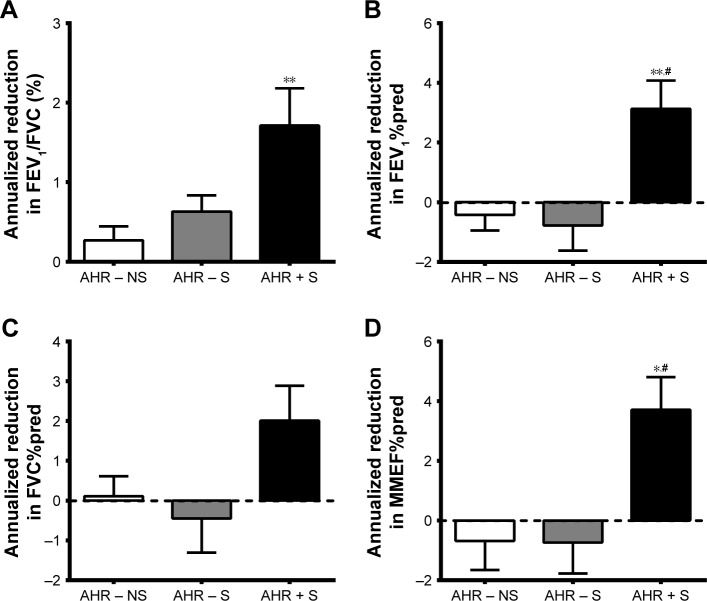
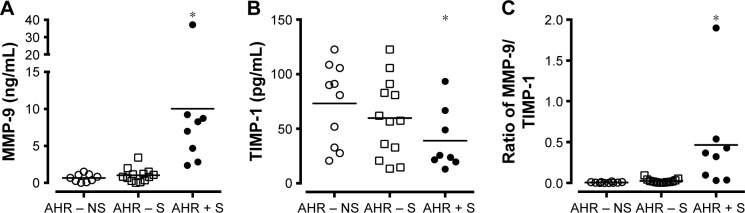
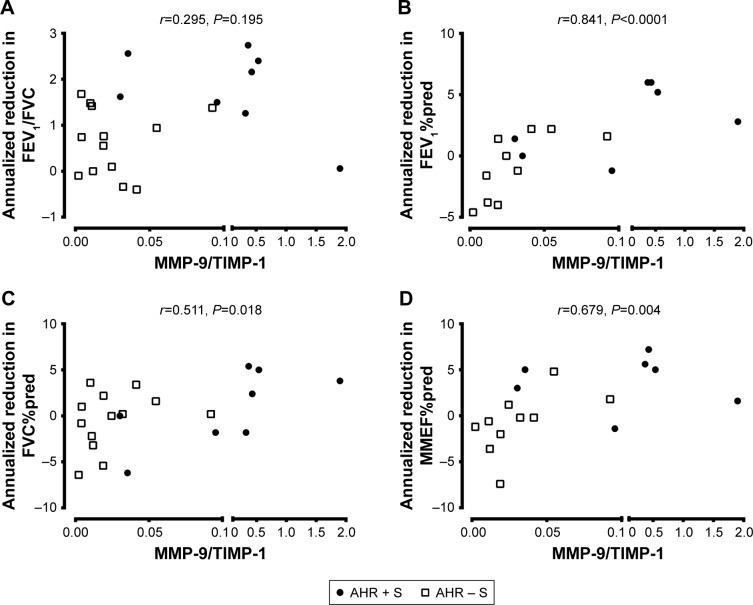
A greater reduction in forced expiratory volume in 1 s (FEV)/forced vital capacity (FVC), FEV (as a percentage of the predicted value [%pred]), and maximal mid-expiratory flow (MMEF) was observed among AHR + S in the 5-year period. There was a higher proportion of neutrophils and a lower proportion of AMs in BAL fluid recovered from AHR + S. Compared to AMs from AHR - NS and AHR - S, AMs from nonsmokers with AHR (AHR + NS) released more MMP-9 and less TIMP-1, with an increase in MMP-9/TIMP-1 ratios. The MMP-9/TIMP-1 ratio in smokers was positively correlated with the annual decline in FEV%pred, FVC%pred, and MMEF%pred. Both SB203580 and PD98059 significantly reduced MMP-9, but not TIMP-1, from AMs of smokers.
AMs of AHR + NS produce excessive MMP-9 over TIMP-1, which may be a predictor of the development of airway obstruction. Inhibition of p38 MAPK and ERK suppresses the generation of MMP-9 by AMs from smokers.
气道高反应性(AHR)与气道炎症及肺功能快速下降相关,是吸烟者未来患慢性阻塞性肺疾病(COPD)风险的预测指标。慢性阻塞性肺疾病患者的肺泡巨噬细胞(AM)释放大量基质金属蛋白酶(MMP)-9。我们推测MMP-9与金属蛋白酶组织抑制剂-1(TIMP-1)之间的失衡与吸烟者的气道高反应性有关。
纳入有气道高反应性的健康吸烟者(AHR + S)或无气道高反应性的吸烟者(AHR - S;根据乙酰甲胆碱激发试验划分)以及无气道高反应性的非吸烟者(AHR - NS)。在入组时进行肺功能测定,并在5年后重复测定。最初,将从支气管肺泡灌洗(BAL)液中回收的肺泡巨噬细胞在存在p38丝裂原活化蛋白激酶(MAPK)抑制剂(SB203580)、MAPK激酶(MEK)1/2(细胞外信号调节激酶[ERK]抑制剂的MEK,PD98059)或单独培养基的情况下培养24小时。通过酶联免疫吸附测定法测量培养上清液中MMP-9和TIMP-1的释放量。
在5年期间,AHR + S组的第1秒用力呼气容积(FEV)/用力肺活量(FVC)、FEV(预测值的百分比[%pred])和最大呼气中期流速(MMEF)下降幅度更大。从AHR + S组回收的BAL液中中性粒细胞比例较高,肺泡巨噬细胞比例较低。与AHR - NS和AHR - S组的肺泡巨噬细胞相比,有气道高反应性的非吸烟者(AHR + NS)的肺泡巨噬细胞释放更多的MMP-9和更少的TIMP-1,MMP-9/TIMP-1比值增加。吸烟者的MMP-9/TIMP-1比值与FEV%pred、FVC%pred和MMEF%pred的年下降率呈正相关。SB203580和PD98059均显著降低了吸烟者肺泡巨噬细胞中的MMP-9,但未降低TIMP-1。
AHR + NS组的肺泡巨噬细胞产生的MMP-9相对于TIMP-1过多,这可能是气道阻塞发展的预测指标。抑制p38 MAPK和ERK可抑制吸烟者肺泡巨噬细胞产生MMP-9。