Adibi Atoosa, Ferasat Farbod, Baradaran Mahdavi Mohammad Mehdi, Kazemi Kimia, Sadeghian Sina
Department of Radiology and Imaging, Isfahan University of Medical Sciences, Isfahan, Iran.
Department of Radiology and Imaging, School of Medicine, Isfahan University of Medical Sciences, Isfahan, Iran.
J Res Med Sci. 2018 Mar 27;23:29. doi: 10.4103/jrms.JRMS_875_17. eCollection 2018.
Spleen is the most common viscera that may be hurt in blunt abdominal trauma. Operative or nonoperative management of splenic injury is a dilemma. The American Association for the Surgery of Trauma (AAST) is the most common grading system which has been used for the management of blunt splenic injuries. The new recommended grading system assesses other aspects of splenic injury such as contrast extravasation, pseudoaneurysm, arteriovenous fistula, and severity of hemoperitoneum, as well. The aim of this study is to compare and prioritize the cutoff of AAST grading system with the new recommended one.
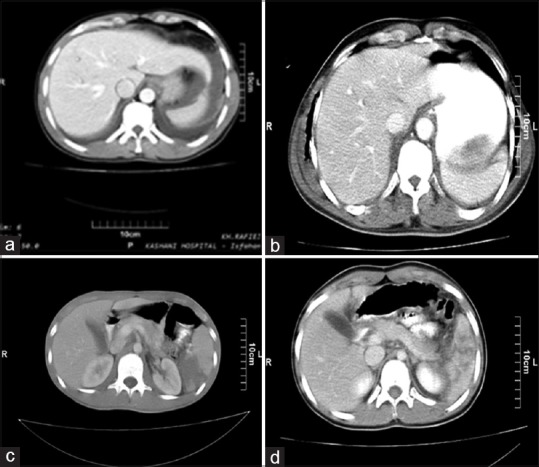
This is a cross-sectional study on patients with splenic injury caused by abdominal blunt trauma referred to Isfahan University of Medical Sciences affiliated Hospitals, Iran, in 2013-2016. All patients underwent abdominopelvic computed tomography scanning with intravenous (IV) contrast. All images were reported by a single expert radiologist, and splenic injury grading was reported based on AAST and the new recommended system. Then, all patients were followed to see if they needed surgical or nonsurgical management.
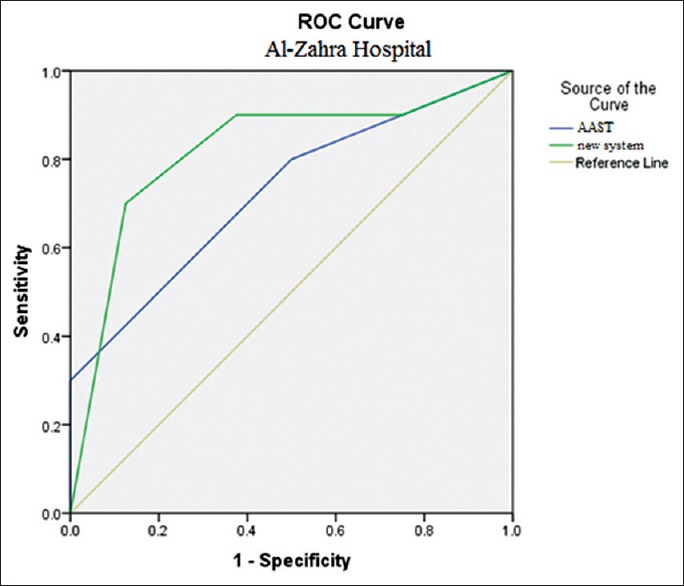
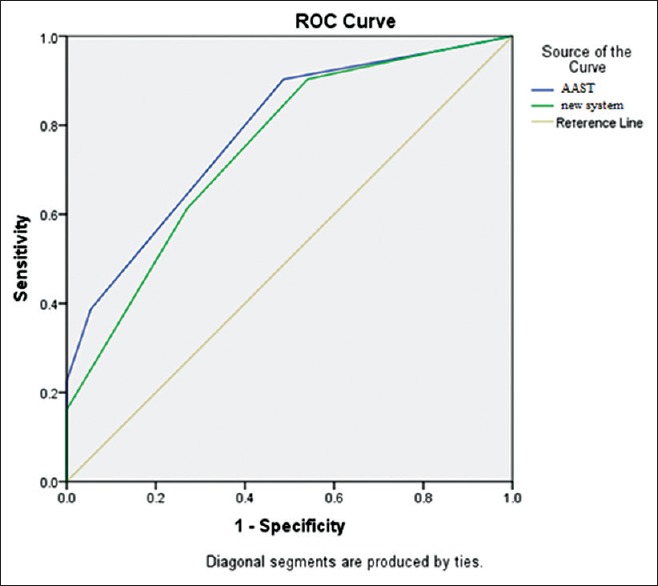
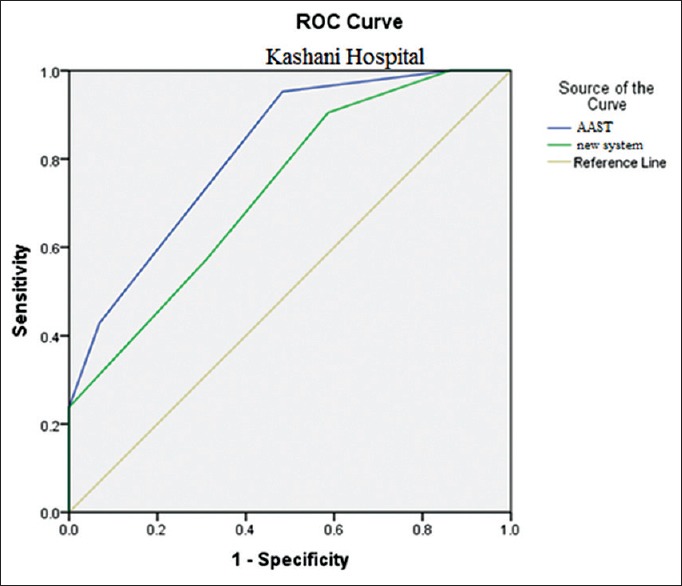
Based on the findings of this study conducted on 68 patients, cutoff point of Grade 2, in AAST system, had 90.3% (95% confidence interval [CI]: 0.73-0.97) specificity, 51.4% (95% CI: 0.34-0.67) sensitivity, 86.4% (95% CI: 0.64-0.95) positive predictive value (PPV), and 60.9% (95% CI: 0.45-0.74) negative predictive value (NPV) for prediction of surgical management requirement, while it was 90.3% (95% CI: 0.73-0.97) specificity, 45.9% (95% CI: 0.29-0.63) sensitivity, 85% (95% CI: 0.61-0.96) PPV, and 58.3% (95% CI: 0.43-0.72) NPV for the new system ( = 0.816).
In contrast to the previous studies, the new splenic injury grading method was not superior to AAST. Further studies with larger populations are recommended.
脾脏是钝性腹部创伤中最常受损的内脏器官。脾损伤的手术或非手术治疗是一个难题。美国创伤外科学会(AAST)分级系统是最常用于钝性脾损伤治疗的分级系统。新推荐的分级系统还评估脾损伤的其他方面,如对比剂外渗、假性动脉瘤、动静脉瘘以及腹腔积血的严重程度。本研究的目的是比较AAST分级系统和新推荐分级系统的截断值并对其进行优先级排序。
这是一项对2013年至2016年转诊至伊朗伊斯法罕医科大学附属医院的腹部钝性创伤所致脾损伤患者的横断面研究。所有患者均接受了静脉注射(IV)对比剂的腹部盆腔计算机断层扫描。所有图像均由一名专家放射科医生报告,并根据AAST和新推荐系统报告脾损伤分级。然后,对所有患者进行随访,观察他们是否需要手术或非手术治疗。
基于对68例患者的研究结果,AAST系统中2级的截断点对于预测手术治疗需求的特异性为90.3%(95%置信区间[CI]:0.73 - 0.97),敏感性为51.4%(95% CI:0.34 - 0.67),阳性预测值(PPV)为86.4%(95% CI:0.64 - 0.95),阴性预测值(NPV)为60.9%(95% CI:0.45 - 0.74),而新系统的相应值分别为90.3%(95% CI:0.73 - 0.97)、45.9%(95% CI:0.29 - 0.63)、85%(95% CI:0.61 - 0.96)和58.3%(95% CI:0.43 - 0.72)(P = 0.816)。
与先前的研究不同,新的脾损伤分级方法并不优于AAST。建议进行更大样本量的进一步研究。