Garza-Ramos U, Barrios-Camacho H, Moreno-Domínguez S, Toribio-Jiménez J, Jardón-Pineda D, Cuevas-Peña J, Sánchez-Pérez A, Duran-Bedolla J, Olguín-Rodriguez J, Román-Román A
Instituto Nacional de Salud Pública (INSP), Centro de Investigación Sobre Enfermedades Infecciosas (CISEI), Laboratorio de Resistencia Bacteriana y Genómica de Bacterias, Cuernavaca, Morelos, Mexico.
Laboratorio de Biotecnología y Genética Microbiana, Unidad Académica de Ciencias Químico Biológicas, Universidad Autónoma de Guerrero, Chilpancingo, Guerrero, Mexico.
New Microbes New Infect. 2018 Feb 17;23:17-27. doi: 10.1016/j.nmni.2018.02.002. eCollection 2018 May.
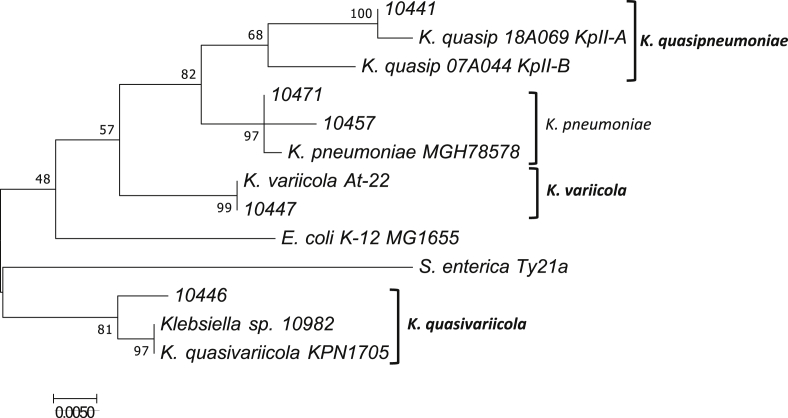
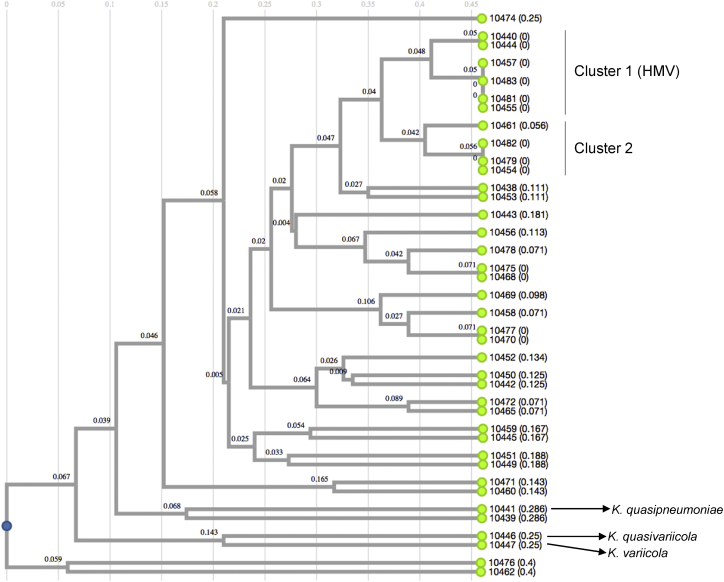
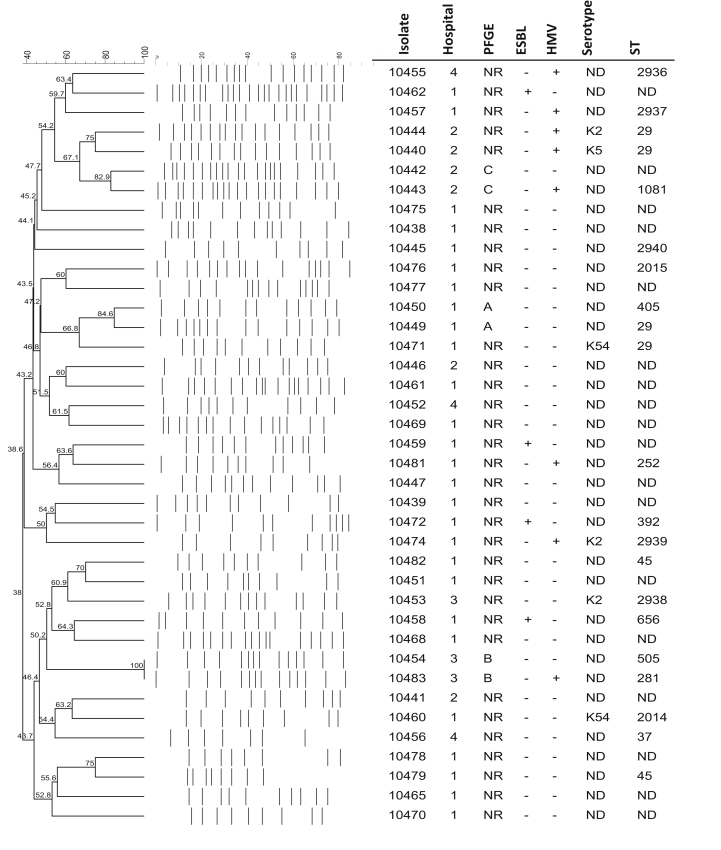
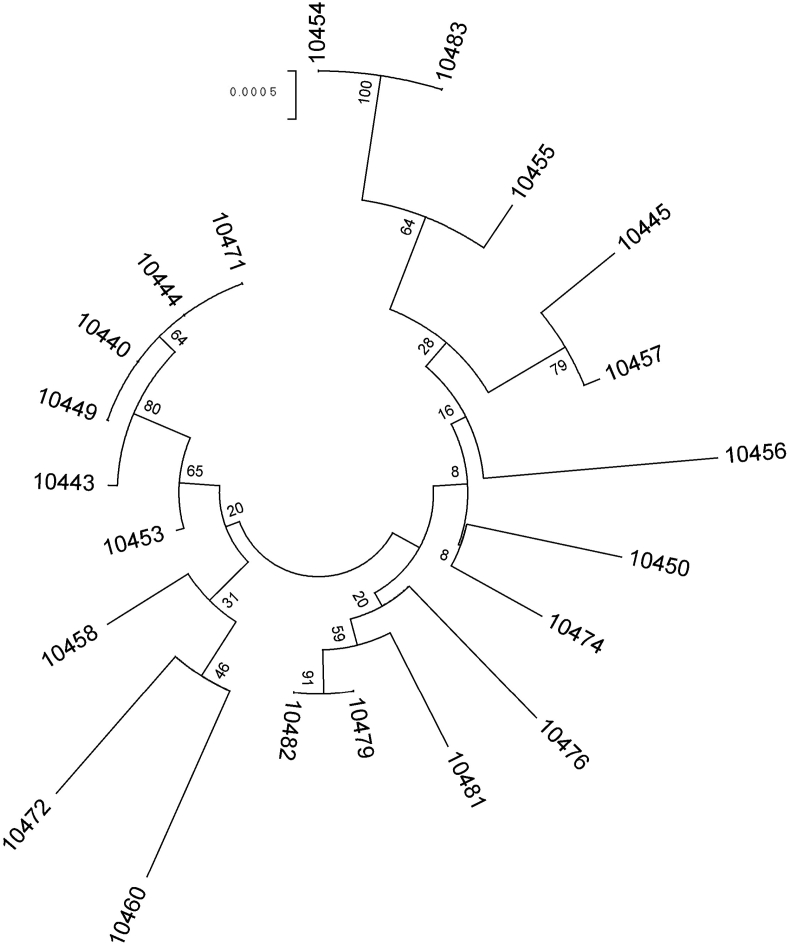
spp. isolates from community-acquired infections were characterized. A total of 39 spp. isolates were obtained from outpatients at four rural hospitals in Mexico (2013-2014). The biochemical tests identified all as being . The molecular multiplex-PCR test identified 36 (92.4%) isolates and one (2.5%) isolate, and phylogenetic analysis of the gene identified two isolates (5.1%) belonging to subsp. and . The last one was confirmed by phylogenetic analysis of six-loci concatenated genes. Mostly the isolates were multidrug resistant; however, a minority were extended-spectrum β-lactamase producing (10.2%). The extended-spectrum β-lactamase CTX-M-15 gene was identified in these isolates. Analysis of biofilm production and the hypermucoviscosity phenotype showed a total of 35 (92.3%) and seven (17.9%) of the isolates were positive for these phenotypes respectively. The K2 (4/39, 10.2%), K5 (2/39, 5.1%) and K54 (1/39, 2.5%) serotypes were identified in seven (17.9%) of the isolates, and only 28.5% (2/7) hypermucoviscous isolates were positive for the K2 and K5 serotypes. In general, the sequence type (ST) analysis and phylogenetic analysis of seven multilocus sequence typing loci were heterogeneous; however, ST29 was the most prevalent ST in the analysed isolates, accounting for 19% (4/21) of the total isolates. Two of the four ST29 isolates had the hypermucoviscosity phenotype. The virulence factors for fimbriae were the most prevalent, followed by siderophores. Community-acquired infections are caused by various species from genus, with different profiles of antibiotic resistance and heterogeneous virulence factors.
对社区获得性感染分离出的菌株进行了特征分析。从墨西哥四家农村医院的门诊患者中总共获得了39株菌株(2013 - 2014年)。生化试验鉴定所有菌株均为[此处原文缺失具体鉴定结果]。多重聚合酶链反应(multiplex-PCR)分子检测鉴定出36株(92.4%)[此处原文缺失具体菌株名称]菌株和1株(2.5%)[此处原文缺失具体菌株名称]菌株,对[此处原文缺失具体基因名称]基因的系统发育分析鉴定出2株(5.1%)属于[此处原文缺失具体亚种名称]亚种和[此处原文缺失具体亚种名称]亚种。最后一株通过六个基因座串联基因的系统发育分析得到确认。大多数菌株具有多重耐药性;然而,少数菌株产超广谱β-内酰胺酶(10.2%)。在这些菌株中鉴定出了超广谱β-内酰胺酶CTX-M-15基因。生物膜形成和高黏液性表型分析显示,分别有35株(92.3%)和7株(17.9%)菌株对这些表型呈阳性。在7株(17.9%)菌株中鉴定出了K2(4/39,10.2%)、K5(2/39,5.1%)和K54(1/39,2.5%)血清型,仅28.5%(2/7)的高黏液性菌株对K2和K5血清型呈阳性。总体而言,七个多位点序列分型位点的序列类型(ST)分析和系统发育分析结果各异;然而,ST29是分析菌株中最常见的ST,占总菌株数的19%(4/21)。四个ST29菌株中有两个具有高黏液性表型。菌毛的毒力因子最为常见,其次是铁载体。社区获得性感染由[此处原文缺失具体属名]属的多种物种引起,具有不同的抗生素耐药谱和各异的毒力因子。