Institute of Biomedical Engineering, University of Montréal, Montréal, Canada.
Research Centre, CHU Sainte-Justine, Montréal, Canada.
Sci Rep. 2018 Apr 25;8(1):6511. doi: 10.1038/s41598-018-24836-8.
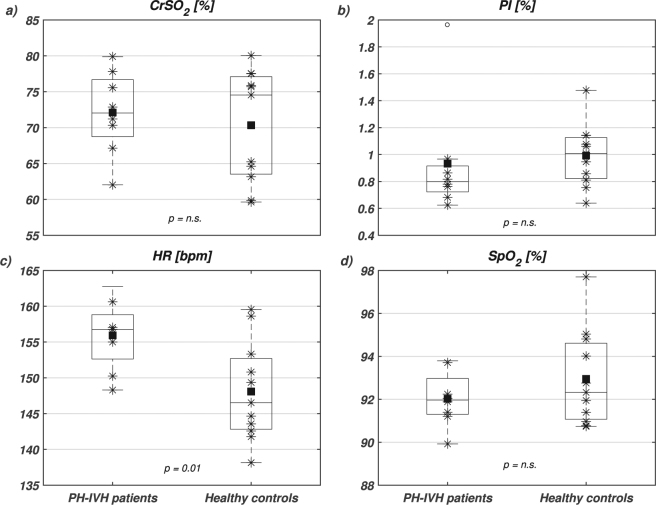
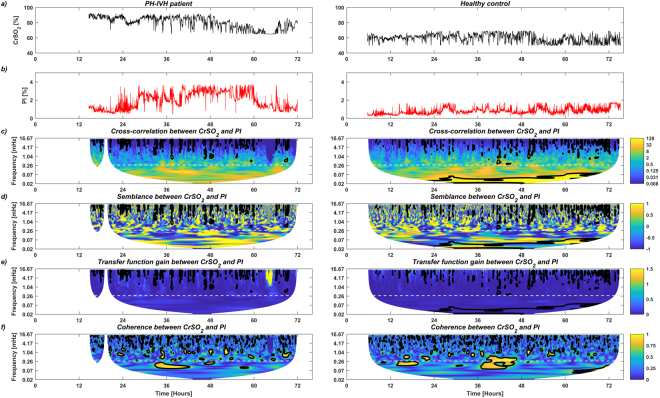
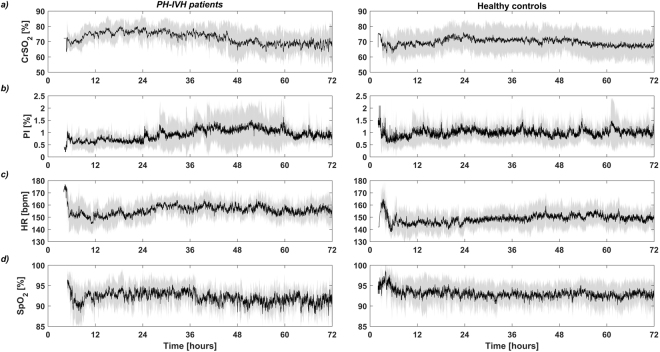
Extremely preterm infants are at higher risk of pulmonary (PH) and intraventricular (IVH) haemorrhage during the transitioning physiology due to immature cardiovascular system. Monitoring of haemodynamics can detect early abnormal circulation that may lead to these complications. We described time-frequency relationships between near infrared spectroscopy (NIRS) cerebral regional haemoglobin oxygen saturation (CrSO) and preductal peripheral perfusion index (PI), capillary oxygen saturation (SpO) and heart rate (HR) in extremely preterm infants in the first 72 h of life. Patients were sub-grouped in infants with PH and/or IVH (N = 8) and healthy controls (N = 11). Data were decomposed in wavelets allowing the analysis of localized variations of power. This approach allowed to quantify the percentage of time of significant cross-correlation, semblance, gain (transfer function) and coherence between signals. Ultra-low frequencies (<0.28 mHz) were analyzed as slow and prolonged periods of impaired circulation are considered more detrimental than transient fluctuations. Cross-correlation between CrSO and oximetry (PI, SpO and HR) as well as in-phase semblance and gain between CrSO and HR were significantly lower while anti-phase semblance between CrSO and HR was significantly higher in PH-IVH infants compared to controls. These differences may reflect haemodynamic instability associated with cerebrovascular autoregulation and hemorrhagic complications observed during the transitioning physiology.
极早产儿由于心血管系统不成熟,在过渡生理期间发生肺(PH)和脑室内(IVH)出血的风险较高。血流动力学监测可以检测到可能导致这些并发症的早期异常循环。我们描述了生命最初 72 小时内极早产儿近红外光谱(NIRS)脑区域性血红蛋白氧饱和度(CrSO)与外周前向灌注指数(PI)、毛细血管氧饱和度(SpO)和心率(HR)之间的时频关系。将患者分为伴有 PH 和/或 IVH(N = 8)和健康对照组(N = 11)的亚组。数据在小波中分解,允许分析功率的局部变化。这种方法可以量化信号之间有意义的互相关、相似性、增益(传递函数)和相干性的时间百分比。超低频(<0.28 mHz)被分析为血流受损的缓慢和延长时期被认为比短暂波动更有害。与对照组相比,PH-IVH 婴儿的 CrSO 和血氧饱和度(PI、SpO 和 HR)之间的互相关以及 CrSO 和 HR 之间的同相相似性和增益显著降低,而 CrSO 和 HR 之间的反相相似性显著增加。这些差异可能反映了与脑血管自动调节和过渡生理期间观察到的出血并发症相关的血流动力学不稳定。