Evseev Danyel, Magor Katharine E
Department of Biological Sciences, University of Alberta, Edmonton, AB T6G 2E9, Canada.
Li Ka Shing Institute of Virology, University of Alberta, Edmonton, AB T6G 2E9, Canada.
Vet Sci. 2019 Jan 10;6(1):5. doi: 10.3390/vetsci6010005.
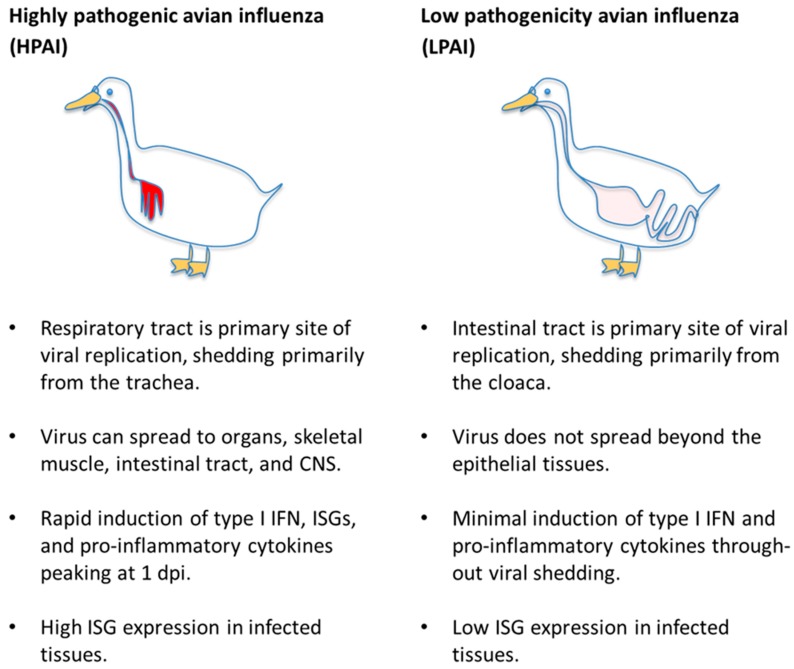
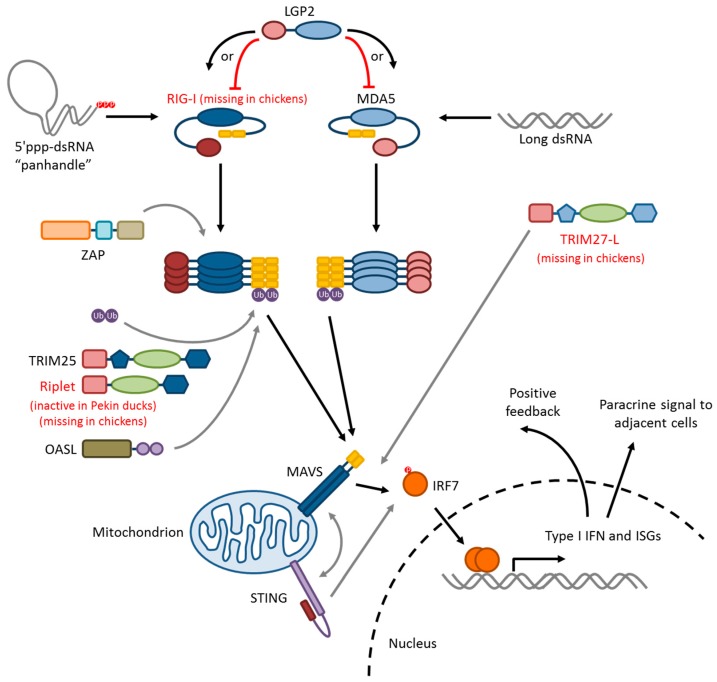
Mallard ducks are important natural hosts of low pathogenic avian influenza (LPAI) viruses and many strains circulate in this reservoir and cause little harm. Some strains can be transmitted to other hosts, including chickens, and cause respiratory and systemic disease. Rarely, these highly pathogenic avian influenza (HPAI) viruses cause disease in mallards, while chickens are highly susceptible. The long co-evolution of mallard ducks with influenza viruses has undoubtedly fine-tuned many immunological host⁻pathogen interactions to confer resistance to disease, which are poorly understood. Here, we compare innate responses to different avian influenza viruses in ducks and chickens to reveal differences that point to potential mechanisms of disease resistance. Mallard ducks are permissive to LPAI replication in their intestinal tissues without overtly compromising their fitness. In contrast, the mallard response to HPAI infection reflects an immediate and robust induction of type I interferon and antiviral interferon stimulated genes, highlighting the importance of the RIG-I pathway. Ducks also appear to limit the duration of the response, particularly of pro-inflammatory cytokine expression. Chickens lack RIG-I, and some modulators of the signaling pathway and may be compromised in initiating an early interferon response, allowing more viral replication and consequent damage. We review current knowledge about innate response mediators to influenza infection in mallard ducks compared to chickens to gain insight into protective immune responses, and open questions for future research.
绿头鸭是低致病性禽流感(LPAI)病毒的重要自然宿主,许多毒株在这个宿主群体中传播,危害较小。一些毒株可传播给包括鸡在内的其他宿主,并引发呼吸道和全身性疾病。极少情况下,这些高致病性禽流感(HPAI)病毒会在绿头鸭中引发疾病,而鸡对此高度易感。绿头鸭与流感病毒长期的共同进化无疑对许多免疫宿主 - 病原体相互作用进行了微调,使其具有抗病能力,但人们对此了解甚少。在此,我们比较鸭和鸡对不同禽流感病毒的先天免疫反应,以揭示指向抗病潜在机制的差异。绿头鸭的肠道组织允许LPAI病毒复制,且不会明显损害其健康状况。相比之下,绿头鸭对HPAI感染的反应体现出I型干扰素和抗病毒干扰素刺激基因的迅速且强烈的诱导,突出了RIG - I途径的重要性。鸭似乎还能限制这种反应的持续时间,尤其是促炎细胞因子的表达。鸡缺乏RIG - I以及一些信号通路调节剂,可能在启动早期干扰素反应方面存在缺陷,从而使病毒有更多复制机会并导致后续损害。我们回顾了目前关于绿头鸭与鸡相比对流感感染的先天免疫反应介质的认识,以深入了解保护性免疫反应,并提出未来研究的开放性问题。