School of Biomedical Sciences, The University of Hong Kong, Hong Kong, SAR, China.
Department of Microbiology, The University of Hong Kong, Hong Kong, SAR, China.
BMC Infect Dis. 2018 Apr 25;18(1):195. doi: 10.1186/s12879-018-3104-y.
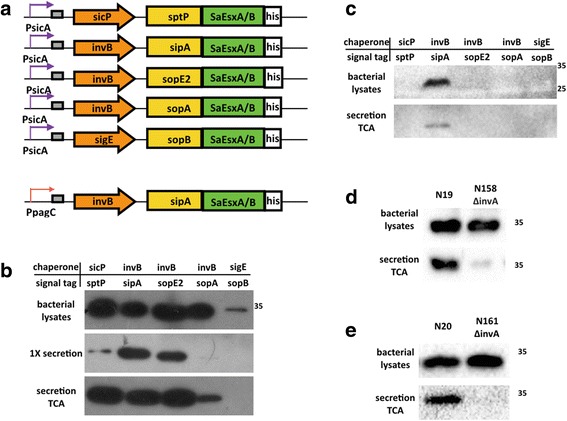
Staphylococcus aureus (S. aureus) causes a wide range of infectious diseases in human and animals. The emergence of antibiotic-resistant strains demands novel strategies for prophylactic vaccine development. In this study, live attenuated S. enterica subsp. enterica serotype Typhimurium (S. Typhimurium) vaccine against S. aureus infection was developed, in which Salmonella Pathogenesis Island-1 Type 3 Secretion System (SPI-1 T3SS) was employed to deliver SaEsxA and SaEsxB, two of ESAT-6-like (Early Secreted Antigenic Target-6) virulence factors of S. aureus.
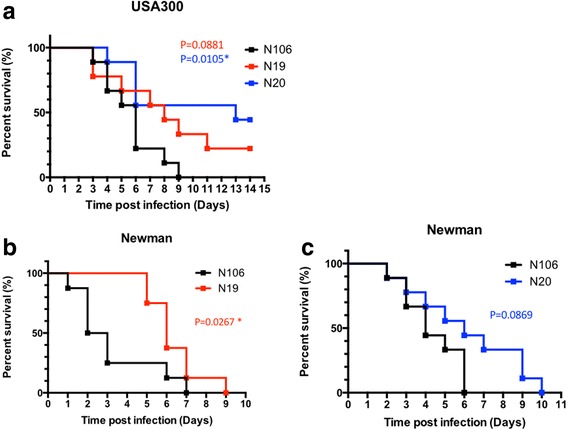
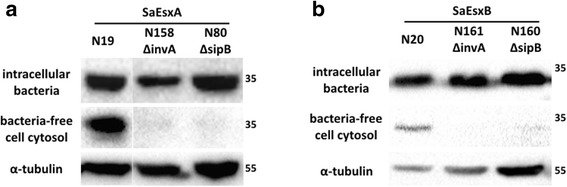
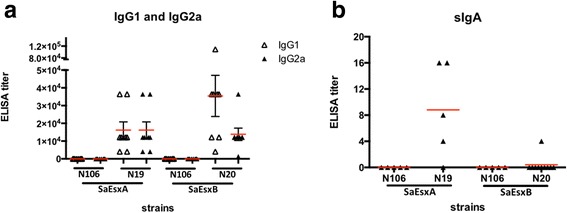
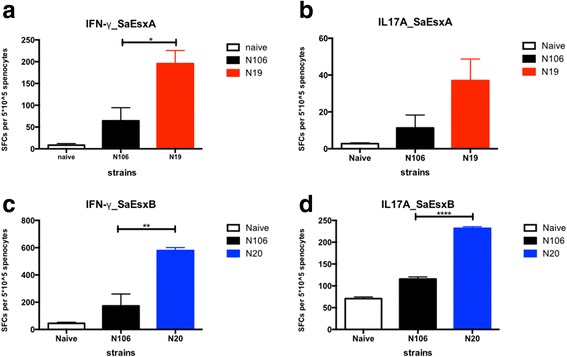
Antigens SaEsxA and SaEsxB were fused with the N-terminal secretion and translocation domain of SPI-1 effector SipA. And cytosolic delivery of Staphylococcal antigens into macrophages was examined by western blot. BALB/c mice were orally immunized with S. Typhimurium-SaEsxA and S. Typhimurium-SaEsxB vaccines. Antigen-specific humoral and Th1/Th17 immune responses were examined by ELISA and ELISPOT assays 7-9 days after the 2nd booster. For ELISPOT assays, the statistical significance was determined by Student's t test. The vaccine efficacy was evaluated by lethal challenge with two S. aureus clinical isolates Newman strain and USA 300 strain. Statistical significance was determined by Log rank (Mantel-Cox) analysis. And a P value of < 0.05 was considered statistically significant.
Oral administration of S. Typhimurium-SaEsxA and S. Typhimurium-SaEsxB vaccines induced antigen-specific humoral and Th1/Th17 immune responses, which increased the survival rate for vaccinated mice when challenged with S. aureus strains.
The newly developed S. Typhimurium-based vaccines delivering SaEsxA and SaEsxB by SPI-1 T3SS could confer protection against S. aureus infection. This study provides evidence that translocation of foreign antigens via Salmonella SPI-1 T3SS into the cytosol of antigen presenting cells (APCs) could induce potent immune responses against pathogens.
金黄色葡萄球菌(S. aureus)可引起人类和动物的多种感染性疾病。抗生素耐药菌株的出现要求开发新的预防性疫苗策略。在这项研究中,开发了针对金黄色葡萄球菌感染的减毒活鼠伤寒沙门氏菌(S. Typhimurium)疫苗,该疫苗利用沙门氏菌致病岛-1 型 3 型分泌系统(SPI-1 T3SS)递送金黄色葡萄球菌的两种 ESAT-6 样(早期分泌抗原靶-6)毒力因子 SaEsxA 和 SaEsxB。
将抗原 SaEsxA 和 SaEsxB 与 SPI-1 效应物 SipA 的 N 端分泌和转运结构域融合。并用 Western blot 检测细胞质中金黄色葡萄球菌抗原的递呈。用 S. Typhimurium-SaEsxA 和 S. Typhimurium-SaEsxB 疫苗经口免疫 BALB/c 小鼠。通过 ELISA 和 ELISPOT 检测 2 次加强免疫后 7-9 天的抗原特异性体液和 Th1/Th17 免疫应答。ELISPOT 检测的统计学意义采用 Student's t 检验确定。用两种金黄色葡萄球菌临床分离株 Newman 株和 USA 300 株进行致死性攻毒评估疫苗的功效。统计学意义采用 Log rank(Mantel-Cox)分析确定。P 值<0.05 认为具有统计学意义。
口服 S. Typhimurium-SaEsxA 和 S. Typhimurium-SaEsxB 疫苗可诱导抗原特异性体液和 Th1/Th17 免疫应答,增加接种小鼠对金黄色葡萄球菌菌株的存活率。
新开发的通过 SPI-1 T3SS 递呈 SaEsxA 和 SaEsxB 的 S. Typhimurium 疫苗可预防金黄色葡萄球菌感染。本研究证明,通过沙门氏菌 SPI-1 T3SS 将外源性抗原转运至抗原呈递细胞(APC)的细胞质中可诱导针对病原体的有效免疫应答。