Bolliger Marc, Blight Andrew R, Field-Fote Edelle C, Musselman Kristin, Rossignol Serge, Barthélemy Dorothy, Bouyer Laurent, Popovic Milos R, Schwab Jan M, Boninger Michael L, Tansey Keith E, Scivoletto Giorgio, Kleitman Naomi, Jones Linda A T, Gagnon Dany H, Nadeau Sylvie, Haupt Dirk, Awai Lea, Easthope Chris S, Zörner Björn, Rupp Ruediger, Lammertse Dan, Curt Armin, Steeves John
Spinal Cord Injury Center, University Hospital Balgrist, University Zurich, Zurich, Switzerland.
Swiss Center for Clinical Movement Analysis (SCMA), Zurich, Switzerland.
Spinal Cord. 2018 Jul;56(7):628-642. doi: 10.1038/s41393-018-0097-8. Epub 2018 Apr 27.
This is a focused review article.
To identify important concepts in lower extremity (LE) assessment with a focus on locomotor outcomes and provide guidance on how existing outcome measurement tools may be best used to assess experimental therapies in spinal cord injury (SCI). The emphasis lies on LE outcomes in individuals with complete and incomplete SCI in Phase II-III trials.
This review includes a summary of topics discussed during a workshop focusing on LE function in SCI, conceptual discussion of corresponding outcome measures and additional focused literature review.
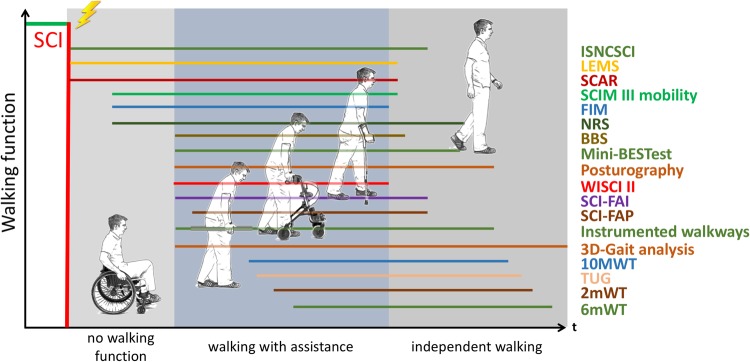
There are a number of sensitive, accurate, and responsive outcome tools measuring both quantitative and qualitative aspects of LE function. However, in trials with individuals with very acute injuries, a baseline assessment of the primary (or secondary) LE outcome measure is often not feasible.
There is no single outcome measure to assess all individuals with SCI that can be used to monitor changes in LE function regardless of severity and level of injury. Surrogate markers have to be used to assess LE function in individuals with severe SCI. However, it is generally agreed that a direct measurement of the performance for an appropriate functional activity supersedes any surrogate marker. LE assessments have to be refined so they can be used across all time points after SCI, regardless of the level or severity of spinal injury.
Craig H. Neilsen Foundation, Spinal Cord Outcomes Partnership Endeavor.
这是一篇重点综述文章。
确定下肢(LE)评估中的重要概念,重点关注运动结果,并就如何最佳使用现有结果测量工具来评估脊髓损伤(SCI)的实验性疗法提供指导。重点在于II - III期试验中完全性和不完全性SCI个体的LE结果。
本综述包括在一次聚焦于SCI中LE功能的研讨会上讨论的主题总结、相应结果测量指标的概念性讨论以及额外的重点文献综述。
有许多敏感、准确且反应性良好的结果工具可测量LE功能的定量和定性方面。然而,在针对极急性损伤个体的试验中,对主要(或次要)LE结果测量指标进行基线评估往往不可行。
不存在单一的结果测量指标可用于评估所有SCI个体,以监测LE功能的变化,而不考虑损伤的严重程度和水平。对于严重SCI个体,必须使用替代指标来评估LE功能。然而,人们普遍认为,对适当功能活动表现的直接测量优于任何替代指标。LE评估必须加以完善,以便能在SCI后的所有时间点使用,而不论脊髓损伤的水平或严重程度如何。
克雷格·H·尼尔森基金会、脊髓结果合作项目。