Institute of Pathology, Faculty of Medicine, LMU Munich, Thalkirchner Straße 36, 80337, Munich, Germany.
Department of General, Visceral, Transplantation, Vascular and Thoracic Surgery, Medical Center of the University of Munich, Munich, Germany.
BMC Cancer. 2018 Apr 27;18(1):483. doi: 10.1186/s12885-018-4413-7.
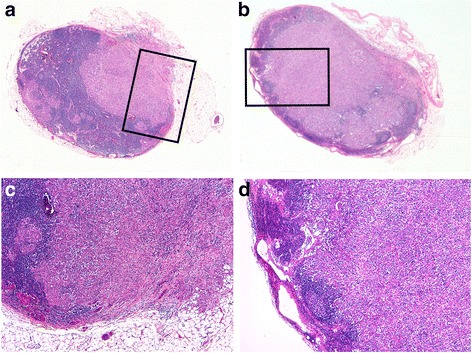
Extra-capsular growth (ECG) describes the extension of neoplastic cells beyond the lymph node capsule. Aim of this study was to investigate the prognostic value of ECG and its association with a stem cell like phenotype indicated by expression of the transcription factor SOX9 in gastric cancer.
By histological evaluation, 199 patients with nodal positive gastric cancer or adeoncarcinoma of the esophageal-gastric junction (AEG) were divided into two groups according to the presence (ECG) or absence (ICG) of extracapsular growth in at least one nodal metastasis. Of these, 194 patients were stained for SOX9 and SOX2 using immunohistochemistry. Seventeen nodal negative patients (pT3/4, pN0, pM0) served as controls.
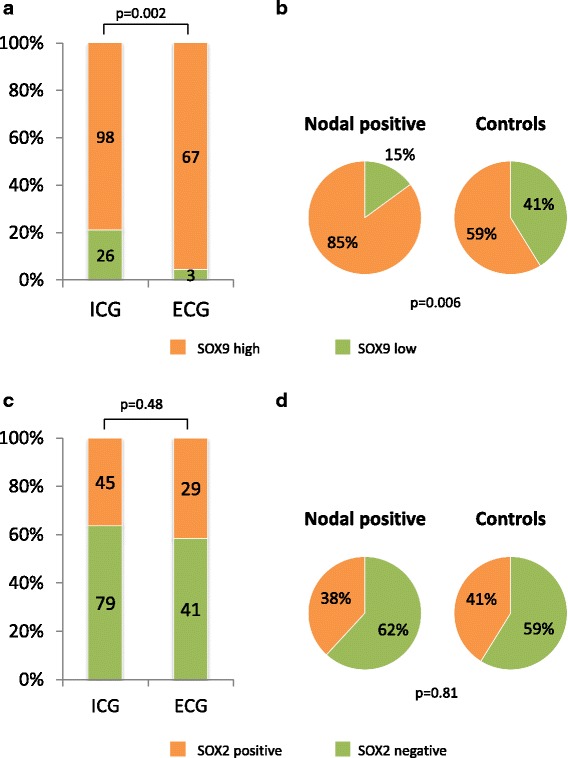
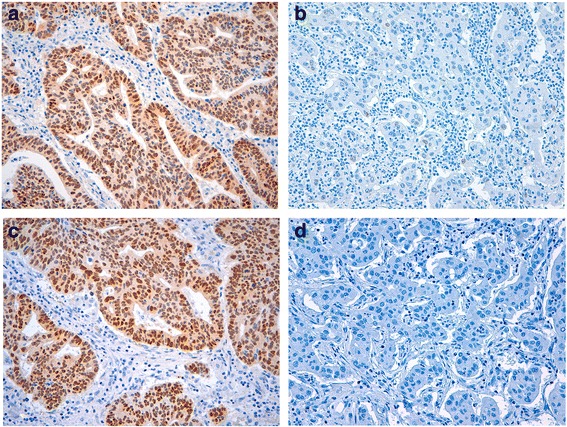
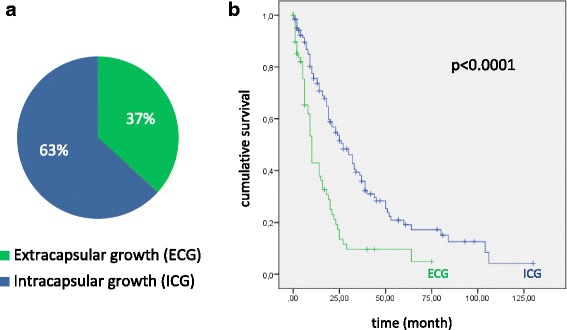
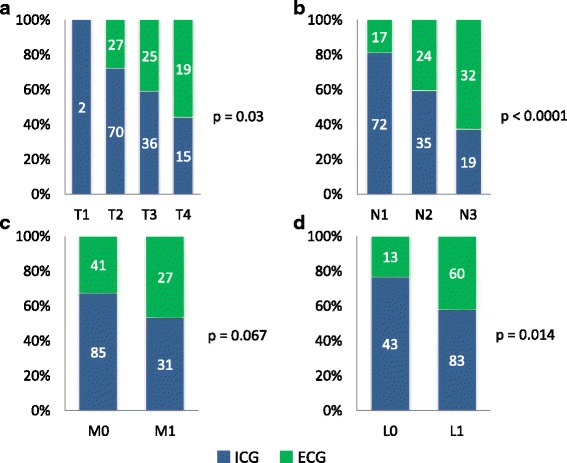
Seventy-three patients (36.7%) showed ECG. ECG was associated with lower overall survival (p < 0.0001), advanced pT- (p = 0.03) and pN- category (p < 0.0001) and lymphovascular invasion (p = 0.014). In multivariate analysis, ECG was found to be an independent prognostic factor (HR = 2.1; 95% CI 1.7-3.4; p = 0.001). SOX9 expression correlated significantly with ECG (96% SOX9 high in ECG patients vs. 79% SOX9 high in patients with ICG; p = 0.002). Controls showed significantly reduced SOX9 expression compared to nodal positive carcinomas (59% vs. 85% high SOX9 expression; p = 0.006). No significant correlation of ECG and SOX2 (59% SOX2 negative in ECG patients vs. 64% in patients with ICG, p = 0.48) could be obtained.
Patients with ECG exhibit poorer prognosis and ECG was found to be an independent prognostic factor. Thus, ECG turns out to be a morphological biomarker for a more aggressive phenotype in gastric cancer. This is supported by the fact that ECG correlates with the expression of SOX9, which has been described in the context of pro-oncogenic properties of tumours. However, the fact that SOX2 failed to show significant results indicate that ECG is not associated with a distinct cancer stem cell phenotype in gastric cancer.
包膜外生长(ECG)描述了肿瘤细胞向淋巴结包膜外的延伸。本研究旨在探讨 ECG 的预后价值及其与胃癌中由转录因子 SOX9 表达指示的干细胞样表型的关系。
通过组织学评估,将 199 例淋巴结阳性胃癌或食管胃交界部腺癌(AEG)患者根据至少一个淋巴结转移中是否存在(ECG)或不存在(ICG)包膜外生长分为两组。其中,194 例患者接受 SOX9 和 SOX2 的免疫组织化学染色。17 例淋巴结阴性患者(pT3/4、pN0、pM0)作为对照。
73 例(36.7%)患者出现 ECG。ECG 与总生存率降低相关(p<0.0001),与更晚期的 pT-(p=0.03)和 pN-期(p<0.0001)以及血管淋巴管侵犯(p=0.014)相关。多变量分析显示,ECG 是独立的预后因素(HR=2.1;95%CI 1.7-3.4;p=0.001)。SOX9 表达与 ECG 显著相关(ECG 患者中 96%的 SOX9 高表达,而 ICG 患者中为 79%;p=0.002)。对照与淋巴结阳性癌相比,SOX9 表达显著降低(59% vs. 85%高 SOX9 表达;p=0.006)。未能获得 ECG 和 SOX2 之间的显著相关性(ECG 患者中 59%的 SOX2 阴性,ICG 患者中 64%的 SOX2 阴性,p=0.48)。
出现 ECG 的患者预后较差,ECG 是独立的预后因素。因此,ECG 成为胃癌中侵袭性表型的形态学生物标志物。这一事实得到了支持,即 ECG 与 SOX9 的表达相关,SOX9 在肿瘤的致癌性质中已有描述。然而,SOX2 未显示出显著结果表明,ECG 与胃癌中独特的癌症干细胞表型无关。