Laboratory of Exercise Biochemistry, Department of Physical Education, College of Arts and Physical Education, Dong-A University, 37 Nakdong-daero 550 beon-gil, Hadan-dong, Saha-gu, Busan, 604-714, Republic of Korea.
Lipids Health Dis. 2018 Sep 1;17(1):207. doi: 10.1186/s12944-018-0852-z.
This study aimed to analyze the effect of exercise and/or dietary change on improvement of non-alcoholic fatty liver disease (NAFLD) in chronic high-fat diet (HFD)-induced obese mice.
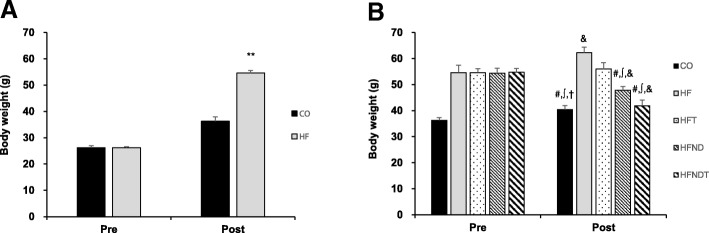
Forty male C57BL/6 (8 weeks old) mice were divided into normal diet (CO, n = 8) and high-fat diet (HF, n = 32) groups. The HF group was fed with 60% fat chow for 16 weeks to induce obesity. After the obesity induction period, the HF group was subdivided into HFD + sedentary (n = 8), HFD + training (HFT, n = 8), dietary change to normal-diet + sedentary (HFND, n = 8), and dietary change to normal-diet + training (HFNDT, n = 8) groups, and the mice in the training groups underwent treadmill training for 8 weeks, 5 times per week, 40 min per day.
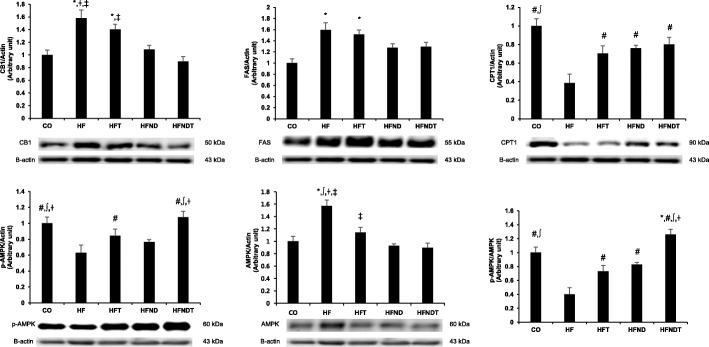
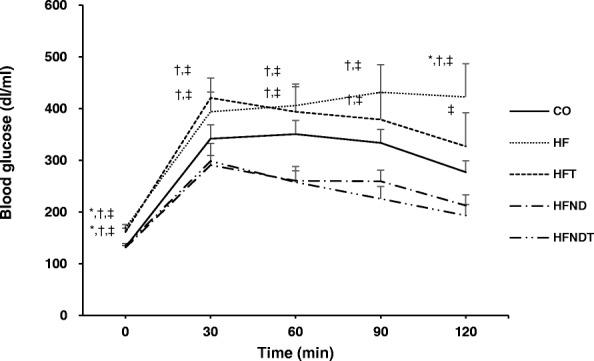
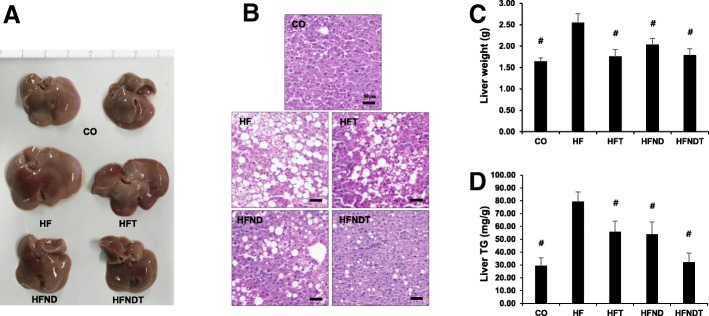
A 24-week HFD induced increase of cannabinoid-1 receptor (CB1), fatty acid synthase (FAS), and AMP-activated protein kinase (AMPK) protein expressions (p < 0.05) and decrease of p-AMPK and carnitine palmitoyltransferase1 (CPT1) protein expressions (P < 0.05), resulting in increased liver fat accumulation. Treatment of exercise with dietary change and dietary change alone decreased CB1 and AMPK protein expressions with increased p-AMPK and CPT1 protein expressions (P < 0.05), leading to decreased body weight and liver fat (P < 0.05). The CB1 and FAS protein expressions in the HFT group were still higher than those in the CO group (P < 0.05), but the p-AMPK and CPT1 protein expressions were higher than those in the HF group (P < 0.05). Moreover, improved glucose tolerance and decreased liver fat were confirmed, although treatment of exercise alone had no effect on weight loss compared to pre-exercise.
Even in the case of obesity induced by chronic HFD, exercise and/or dietary interventions have preventive and therapeutic effects on fat accumulation in the liver, resulting from upregulations of lipolytic factors. Therefore, the results of this study suggested that treatment of exercise alone without dietary change also leads to improvement of NAFLD and glucose tolerance without weight loss benefits.
本研究旨在分析运动和/或饮食改变对慢性高脂肪饮食(HFD)诱导肥胖小鼠非酒精性脂肪肝(NAFLD)改善的影响。
40 只 8 周龄雄性 C57BL/6 小鼠分为正常饮食(CO,n=8)和高脂肪饮食(HF,n=32)组。HF 组给予 60%脂肪饲料喂养 16 周诱导肥胖。肥胖诱导期结束后,HF 组分为高脂肪饮食+安静(n=8)、高脂肪饮食+运动(HFT,n=8)、饮食改变为正常饮食+安静(HFND,n=8)和饮食改变为正常饮食+运动(HFNDT,n=8)组,运动组进行 8 周、每周 5 次、每天 40 分钟的跑步机训练。
24 周 HFD 诱导大麻素 1 型受体(CB1)、脂肪酸合成酶(FAS)和 AMP 激活蛋白激酶(AMPK)蛋白表达增加(p<0.05),p-AMPK 和肉碱棕榈酰转移酶 1(CPT1)蛋白表达减少(P<0.05),导致肝脏脂肪堆积增加。运动结合饮食改变和单纯饮食改变治疗可降低 CB1 和 AMPK 蛋白表达,增加 p-AMPK 和 CPT1 蛋白表达(P<0.05),从而降低体重和肝脏脂肪(P<0.05)。HFT 组的 CB1 和 FAS 蛋白表达仍高于 CO 组(P<0.05),但 p-AMPK 和 CPT1 蛋白表达高于 HF 组(P<0.05)。此外,虽然与运动前相比,单独运动治疗对体重减轻没有影响,但证实了葡萄糖耐量的改善和肝脏脂肪的减少。
即使在慢性 HFD 诱导肥胖的情况下,运动和/或饮食干预对脂解因子上调引起的肝脏脂肪堆积也具有预防和治疗作用。因此,本研究结果表明,单独运动治疗而不改变饮食也可改善 NAFLD 和葡萄糖耐量,而不减轻体重。