Institute of Veterinary Science, University of Liverpool, Liverpool, UK.
Infection Biology, Institute of Infection and Global Health, University of Liverpool, Liverpool, UK.
Parasit Vectors. 2018 Apr 27;11(1):272. doi: 10.1186/s13071-018-2842-4.
Male fruitflies Phortica variegata (Drosophilidae, Steganinae) are the intermediate host of the zoonotic nematode Thelazia callipaeda (Spirurida, Thelaziidae). More than 10 years ago, when T. callipaeda was confined to remote regions of southern Italy, ecological niche models were used to predict the potential distribution of P. variegata across Europe and the likely risk of the nematode spreading through infected dogs travelling to/from endemic regions. As predicted, over the last 10 years T. callipaeda has spread rapidly across Europe. Recently, we identified the potential for its introduction to the UK through infected dogs travelling to/from endemic regions of mainland Europe.
Here updated information is used to re-evaluate the model-predicted European, and specifically, UK distribution to determine the likelihood of T. callipaeda becoming established. Additionally, the UK distribution of P. variegata was further investigated through snapshot fly trapping at model-predicted locations.
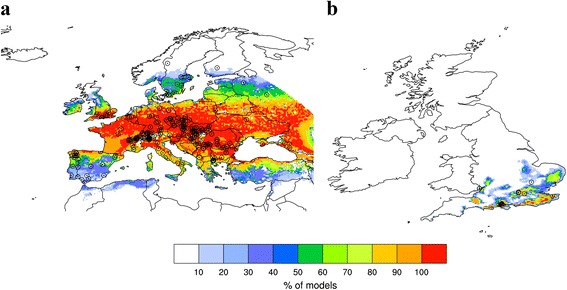
Ecological niche modelling using Genetic Algorithm for Rule-set Prediction (GARP) analysis suggests a European range similar to that described previously, with some indication of potential spread further eastward. Finer scale UK mapping suggested that P. variegata presence was limited mostly to southern England, but highlighted regions where P. variegata has not been documented previously. The arbitrary fly trapping identified activity of P. variegata at two locations where the species has been found previously late in the season. No specimens were collected at model-predicted locations, although habitat suitable for the species was identified.
GARP-model prediction of P. variegata distribution suggests presence of suitable conditions in previously undocumented regions of the UK and Europe and highlight the possibility for further spread of T. callipaeda across Europe, including the UK. Further work to validate the P. variegata UK model with field data will help improve its accuracy in predicting suitable areas, whilst surveillance of sylvatic definitive host species in such locations is advised to monitor for evidence of autochthonous T. callipaeda transmission.
雄性果蝇 Phortica variegata(双翅目,Steganinae)是人畜共患线虫 Thelazia callipaeda(旋尾目,Thelaziidae)的中间宿主。十多年前,当 T. callipaeda 局限于意大利南部偏远地区时,生态位模型被用于预测 P. variegata 在整个欧洲的潜在分布以及受感染的狗从流行地区旅行到/到其他地区时传播线虫的可能风险。正如预测的那样,在过去的 10 年中,T. callipaeda 在欧洲迅速传播。最近,我们发现,通过从流行地区旅行到/到欧洲大陆的受感染的狗,有可能将其引入英国。
这里使用更新的信息来重新评估模型预测的欧洲,特别是英国的分布,以确定 T. callipaeda 建立的可能性。此外,通过在模型预测的地点进行快照式蝇类诱捕,进一步调查了 P. variegata 在英国的分布。
使用遗传算法规则集预测(GARP)分析的生态位模型表明,与以前描述的类似,存在进一步向东扩散的可能性。更精细的英国地图绘制表明,P. variegata 的存在主要局限于英格兰南部,但突出了以前没有记录过该物种的地区。随意的蝇类诱捕在两个以前发现过该物种的季节后期发现了 P. variegata 的活动。虽然确定了适合该物种的栖息地,但在模型预测的地点没有收集到标本。
GARP 模型预测 P. variegata 的分布表明,在英国和欧洲以前未记录的地区存在适宜的条件,并突出了 T. callipaeda 在欧洲进一步传播的可能性,包括英国。用实地数据验证 P. variegata 英国模型的进一步工作将有助于提高其预测适宜区域的准确性,同时建议在这些地点监测森林性终宿主物种,以监测是否存在本地传播的 T. callipaeda。