Komarzynski Sandra, Huang Qi, Innominato Pasquale F, Maurice Monique, Arbaud Alexandre, Beau Jacques, Bouchahda Mohamed, Ulusakarya Ayhan, Beaumatin Nicolas, Breda Gabrièle, Finkenstädt Bärbel, Lévi Francis
Cancer Chronotherapy Team, School of Medicine, University of Warwick, Coventry, United Kingdom.
European Associated Laboratory of the Unité Mixte de Recherche Scientifique 935, Institut National de la Santé et de la Recherche Médicale, Villejuif, France.
J Med Internet Res. 2018 Jun 11;20(6):e204. doi: 10.2196/jmir.9779.
Experimental and epidemiologic studies have shown that circadian clocks' disruption can play an important role in the development of cancer and metabolic diseases. The cellular clocks outside the brain are effectively coordinated by the body temperature rhythm. We hypothesized that concurrent measurements of body temperature and rest-activity rhythms would assess circadian clocks coordination in individual patients, thus enabling the integration of biological rhythms into precision medicine.
The objective was to evaluate the circadian clocks' coordination in healthy subjects and patients through simultaneous measurements of rest-activity and body temperature rhythms.
Noninvasive real-time measurements of rest-activity and chest temperature rhythms were recorded during the subject's daily life, using a dedicated new mobile electronic health platform (PiCADo). It involved a chest sensor that jointly measured accelerations, 3D orientation, and skin surface temperature every 1-5 min and relayed them out to a mobile gateway via Bluetooth Low Energy. The gateway tele-transmitted all stored data to a server via General Packet Radio Service every 24 hours. The technical capabilities of PiCADo were validated in 55 healthy subjects and 12 cancer patients, whose rhythms were e-monitored during their daily routine for 3-30 days. Spectral analyses enabled to compute rhythm parameters values, with their 90% confidence limits, and their dynamics in each subject.
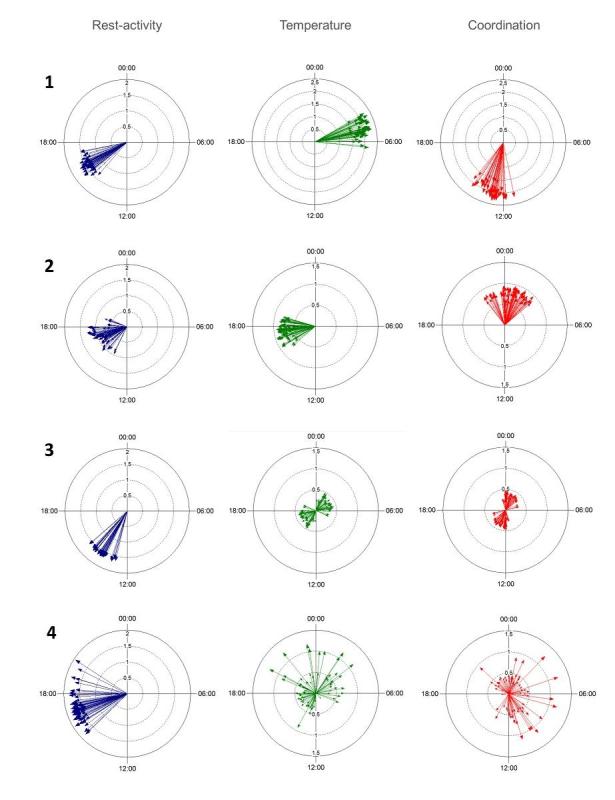
All the individuals displayed a dominant circadian rhythm in activity with maxima occurring from 12:09 to 20:25. This was not the case for the dominant temperature period, which clustered around 24 hours for 51 out of 67 subjects (76%), and around 12 hours for 13 others (19%). Statistically significant sex- and age-related differences in circadian coordination were identified in the noncancerous subjects, based upon the range of variations in temperature rhythm amplitudes, maxima (acrophases), and phase relations with rest-activity. The circadian acrophase of chest temperature was located at night for the majority of people, but it occurred at daytime for 26% (14/55) of the noncancerous people and 33% (4/12) of the cancer patients, thus supporting important intersubject differences in circadian coordination. Sex, age, and cancer significantly impacted the circadian coordination of both rhythms, based on their phase relationships.
Complementing rest-activity with chest temperature circadian e-monitoring revealed striking intersubject differences regarding human circadian clocks' coordination and timing during daily routine. To further delineate the clinical importance of such finding, the PiCADo platform is currently applied for both the assessment of health effects resulting from atypical work schedules and the identification of the key determinants of circadian disruption in cancer patients.
实验和流行病学研究表明,昼夜节律的破坏在癌症和代谢性疾病的发展中可能起重要作用。大脑外的细胞时钟由体温节律有效协调。我们假设,同时测量体温和静息-活动节律将评估个体患者的昼夜节律协调性,从而能够将生物节律纳入精准医学。
目的是通过同时测量静息-活动和体温节律来评估健康受试者和患者的昼夜节律协调性。
使用专用的新型移动电子健康平台(PiCADo)在受试者日常生活中对静息-活动和胸部温度节律进行无创实时测量。它包括一个胸部传感器,每1-5分钟联合测量加速度、三维方向和皮肤表面温度,并通过低功耗蓝牙将数据传输到移动网关。网关每24小时通过通用分组无线服务将所有存储的数据远程传输到服务器。PiCADo的技术能力在55名健康受试者和12名癌症患者中得到验证,他们的节律在日常活动中通过电子监测3-30天。频谱分析能够计算节律参数值及其90%置信区间,以及每个受试者的节律动态。
所有个体在活动中均表现出占主导地位的昼夜节律,最大值出现在12:09至20:25之间。主导温度周期则不然,67名受试者中有51名(76%)集中在24小时左右,另外13名(19%)集中在12小时左右。基于温度节律幅度、最大值(峰相位)以及与静息-活动的相位关系的变化范围,在非癌症受试者中发现了昼夜节律协调性存在统计学上显著的性别和年龄差异。大多数人的胸部温度昼夜峰相位位于夜间,但26%(14/55)的非癌症患者和33%(4/12)的癌症患者的峰相位出现在白天,这支持了昼夜节律协调性存在重要的个体间差异。基于相位关系,性别、年龄和癌症显著影响两种节律的昼夜协调性。
通过胸部温度昼夜电子监测补充静息-活动情况,揭示了日常活动中人类昼夜节律协调性和时间安排方面显著的个体间差异。为了进一步阐明这一发现的临床重要性,PiCADo平台目前正应用于评估非典型工作时间表对健康的影响以及确定癌症患者昼夜节律紊乱的关键决定因素。