Sutton Elizabeth J, Huang Erich P, Drukker Karen, Burnside Elizabeth S, Li Hui, Net Jose M, Rao Arvind, Whitman Gary J, Zuley Margarita, Ganott Marie, Bonaccio Ermelinda, Giger Maryellen L, Morris Elizabeth A
1Department of Radiology, Memorial Sloan Kettering Cancer Center, 1275 York Ave, New York, NY 10065 USA.
2Division of Cancer Treatment and Diagnosis, National Cancer Institute, National Institutes of Health, 9609 Medical Center Drive, Rockville, MD 20892 USA.
Eur Radiol Exp. 2017;1(1):22. doi: 10.1186/s41747-017-0025-2. Epub 2017 Nov 21.
In this study, we sought to investigate if computer-extracted magnetic resonance imaging (MRI) phenotypes of breast cancer could replicate human-extracted size and Breast Imaging-Reporting and Data System (BI-RADS) imaging phenotypes using MRI data from The Cancer Genome Atlas (TCGA) project of the National Cancer Institute.
Our retrospective interpretation study involved analysis of Health Insurance Portability and Accountability Act-compliant breast MRI data from The Cancer Imaging Archive, an open-source database from the TCGA project. This study was exempt from institutional review board approval at Memorial Sloan Kettering Cancer Center and the need for informed consent was waived. Ninety-one pre-operative breast MRIs with verified invasive breast cancers were analysed. Three fellowship-trained breast radiologists evaluated the index cancer in each case according to size and the BI-RADS lexicon for shape, margin, and enhancement (human-extracted image phenotypes [HEIP]). Human inter-observer agreement was analysed by the intra-class correlation coefficient (ICC) for size and Krippendorff's α for other measurements. Quantitative MRI radiomics of computerised three-dimensional segmentations of each cancer generated computer-extracted image phenotypes (CEIP). Spearman's rank correlation coefficients were used to compare HEIP and CEIP.
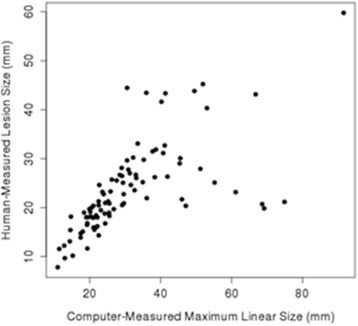
Inter-observer agreement for HEIP varied, with the highest agreement seen for size (ICC 0.679) and shape (ICC 0.527). The computer-extracted maximum linear size replicated the human measurement with < 10. CEIP of shape, specifically sphericity and irregularity, replicated HEIP with both values < 0.001. CEIP did not demonstrate agreement with HEIP of tumour margin or internal enhancement.
Quantitative radiomics of breast cancer may replicate human-extracted tumour size and BI-RADS imaging phenotypes, thus enabling precision medicine.
在本研究中,我们试图利用美国国立癌症研究所癌症基因组图谱(TCGA)项目的磁共振成像(MRI)数据,调查计算机提取的乳腺癌MRI表型是否能够复制人工提取的大小及乳腺影像报告和数据系统(BI-RADS)成像表型。
我们的回顾性解读研究涉及对来自癌症影像存档库(TCGA项目的一个开源数据库)的符合《健康保险流通与责任法案》的乳腺MRI数据进行分析。本研究在纪念斯隆凯特琳癌症中心无需机构审查委员会批准,且无需获得知情同意。对91例术前经证实的浸润性乳腺癌的乳腺MRI进行了分析。三名经过专科培训的乳腺放射科医生根据大小以及BI-RADS词典中关于形态、边缘和强化的内容对每例中的索引癌进行评估(人工提取的图像表型[HEIP])。通过组内相关系数(ICC)分析大小方面的观察者间一致性,通过Krippendorff's α分析其他测量指标的观察者间一致性。对每种癌症的计算机三维分割进行定量MRI放射组学分析,生成计算机提取的图像表型(CEIP)。使用Spearman等级相关系数比较HEIP和CEIP。
HEIP的观察者间一致性各不相同,在大小方面一致性最高(ICC 0.679),在形态方面一致性较高(ICC 0.527)。计算机提取的最大线性大小与人工测量值的复制程度< 10。形态方面的CEIP,特别是球形度和不规则度,与HEIP的复制程度均< 0.001。CEIP与肿瘤边缘或内部强化的HEIP未显示出一致性。
乳腺癌的定量放射组学可能复制人工提取的肿瘤大小和BI-RADS成像表型,从而实现精准医疗。