Department of Biosystems Machinery Engineering, College of Agriculture and Life Science, Chungnam National University, 99 Daehak-ro, Yuseoung-gu, Daejeon, Korea.
Environmental Microbiology and Food Safety Laboratory, Agriculture Research Services, U.S. Department of Agriculture, Beltsville, United States of America.
PLoS One. 2018 Apr 30;13(4):e0195253. doi: 10.1371/journal.pone.0195253. eCollection 2018.
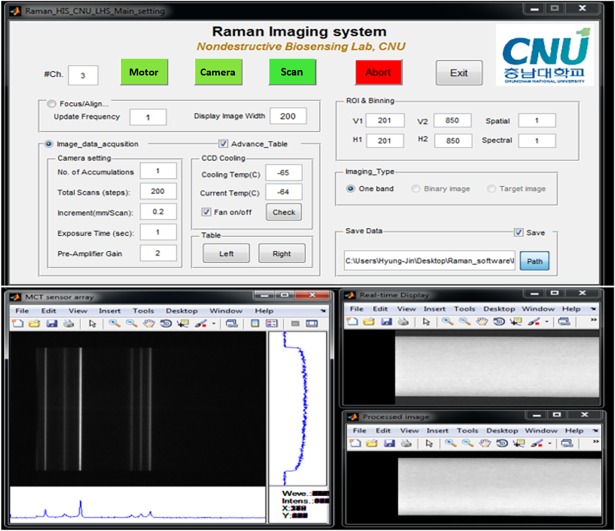
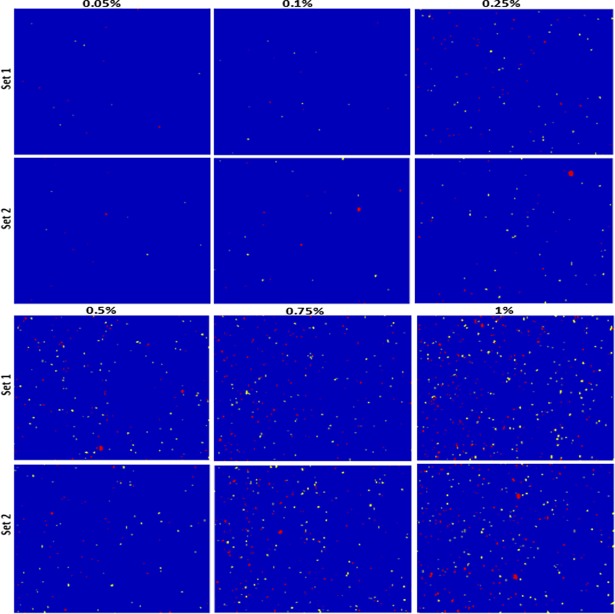
The potential adulteration of foodstuffs has led to increasing concern regarding food safety and security, in particular for powdered food products where cheap ground materials or hazardous chemicals can be added to increase the quantity of powder or to obtain the desired aesthetic quality. Due to the resulting potential health threat to consumers, the development of a fast, label-free, and non-invasive technique for the detection of adulteration over a wide range of food products is necessary. We therefore report the development of a rapid Raman hyperspectral imaging technique for the detection of food adulteration and for authenticity analysis. The Raman hyperspectral imaging system comprises of a custom designed laser illumination system, sensing module, and a software interface. Laser illumination system generates a 785 nm laser line of high power, and the Gaussian like intensity distribution of laser beam is shaped by incorporating an engineered diffuser. The sensing module utilize Rayleigh filters, imaging spectrometer, and detector for collection of the Raman scattering signals along the laser line. A custom-built software to acquire Raman hyperspectral images which also facilitate the real time visualization of Raman chemical images of scanned samples. The developed system was employed for the simultaneous detection of Sudan dye and Congo red dye adulteration in paprika powder, and benzoyl peroxide and alloxan monohydrate adulteration in wheat flour at six different concentrations (w/w) from 0.05 to 1%. The collected Raman imaging data of the adulterated samples were analyzed to visualize and detect the adulterant concentrations by generating a binary image for each individual adulterant material. The results obtained based on the Raman chemical images of adulterants showed a strong correlation (R>0.98) between added and pixel based calculated concentration of adulterant materials. This developed Raman imaging system thus, can be considered as a powerful analytical technique for the quality and authenticity analysis of food products.
食品掺假的潜在可能性导致人们对食品安全和保障的关注度日益增加,尤其是对于粉状食品,因为可以添加廉价的磨碎材料或危险化学品来增加粉末的数量或获得所需的美观质量。由于这会对消费者造成潜在的健康威胁,因此需要开发一种快速、无标记且非侵入性的技术,以广泛检测各种食品产品的掺假情况。因此,我们报告了一种快速拉曼高光谱成像技术的发展,用于检测食品掺假和真实性分析。拉曼高光谱成像系统包括定制设计的激光照明系统、传感模块和软件接口。激光照明系统产生高功率的 785nm 激光线,通过合并工程化的扩散器来对激光束的高斯状强度分布进行整形。传感模块利用瑞利滤波器、成像光谱仪和探测器沿激光线收集拉曼散射信号。定制的软件用于获取拉曼高光谱图像,还可以实时可视化扫描样品的拉曼化学图像。所开发的系统用于同时检测辣椒粉中苏丹染料和刚果红染料的掺假,以及小麦粉中过氧化苯甲酰和一水合尿酸的掺假,浓度为 0.05 至 1%(w/w),共 6 个不同浓度。对掺假样品的拉曼成像数据进行分析,通过为每个单独的掺假材料生成二进制图像来可视化和检测掺假浓度。基于掺假剂的拉曼化学图像获得的结果显示,添加的和基于像素计算的掺假材料浓度之间存在很强的相关性(R>0.98)。因此,这种开发的拉曼成像系统可以被视为一种用于食品产品质量和真实性分析的强大分析技术。