Want Andrew, Ho Derek K-H, Karri Bhavani, Mathews Divya
Stanley Eye Unit, Abergele Hospital, Llanfair Road, Abergele, Conwy, LL22 8DP, UK.
BMC Ophthalmol. 2018 May 2;18(1):111. doi: 10.1186/s12886-018-0773-7.
To evaluate the outcomes of Viscocanalostomy (VC) and Phacoviscocanalostomy (PV) in controlling primary and secondary glaucoma in a large cohort of patients from a single eye unit and performed by a single surgeon.
This non-randomised, retrospective study was conducted on 620 eyes of 458 patients. All patients who had either viscocanalostomy (VC) or combined phacoemulsification and viscocanalostomy (PV) over a three-year period were included. Intraocular pressures (IOP), number of anti-glaucoma medications used, and any complications were recorded over a 3-year follow up period. Paired T-Test was used to compare preoperative and post-operative IOP at specified time points. Kaplan-Meier survival models were used to determine success rates over the study period.
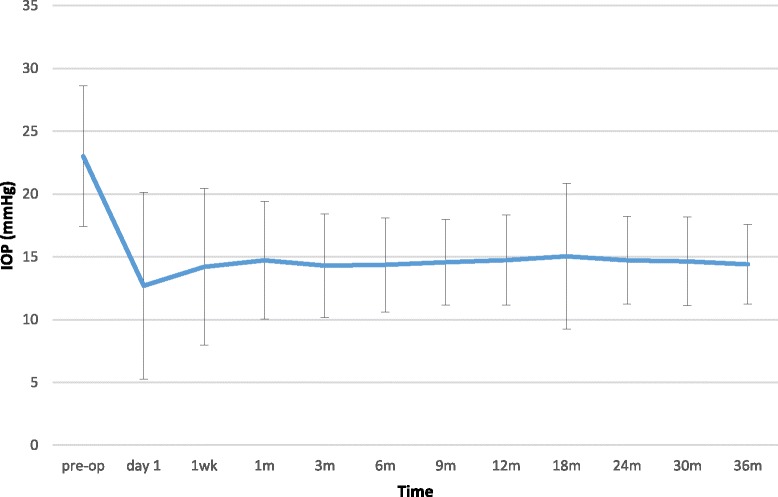
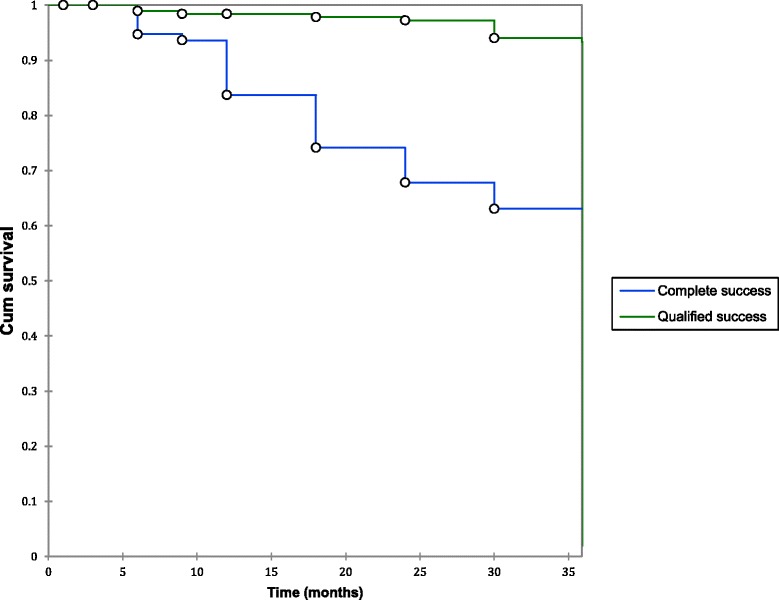
Six hundred twenty procedures were performed during the 3-year study period, of which 427 were PV and 193 VC. The mean follow-up was 31.8 months. Overall complete success (IOP ≤ 21 mmHg, without medication) at 3 years was achieved in 65.7% of patients, with qualified success (IOP ≤21 mmHg with or without medication) achieved in 96.0%. Subgroup analysis showed complete success rate of 76.0% for PV and 63.1% for VC (p = 0.005), with qualified success 95.9% for PV and 94.0% for VC (p = 0.668). Mean pre-operative IOP (mmHg) for all procedures was 23.02 ± 5.6, with PV and VC subgroups at 22.54 ± 5.10 and 24.06 ± 6.45. Post-operatively IOP at month 12 and 36 was 14.74 ± 3.57 and 14.40 ± 3.17 respectively for all procedures, 14.62 ± 3.26 and 14.44 ± 3.10 for PV, and 15.03 ± 4.18 and 14.31 ± 3.33 for VC. Across all procedures, pre-operatively an average of 3.05 ± 0.96 anti-glaucoma medications were used. This reduced to 0.13 ± 0.39 in 12 months and 0.38 + 0.71 by 36 months. Sixty-five cases had complications due to trabeculo-Descemet window perforation during viscocanalostomy with 7 cases developing complications from the cataract element. In the 12.9% of patients who had complications there were no differences of IOP noted at 3 years.
VC and PV have good IOP lowering capacity and are both effective at sustaining a reduction in IOP at 3 years. PV achieved a higher success rate without medication. The low complication profile with reduced post-operative care means these procedures may be a preferred option for early surgical intervention.
评估在单一眼科单位由单一外科医生实施的粘小管切开术(VC)和晶状体超声乳化联合粘小管切开术(PV)对一大群患者原发性和继发性青光眼的控制效果。
对458例患者的620只眼进行了这项非随机、回顾性研究。纳入了在三年期间接受过粘小管切开术(VC)或晶状体超声乳化联合粘小管切开术(PV)的所有患者。在三年的随访期内记录眼压(IOP)、使用的抗青光眼药物数量以及任何并发症。采用配对t检验比较特定时间点的术前和术后眼压。使用Kaplan-Meier生存模型确定研究期间的成功率。
在三年研究期间共进行了620例手术,其中427例为PV,193例为VC。平均随访时间为31.8个月。三年时总体完全成功(眼压≤21 mmHg,无需用药)的患者比例为65.7%,合格成功(眼压≤21 mmHg,无论是否用药)的患者比例为96.0%。亚组分析显示PV的完全成功率为76.0%,VC为63.1%(p = 0.005),PV的合格成功率为95.9%,VC为94.0%(p = 0.668)。所有手术的术前平均眼压(mmHg)为23.02±5.6,PV和VC亚组分别为22.54±5.10和24.06±6.45。术后第12个月和36个月时,所有手术的眼压分别为14.74±3.57和14.40±3.17,PV分别为14.62±3.26和14.44±3.10,VC分别为15.03±4.18和14.31±3.33。所有手术术前平均使用3.05±0.96种抗青光眼药物。1年内降至0.13±0.39种,36个月时降至0.38 + 0.71种。65例患者在粘小管切开术期间因小梁-Descemet膜窗口穿孔出现并发症,7例患者因白内障部分出现并发症。在出现并发症的12.9%的患者中,三年时眼压无差异。
VC和PV具有良好的降眼压能力,且在三年时均能有效维持眼压降低。PV在无需用药的情况下成功率更高。并发症发生率低且术后护理需求减少,这意味着这些手术可能是早期手术干预的首选方案。