Furuya Mitsuko, Kobayashi Hironori, Baba Masaya, Ito Takaaki, Tanaka Reiko, Nakatani Yukio
Department of Molecular Pathology, Yokohama City University Graduate School of Medicine, 3-9 Fukuura, Kanazawa-ku, Yokohama, 236-0004, Japan.
Department of Thoracic Surgery, Kumamoto Saishunso National Hospital, Kumamoto, Japan.
BMC Med Genomics. 2018 May 2;11(1):42. doi: 10.1186/s12920-018-0359-5.
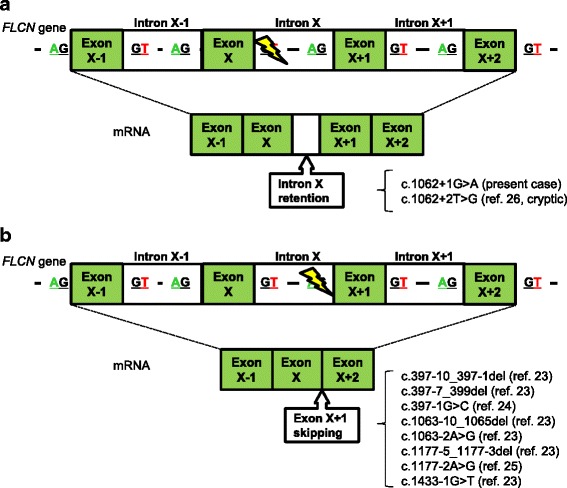
Birt-Hogg-Dubé syndrome (BHD) is an autosomal dominant disorder caused by germline mutations in the folliculin gene (FLCN). Nearly 150 pathogenic mutations have been identified in FLCN. The most frequent pattern is a frameshift mutation within a coding exon. In addition, splice-site mutations have been reported, and previous studies have confirmed exon skipping in several cases. However, it is poorly understood whether there are any splice-site mutations that cause translation of intron regions in FLCN.
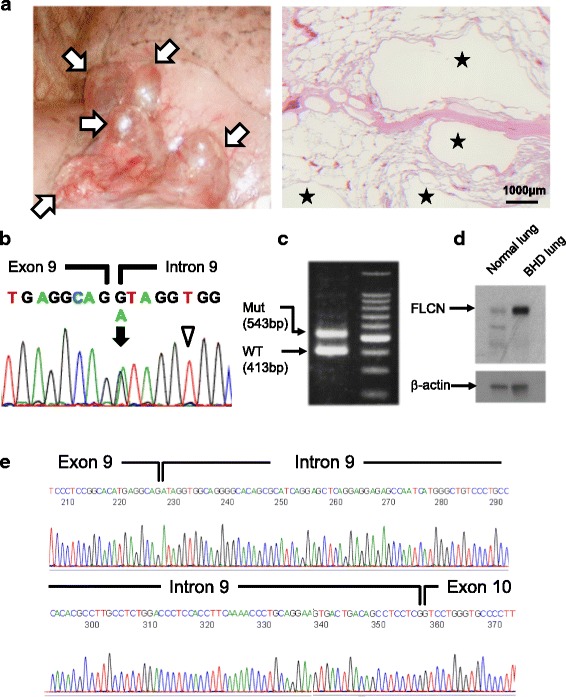
A 59-year-old Japanese patient with multiple pulmonary cysts and pneumothorax was hospitalized due to dyspnea. BHD was suspected and genetic testing was performed. The patient exhibited the splice-site mutation of FLCN in the 5' end of intron 9 (c.1062 + 1G > A). Total mRNA was extracted from pulmonary cysts, and RT-PCR assessment and sequence analyses were done. Two distinct bands were generated; one was wild-type and the other was a larger-sized mutant. Sequence analysis of the latter transcript revealed the insertion of 130 base pairs of intron 9 from the beginning of the splice-site between exons 9 and 10.
To our knowledge, this is the first report of distinct intron insertion using a BHD patient's diseased tissue-derived mRNA. The present case suggests that a splice-site mutation can lead to exon skipping as well as intron reading mRNA. The splicing process may be dependent in part on whether the donor or acceptor site is affected.
Birt-Hogg-Dubé综合征(BHD)是一种由卵泡抑素基因(FLCN)种系突变引起的常染色体显性疾病。在FLCN中已鉴定出近150种致病突变。最常见的模式是编码外显子内的移码突变。此外,还报道了剪接位点突变,并且先前的研究已在几例病例中证实了外显子跳跃。然而,对于是否存在导致FLCN内含子区域翻译的剪接位点突变,人们了解甚少。
一名59岁的日本患者因多发性肺囊肿和气胸伴呼吸困难入院。怀疑为BHD并进行了基因检测。该患者在第9内含子5'端出现FLCN剪接位点突变(c.1062 + 1G > A)。从肺囊肿中提取总mRNA,并进行逆转录聚合酶链反应(RT-PCR)评估和序列分析。产生了两条不同的条带;一条是野生型,另一条是更大尺寸的突变体。对后一种转录本的序列分析显示,从第9外显子和第10外显子之间剪接位点开始插入了130个碱基对的第9内含子。
据我们所知,这是首例使用BHD患者患病组织来源的mRNA进行独特内含子插入的报告。本病例表明,剪接位点突变可导致外显子跳跃以及内含子读码mRNA。剪接过程可能部分取决于供体或受体位点是否受到影响。