Division of Rheumatology, Department of Medicine, Karolinska Institutet, Karolinska University Hospital, Center for Molecular Medicine, Stockholm, Sweden.
Department of Environmental Science and Analytical Chemistry, Stockholm University, Stockholm, Sweden.
Arthritis Res Ther. 2018 May 2;20(1):83. doi: 10.1186/s13075-018-1579-y.
Polymyositis (PM) and dermatomyositis (DM) are severe chronic autoimmune diseases, characterized by muscle fatigue and low muscle endurance. Conventional treatment includes high doses of glucocorticoids and immunosuppressive drugs; however, few patients recover full muscle function. One explanation of the persistent muscle weakness could be altered lipid metabolism in PM/DM muscle tissue as we previously reported. Using a targeted lipidomic approach we aimed to characterize serum lipid profiles in patients with PM/DM compared to healthy individuals (HI) in a cross-sectional study. Also, in the longitudinal study we compared serum lipid profiles in patients newly diagnosed with PM/DM before and after immunosuppressive treatment.
Lipidomic profiles were analyzed in serum samples from 13 patients with PM/DM, 12 HI and 8 patients newly diagnosed with PM/DM before and after conventional immunosuppressive treatment using liquid chromatography tandem mass spectrometry (LC-MS/MS) and a gas-chromatography flame ionization detector (GC-FID). Functional Index (FI), as a test of muscle performance and serum levels of creatine kinase (s-CK) as a proxy for disease activity were analyzed.
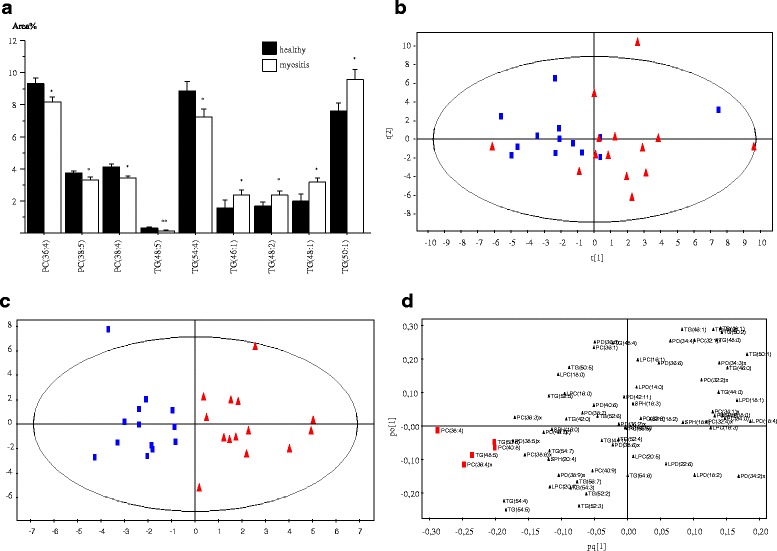
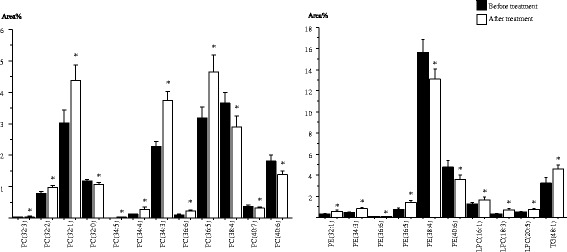
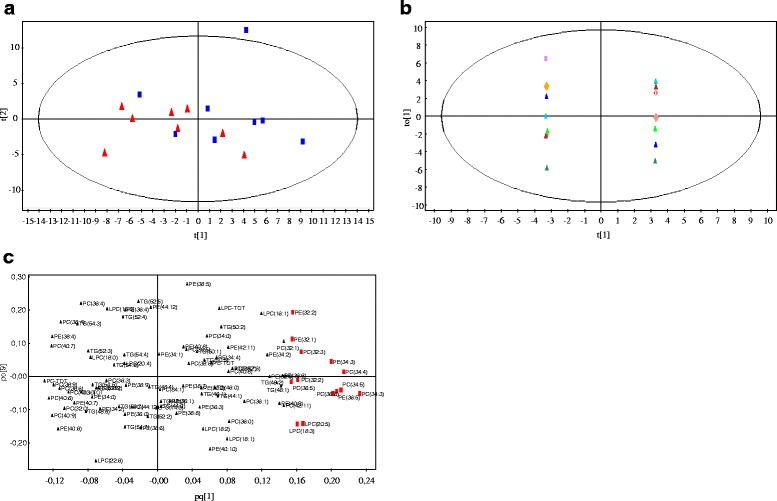
The fatty acid (FA) composition of total serum lipids was altered in patients with PM/DM compared to HI; the levels of palmitic (16:0) acid were significantly higher while the levels of arachidonic (20:4, n-6) acid were significantly lower in patients with PM/DM. The profiles of serum phosphatidylcholine and triacylglycerol species were changed in patients with PM/DM compared to HI, suggesting disproportionate levels of saturated and polyunsaturated FAs that might have negative effects on muscle performance. After immunosuppressive treatment the total serum lipid levels of eicosadienoic (20:2, n-6) and eicosapentaenoic (20:5, n-3) acids were increased and serum phospholipid profiles were altered in patients with PM/DM. The correlation between FI or s-CK and levels of several lipid species indicate the important role of lipid changes in muscle performance and inflammation.
Serum lipids profiles are significantly altered in patients with PM/DM compared to HI. Moreover, immunosuppressive treatment in patients newly diagnosed with PM/DM significantly affected serum lipid profiles. These findings provide new evidence of the dysregulated lipid metabolism in patients with PM/DM that could possibly contribute to low muscle performance.
多发性肌炎(PM)和皮肌炎(DM)是严重的慢性自身免疫性疾病,其特征是肌肉疲劳和低肌肉耐力。常规治疗包括大剂量的糖皮质激素和免疫抑制剂;然而,很少有患者能完全恢复肌肉功能。我们之前的研究表明,PM/DM 肌肉组织中脂质代谢的改变可能是持续肌肉无力的一个解释。我们采用靶向脂质组学方法,在横断面研究中比较了 PM/DM 患者与健康对照者(HI)的血清脂质谱。在纵向研究中,我们比较了新诊断为 PM/DM 的患者在免疫抑制治疗前后的血清脂质谱。
采用液相色谱串联质谱(LC-MS/MS)和气相色谱火焰离子化检测器(GC-FID)分析了 13 例 PM/DM 患者、12 例 HI 和 8 例新诊断为 PM/DM 患者的血清样本中的脂质组学谱。还分析了功能指数(FI),作为肌肉功能的测试和血清肌酸激酶(s-CK)水平,作为疾病活动的替代指标。
与 HI 相比,PM/DM 患者的总血清脂质脂肪酸(FA)组成发生改变;PM/DM 患者的棕榈酸(16:0)酸水平显著升高,而花生四烯酸(20:4,n-6)酸水平显著降低。与 HI 相比,PM/DM 患者的血清磷脂酰胆碱和三酰甘油种类谱发生改变,提示饱和和多不饱和 FA 水平不成比例,可能对肌肉功能产生负面影响。免疫抑制治疗后,PM/DM 患者的二十碳二烯酸(20:2,n-6)和二十碳五烯酸(20:5,n-3)总血清脂质水平升高,血清磷脂谱发生改变。FI 或 s-CK 与几种脂质种类水平之间的相关性表明脂质变化在肌肉功能和炎症中起着重要作用。
与 HI 相比,PM/DM 患者的血清脂质谱明显改变。此外,新诊断为 PM/DM 的患者的免疫抑制治疗显著影响了血清脂质谱。这些发现为 PM/DM 患者中失调的脂质代谢提供了新的证据,这可能导致低肌肉功能。