Department of Veterinary Parasitology, Faculty of Veterinary Medicine, University of Ibadan, Ibadan, Nigeria.
Division of Infection and Pathway Medicine, Deanery of Biomedical Sciences, University of Edinburgh, Edinburgh, EH8 9JZ, UK.
Parasit Vectors. 2018 May 2;11(1):280. doi: 10.1186/s13071-018-2801-0.
African animal trypanosomiasis is an economically significant disease that affects the livestock industry in Nigeria. It is caused by several parasites of the genus Trypanosoma. National estimates of the disease prevalence in livestock and tsetse flies are lacking, therefore a systematic review and meta-analysis were performed to understand the trend of the disease prevalence over the years.
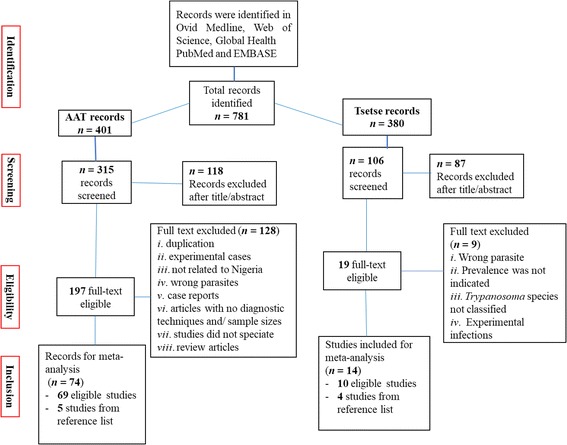
Publications were screened in Web of Science, Ovid MEDLINE, Global Health, EMBASE and PubMed databases. Using four-stage (identification, screening, eligibility and inclusion) process in the PRIMSA checklist, only studies that met the inclusion criteria for AAT and tsetse infections were analysed. Point estimates prevalence and subgroup analyses based on diagnostic techniques in livestock were evaluated at 95% confidence interval (CI).
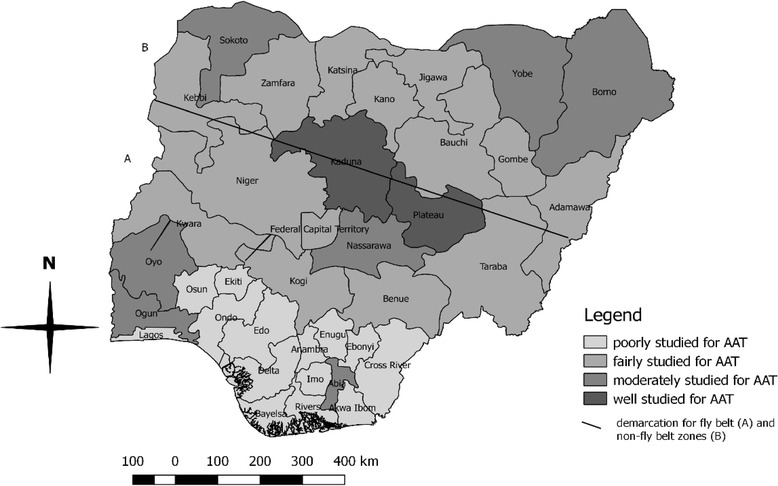
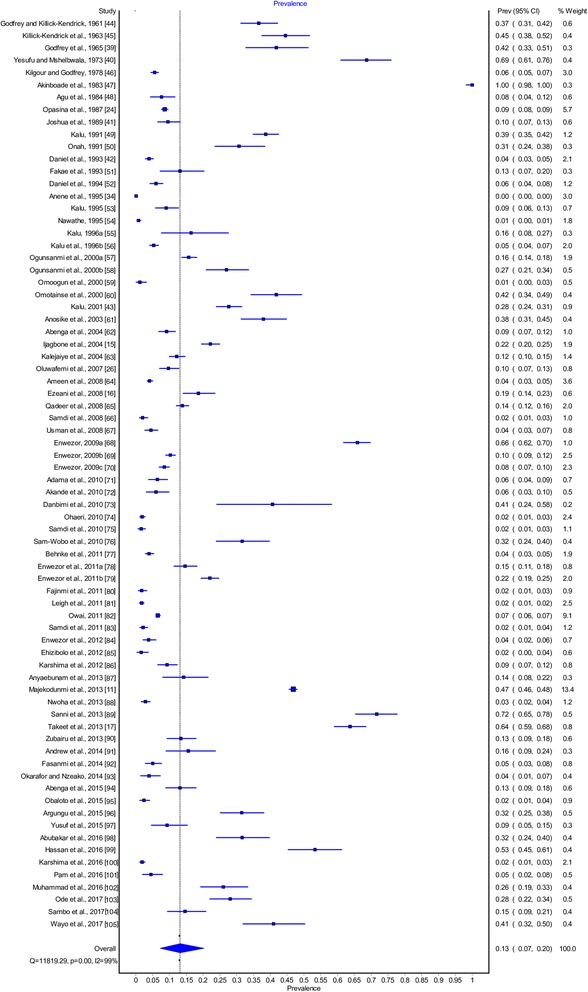
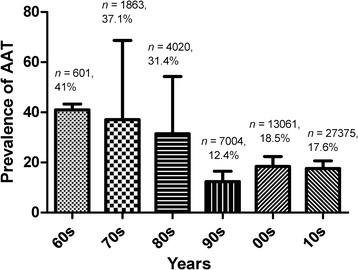
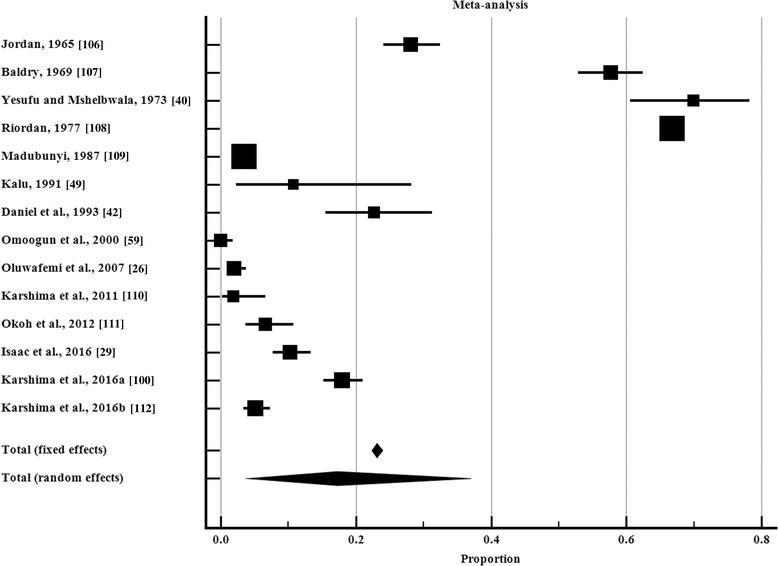
A total of 74 eligible studies published between 1960 and 2017 were selected for meta-analysis. This covers the six geopolitical zones, involving a total of 53,924 animals. The overall prevalence of AAT was 16.1% (95% CI: 12.3-20.3%). Based on diagnostic techniques, the prevalence of AAT in cattle was highest in PCR followed by serology and microscopy while the highest prevalence in pigs was observed with serology. Out of 12,552 tsetse flies examined from 14 eligible studies, an overall prevalence of 17.3% (95% CI: 4.5-36.0%) and subgroup prevalence of 49.7% (95% CI: 30.7-68.8%), 11.5% (95% CI: 6.1-18.5) and 4.5% (95% CI: 1.8-8.8%) in G. morsitans, G. tachinoides and G. palpalis, respectively, were observed using the random effects-model.
The prevalence of trypanosomes in both vectors and animal hosts was high in Nigeria. Therefore, further research on risk factors, seasonal and transhumance effects, vectoral capacity and competence are warranted for an effective control of AAT in Nigeria.
非洲动物锥虫病是一种在尼日利亚畜牧业中具有重要经济意义的疾病,由几种锥虫属寄生虫引起。尼日利亚缺乏对家畜和采采蝇中该病流行率的国家估计,因此进行了系统评价和荟萃分析,以了解该病多年来的流行趋势。
在 Web of Science、Ovid MEDLINE、全球健康、EMBASE 和 PubMed 数据库中筛选出版物。使用 PRISMA 清单中的四阶段(识别、筛选、合格和纳入)过程,仅分析符合 AAT 和采采蝇感染纳入标准的研究。在 95%置信区间(CI)下,基于家畜诊断技术评估点估计流行率和亚组分析。
共选择了 1960 年至 2017 年期间发表的 74 项符合条件的研究进行荟萃分析。这涵盖了六个地缘政治区域,总共涉及 53924 头动物。AAT 的总体流行率为 16.1%(95%CI:12.3-20.3%)。基于诊断技术,牛中 AAT 的流行率以 PCR 最高,其次是血清学和显微镜检查,而猪中以血清学最高。在 14 项符合条件的研究中,共检查了 12552 只采采蝇,总体流行率为 17.3%(95%CI:4.5-36.0%),亚组流行率分别为 49.7%(95%CI:30.7-68.8%)、11.5%(95%CI:6.1-18.5%)和 4.5%(95%CI:1.8-8.8%)在 G. morsitans、G. tachinoides 和 G. palpalis 中,分别使用随机效应模型观察到。
在尼日利亚,两种媒介和动物宿主中的锥虫流行率都很高。因此,需要进一步研究危险因素、季节性和迁徙影响、媒介能力和效能,以有效控制尼日利亚的 AAT。