Department of Women's and Children's Health, Uppsala University, Uppsala, Sweden.
Region Västmanland - Uppsala University, Center for Clinical Research, Hospital of Västmanland, Västerås, Sweden.
Sci Rep. 2018 May 2;8(1):6936. doi: 10.1038/s41598-018-24894-y.
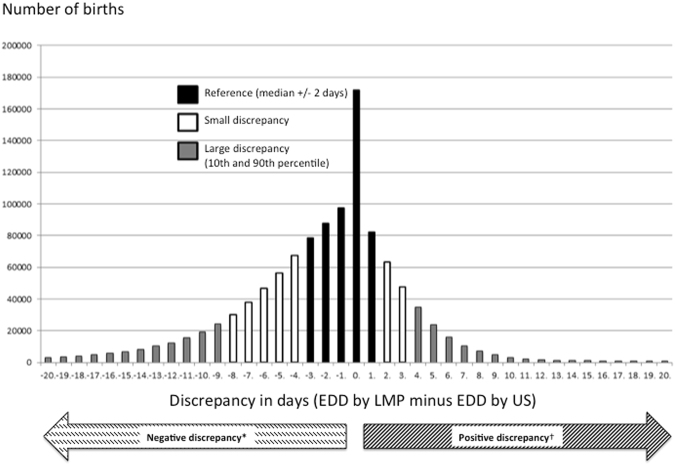
To assess associations between discrepancy of pregnancy dating methods and adverse pregnancy, delivery, and neonatal outcomes, odds ratios (ORs) with 95% confidence intervals (CIs) were calculated for discrepancy categories among all singleton births from the Medical Birth Register (1995-2010) with estimated date of delivery (EDD) by last menstrual period (LMP) minus EDD by ultrasound (US) -20 to +20 days. Negative/positive discrepancy was a fetus smaller/larger than expected when dated by US (EDD postponed/changed to an earlier date). Large discrepancy was <10 or >90 percentile. Reference was median discrepancy ±2 days. Odds for diabetes and preeclampsia were higher in pregnancies with negative discrepancy, and for most delivery outcomes in case of large positive discrepancy (+9 to +20 days): shoulder dystocia [OR 1.16 (95% CI 1.01-1.33)] and sphincter injuries [OR 1.13 (95% CI 1.09-1.17)]. Odds for adverse neonatal outcomes were higher in large negative discrepancy (-4 to -20 days): low Apgar score [OR 1.18 (95% CI 1.09-1.27)], asphyxia [OR 1.18 (95% CI 1.11-1.25)], fetal death [OR 1.47 (95% CI 1.32-1.64)], and neonatal death [OR 2.19 (95% CI 1.91-2.50)]. In conclusion, especially, large negative discrepancy was associated with increased risks of adverse perinatal outcomes.
为了评估妊娠日期评估方法差异与不良妊娠、分娩和新生儿结局之间的关联,我们计算了所有来自医学出生登记(1995-2010 年)的单胎妊娠中,根据末次月经(LMP)减去超声(US)估算的预产期(EDD)的差异类别与 -20 至 +20 天之间的比值比(OR)。当根据 US 日期胎儿比预期小/大(EDD 推迟/更改为较早日期)时,为负/正差异。大差异是指<10 或>90 百分位数。参考值为中位数差异±2 天。与负差异相比,糖尿病和子痫前期的发生风险更高,而在大正差异(+9 至 +20 天)的情况下,大多数分娩结局的风险更高:肩难产[OR 1.16(95% CI 1.01-1.33)]和括约肌损伤[OR 1.13(95% CI 1.09-1.17)]。与大负差异(-4 至-20 天)相比,不良新生儿结局的风险更高:低 Apgar 评分[OR 1.18(95% CI 1.09-1.27)]、窒息[OR 1.18(95% CI 1.11-1.25)]、胎儿死亡[OR 1.47(95% CI 1.32-1.64)]和新生儿死亡[OR 2.19(95% CI 1.91-2.50)]。总之,尤其是大的负差异与不良围产结局的风险增加相关。