Wu Meiying, Chen Wenting, Chen Yu, Zhang Haixian, Liu Chengbo, Deng Zhiting, Sheng Zonghai, Chen Jingqin, Liu Xin, Yan Fei, Zheng Hairong
Paul C. Lauterbur Research Center for Biomedical Imaging Institute of Biomedical and Health Engineering Shenzhen Institutes of Advanced Technology Chinese Academy of Sciences Shenzhen 518055 P. R. China.
State Key Laboratory of High Performance Ceramics and Superfine Microstructure Shanghai Institute of Ceramics Chinese Academy of Sciences Shanghai 200050 P. R. China.
Adv Sci (Weinh). 2018 Jan 10;5(4):1700474. doi: 10.1002/advs.201700474. eCollection 2018 Apr.
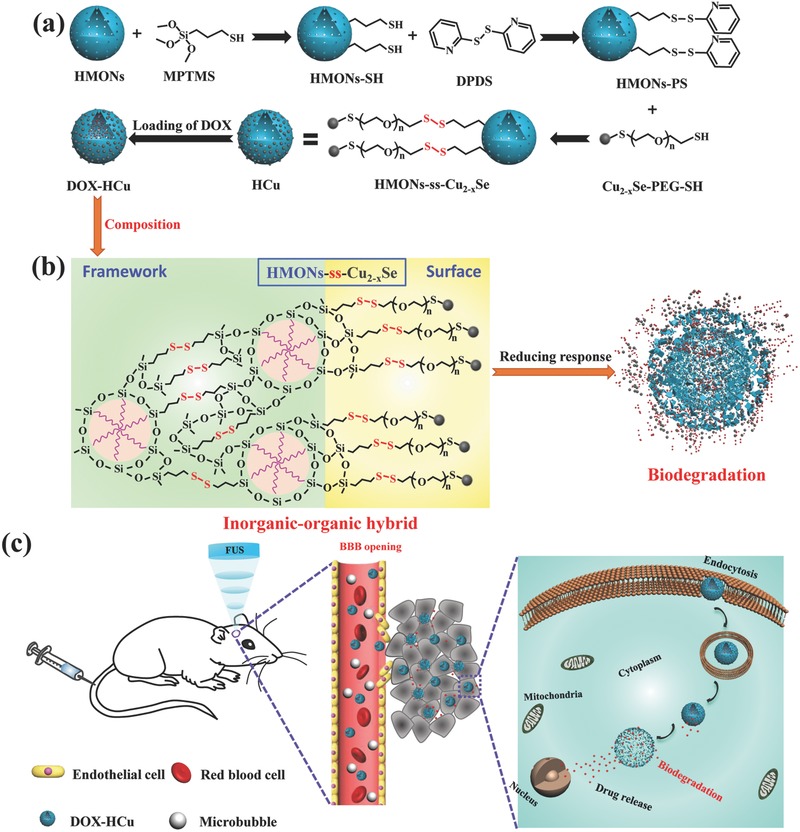
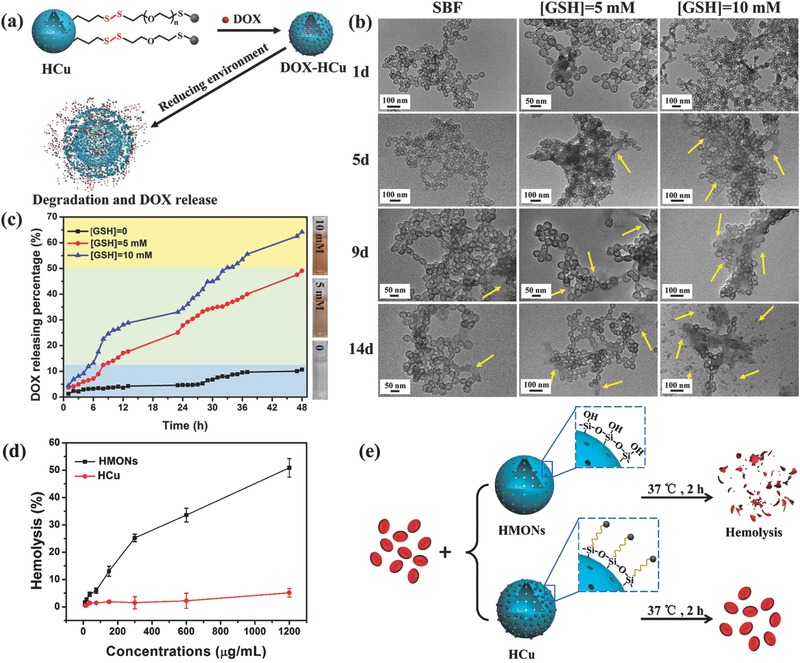
The blood brain barrier is the main obstacle to delivering diagnostic and therapeutic agents to the diseased sites of brain. It is still of great challenge for the combined use of focused ultrasound (FUS) and theranostic nanotechnology to achieve noninvasive and localized delivery of chemotherapeutic drugs into orthotopic brain tumor. In this work, a unique theranostic nanoplatform for highly efficient photoacoustic imagingguided chemotherapy of brain tumor both in vitro and in vivo, which is based on the utilization of hollow mesoporous organosilica nanoparticles (HMONs) to integrate ultrasmall Cu Se particles on the surface and doxorubicin inside the hollow interior, is synthesized. The developed multifunctional theranostic nanosystems exhibit tumor-triggered programmed destruction due to the reducing microenvironment-responsive cleavage of disulfide bonds that are incorporated into the framework of HMONs and linked between HMONs and Cu Se, resulting in tumor-specific biodegradation and on-demand drug-releasing behavior. Such tumor microenvironment-responsive biodegradable and biocompatible theranostic nanosystems in combination with FUS provide a promising delivery nanoplatform with high performance for orthotopic brain tumor imaging and therapy.
血脑屏障是将诊断和治疗剂输送到脑部病变部位的主要障碍。聚焦超声(FUS)与诊疗纳米技术联合使用,将化疗药物无创且局部地输送到原位脑肿瘤中,仍然面临巨大挑战。在这项工作中,合成了一种独特的诊疗纳米平台,用于在体外和体内对脑肿瘤进行高效光声成像引导的化疗,该平台基于利用中空介孔有机硅纳米粒子(HMONs)在其表面整合超小的CuSe粒子,并在中空内部封装阿霉素。所开发的多功能诊疗纳米系统表现出肿瘤触发的程序性破坏,这是由于引入到HMONs框架中并连接HMONs与CuSe的二硫键的还原微环境响应性裂解,导致肿瘤特异性生物降解和按需释药行为。这种肿瘤微环境响应性可生物降解且生物相容的诊疗纳米系统与FUS相结合,为原位脑肿瘤成像和治疗提供了一个具有高性能的有前景的递送纳米平台。