Liao Shutan, McLachlan Craig S
Rural Clinical School, Faculty of Medicine, University of New South Wales, Sydney, NSW 2052, Australia.
The First Affiliated Hospital of Sun Yat-sen University, Guangzhou 510080, China.
J Cardiovasc Dev Dis. 2018 May 1;5(2):23. doi: 10.3390/jcdd5020023.
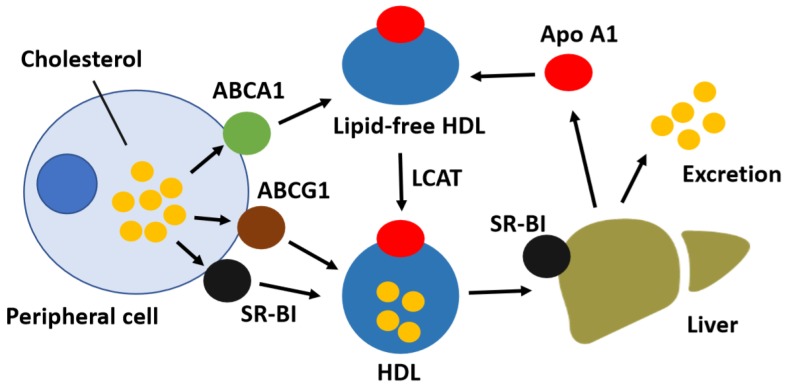
Aortic stiffness during cardiac contraction is defined by the rigidity of the aorta and the elastic resistance to deformation. Recent studies suggest that aortic stiffness may be associated with changes in cholesterol efflux in endothelial cells. This alteration in cholesterol efflux may directly affect endothelial function, extracellular matrix composition, and vascular smooth muscle cell function and behavior. These pathological changes favor an aortic stiffness phenotype. Among all of the proteins participating in the cholesterol efflux process, ATP binding cassette transporter A1 (ABCA1) appears to be the main contributor to arterial stiffness changes in terms of structural and cellular function. ABCA1 is also associated with vascular inflammation mediators implicated in aortic stiffness. The goal of this mini review is to provide a conceptual hypothesis of the recent advancements in the understanding of ABCA1 in cholesterol efflux and its role and association in the development of aortic stiffness, with a particular emphasis on the potential mechanisms and pathways involved.
心脏收缩期间的主动脉僵硬度由主动脉的刚性和对变形的弹性阻力定义。最近的研究表明,主动脉僵硬度可能与内皮细胞中胆固醇流出的变化有关。胆固醇流出的这种改变可能直接影响内皮功能、细胞外基质组成以及血管平滑肌细胞的功能和行为。这些病理变化有利于主动脉僵硬度表型。在所有参与胆固醇流出过程的蛋白质中,就结构和细胞功能而言,ATP结合盒转运蛋白A1(ABCA1)似乎是动脉僵硬度变化的主要促成因素。ABCA1还与涉及主动脉僵硬度的血管炎症介质有关。本综述的目的是提供一个概念性假设,阐述对ABCA1在胆固醇流出中的理解、其在主动脉僵硬度发展中的作用和关联方面的最新进展,特别强调其中涉及的潜在机制和途径。