• 文献检索
  • 文档翻译
  • 深度研究
  • 学术资讯
  • Suppr Zotero 插件Zotero 插件
  • 邀请有礼
  • 套餐&价格
  • 历史记录
应用&插件
Suppr Zotero 插件Zotero 插件浏览器插件Mac 客户端Windows 客户端微信小程序
定价
高级版会员购买积分包购买API积分包
服务
文献检索文档翻译深度研究API 文档MCP 服务
关于我们
关于 Suppr公司介绍联系我们用户协议隐私条款
关注我们

Suppr 超能文献

核心技术专利:CN118964589B侵权必究
粤ICP备2023148730 号-1Suppr @ 2026

文献检索

告别复杂PubMed语法,用中文像聊天一样搜索,搜遍4000万医学文献。AI智能推荐,让科研检索更轻松。

立即免费搜索

文件翻译

保留排版,准确专业,支持PDF/Word/PPT等文件格式,支持 12+语言互译。

免费翻译文档

深度研究

AI帮你快速写综述,25分钟生成高质量综述,智能提取关键信息,辅助科研写作。

立即免费体验

反欺骗:基于实时脑电的可靠生物识别技术,源于面部快速序列视觉呈现的神经反应。

Anti-deception: reliable EEG-based biometrics with real-time capability from the neural response of face rapid serial visual presentation.

机构信息

China National Digital Switching System Engineering and Technological Research Center, Zhengzhou, China.

Key Laboratory for NeuroInformation of Ministry of Education, School of Life Science and Technology, University of Electronic Science and Technology of China, Chengdu, China.

出版信息

Biomed Eng Online. 2018 May 3;17(1):55. doi: 10.1186/s12938-018-0483-7.

DOI:10.1186/s12938-018-0483-7
PMID:29724232
原文链接:https://pmc.ncbi.nlm.nih.gov/articles/PMC5934893/
Abstract

BACKGROUND

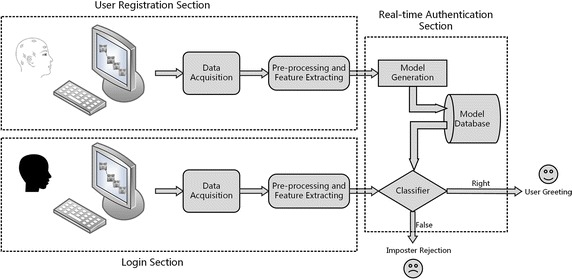
The electroencephalogram (EEG) signal represents a subject's specific brain activity patterns and is considered as an ideal biometric given its superior invisibility, non-clonality, and non-coercion. In order to enhance its applicability in identity authentication, a novel EEG-based identity authentication method is proposed based on self- or non-self-face rapid serial visual presentation.

RESULTS

In contrast to previous studies that extracted EEG features from rest state or motor imagery, the designed paradigm could obtain a distinct and stable biometric trait with a lower time cost. Channel selection was applied to select specific channels for each user to enhance system portability and improve discriminability between users and imposters. Two different imposter scenarios were designed to test system security, which demonstrate the capability of anti-deception. Fifteen users and thirty imposters participated in the experiment. The mean authentication accuracy values for the two scenarios were 91.31 and 91.61%, with 6 s time cost, which illustrated the precision and real-time capability of the system. Furthermore, in order to estimate the repeatability and stability of our paradigm, another data acquisition session is conducted for each user. Using the classification models generated from the previous sessions, a mean false rejected rate of 7.27% has been achieved, which demonstrates the robustness of our paradigm.

CONCLUSIONS

Experimental results reveal that the proposed paradigm and methods are effective for EEG-based identity authentication.

摘要

背景

脑电图(EEG)信号代表了主体特定的大脑活动模式,由于其具有卓越的不可见性、非克隆性和非强制性,因此被认为是一种理想的生物识别特征。为了提高其在身份验证中的适用性,提出了一种基于自我或非自我面孔快速序列视觉呈现的新型 EEG 身份验证方法。

结果

与之前从静息状态或运动想象中提取 EEG 特征的研究不同,所设计的范式可以以较低的时间成本获得独特而稳定的生物特征。通道选择被应用于为每个用户选择特定的通道,以增强系统的便携性并提高用户与赝品之间的可区分性。设计了两种不同的赝品场景来测试系统的安全性,这证明了该系统具有反欺骗能力。十五名用户和三十名赝品参与了实验。两个场景的平均认证准确率分别为 91.31%和 91.61%,时间成本为 6 秒,这说明了系统的精度和实时性。此外,为了估计我们范式的可重复性和稳定性,为每个用户进行了另一次数据采集会话。使用之前会话生成的分类模型,平均错误拒绝率为 7.27%,这证明了我们范式的稳健性。

结论

实验结果表明,所提出的范式和方法对于基于 EEG 的身份验证是有效的。
https://cdn.ncbi.nlm.nih.gov/pmc/blobs/362d/5934893/d2276b27c5d3/12938_2018_483_Fig9_HTML.jpg
https://cdn.ncbi.nlm.nih.gov/pmc/blobs/362d/5934893/111d32bb447a/12938_2018_483_Fig1_HTML.jpg
https://cdn.ncbi.nlm.nih.gov/pmc/blobs/362d/5934893/ccd5c6ce8d07/12938_2018_483_Fig2_HTML.jpg
https://cdn.ncbi.nlm.nih.gov/pmc/blobs/362d/5934893/db5076a192e8/12938_2018_483_Fig3_HTML.jpg
https://cdn.ncbi.nlm.nih.gov/pmc/blobs/362d/5934893/3223d21df529/12938_2018_483_Fig4_HTML.jpg
https://cdn.ncbi.nlm.nih.gov/pmc/blobs/362d/5934893/ffbd7429dd74/12938_2018_483_Fig5_HTML.jpg
https://cdn.ncbi.nlm.nih.gov/pmc/blobs/362d/5934893/a037df08bad8/12938_2018_483_Fig6_HTML.jpg
https://cdn.ncbi.nlm.nih.gov/pmc/blobs/362d/5934893/ce5ba3a5d16a/12938_2018_483_Fig7_HTML.jpg
https://cdn.ncbi.nlm.nih.gov/pmc/blobs/362d/5934893/578950466586/12938_2018_483_Fig8_HTML.jpg
https://cdn.ncbi.nlm.nih.gov/pmc/blobs/362d/5934893/d2276b27c5d3/12938_2018_483_Fig9_HTML.jpg
https://cdn.ncbi.nlm.nih.gov/pmc/blobs/362d/5934893/111d32bb447a/12938_2018_483_Fig1_HTML.jpg
https://cdn.ncbi.nlm.nih.gov/pmc/blobs/362d/5934893/ccd5c6ce8d07/12938_2018_483_Fig2_HTML.jpg
https://cdn.ncbi.nlm.nih.gov/pmc/blobs/362d/5934893/db5076a192e8/12938_2018_483_Fig3_HTML.jpg
https://cdn.ncbi.nlm.nih.gov/pmc/blobs/362d/5934893/3223d21df529/12938_2018_483_Fig4_HTML.jpg
https://cdn.ncbi.nlm.nih.gov/pmc/blobs/362d/5934893/ffbd7429dd74/12938_2018_483_Fig5_HTML.jpg
https://cdn.ncbi.nlm.nih.gov/pmc/blobs/362d/5934893/a037df08bad8/12938_2018_483_Fig6_HTML.jpg
https://cdn.ncbi.nlm.nih.gov/pmc/blobs/362d/5934893/ce5ba3a5d16a/12938_2018_483_Fig7_HTML.jpg
https://cdn.ncbi.nlm.nih.gov/pmc/blobs/362d/5934893/578950466586/12938_2018_483_Fig8_HTML.jpg
https://cdn.ncbi.nlm.nih.gov/pmc/blobs/362d/5934893/d2276b27c5d3/12938_2018_483_Fig9_HTML.jpg

相似文献

1
Anti-deception: reliable EEG-based biometrics with real-time capability from the neural response of face rapid serial visual presentation.反欺骗:基于实时脑电的可靠生物识别技术,源于面部快速序列视觉呈现的神经反应。
Biomed Eng Online. 2018 May 3;17(1):55. doi: 10.1186/s12938-018-0483-7.
2
An EEG-Based Person Authentication System with Open-Set Capability Combining Eye Blinking Signals.基于 EEG 的具有开放式能力的人员认证系统,结合眨眼信号。
Sensors (Basel). 2018 Jan 24;18(2):335. doi: 10.3390/s18020335.
3
EEG-Based Identity Authentication Framework Using Face Rapid Serial Visual Presentation with Optimized Channels.基于面部快速序列视觉呈现和优化通道的脑电身份认证框架。
Sensors (Basel). 2018 Dec 20;19(1):6. doi: 10.3390/s19010006.
4
Application of a brain-computer interface for person authentication using EEG responses to photo stimuli.利用脑电图对光刺激的反应,将脑机接口应用于身份认证
J Integr Neurosci. 2018 Aug 15;17(1):53-60. doi: 10.31083/JIN-170042.
5
Combining Cryptography with EEG Biometrics.将密码学与 EEG 生物识别技术相结合。
Comput Intell Neurosci. 2018 May 22;2018:1867548. doi: 10.1155/2018/1867548. eCollection 2018.
6
Review on EEG-Based Authentication Technology.基于脑电图的认证技术综述。
Comput Intell Neurosci. 2021 Dec 24;2021:5229576. doi: 10.1155/2021/5229576. eCollection 2021.
7
Robust Single-Trial EEG-Based Authentication Achieved with a 2-Stage Classifier.基于两阶段分类器的稳健单次脑电认证。
Biosensors (Basel). 2020 Sep 13;10(9):124. doi: 10.3390/bios10090124.
8
High-accuracy user identification using EEG biometrics.使用脑电图生物识别技术进行高精度用户识别。
Annu Int Conf IEEE Eng Med Biol Soc. 2016 Aug;2016:854-858. doi: 10.1109/EMBC.2016.7590835.
9
EEG-based single-channel authentication systems with optimum electrode placement for different mental activities.基于脑电图的单通道认证系统,针对不同的心理活动进行最佳电极放置。
Biomed J. 2019 Aug;42(4):261-267. doi: 10.1016/j.bj.2019.03.005. Epub 2019 Sep 24.
10
Evidence of a Task-Independent Neural Signature in the Spectral Shape of the Electroencephalogram.脑电图频谱形状中存在任务无关的神经特征证据。
Int J Neural Syst. 2018 Feb;28(1):1750035. doi: 10.1142/S0129065717500356. Epub 2017 Jul 3.

引用本文的文献

1
EEG-Based Authentication Across Various Event-Related Potentials (ERPs).基于脑电图的跨多种事件相关电位(ERP)的认证
Sensors (Basel). 2025 Aug 11;25(16):4962. doi: 10.3390/s25164962.
2
Brain-Computer Interface for EEG-Based Authentication: Advancements and Practical Implications.基于脑电图的认证的脑机接口:进展与实际意义。
Sensors (Basel). 2025 Aug 10;25(16):4946. doi: 10.3390/s25164946.
3
Event-related pupillary response-based authentication system using eye-tracker add-on augmented reality glasses for individual identification.

本文引用的文献

1
Robust Point Set Matching for Partial Face Recognition.用于部分人脸识别的鲁棒点集匹配
IEEE Trans Image Process. 2016 Mar;25(3):1163-76. doi: 10.1109/TIP.2016.2515987. Epub 2016 Jan 8.
2
An Auditory-Tactile Visual Saccade-Independent P300 Brain-Computer Interface.一种听觉-触觉视觉独立于扫视的P300脑机接口。
Int J Neural Syst. 2016 Feb;26(1):1650001. doi: 10.1142/S0129065716500015. Epub 2015 Nov 4.
3
Individual identification via electrocardiogram analysis.通过心电图分析进行个体识别。
基于事件相关瞳孔反应的认证系统,使用带有眼动追踪附加组件的增强现实眼镜进行个人身份识别。
Front Physiol. 2024 Aug 13;15:1325784. doi: 10.3389/fphys.2024.1325784. eCollection 2024.
4
Authentication using c-VEP evoked in a mild-burdened cognitive task.在轻度认知负担任务中使用c-VEP诱发进行验证。
Front Hum Neurosci. 2023 Sep 7;17:1240451. doi: 10.3389/fnhum.2023.1240451. eCollection 2023.
5
Dynamic probability integration for electroencephalography-based rapid serial visual presentation performance enhancement: Application in nighttime vehicle detection.基于脑电图的快速序列视觉呈现性能增强的动态概率积分:在夜间车辆检测中的应用。
Front Comput Neurosci. 2022 Oct 14;16:1006361. doi: 10.3389/fncom.2022.1006361. eCollection 2022.
6
A novel approach for designing authentication system using a picture based P300 speller.一种使用基于图片的P300拼写器设计认证系统的新方法。
Cogn Neurodyn. 2021 Oct;15(5):805-824. doi: 10.1007/s11571-021-09664-3. Epub 2021 Jan 30.
7
The Time-Robustness Analysis of Individual Identification Based on Resting-State EEG.基于静息态脑电图的个体识别的时间稳健性分析
Front Hum Neurosci. 2021 Sep 13;15:672946. doi: 10.3389/fnhum.2021.672946. eCollection 2021.
8
A Benchmark Dataset for RSVP-Based Brain-Computer Interfaces.基于快速序列视觉呈现的脑机接口基准数据集。
Front Neurosci. 2020 Oct 2;14:568000. doi: 10.3389/fnins.2020.568000. eCollection 2020.
9
EEG-Based Identity Authentication Framework Using Face Rapid Serial Visual Presentation with Optimized Channels.基于面部快速序列视觉呈现和优化通道的脑电身份认证框架。
Sensors (Basel). 2018 Dec 20;19(1):6. doi: 10.3390/s19010006.
Biomed Eng Online. 2015 Aug 14;14:78. doi: 10.1186/s12938-015-0072-y.
4
Gaze-independent BCI-spelling using rapid serial visual presentation (RSVP).基于快速序列视觉呈现(RSVP)的无需注视的脑机接口拼写。
Clin Neurophysiol. 2013 May;124(5):901-8. doi: 10.1016/j.clinph.2012.12.050. Epub 2013 Mar 7.
5
Closing the loop in cortically-coupled computer vision: a brain-computer interface for searching image databases.闭环皮质耦合计算机视觉:用于搜索图像数据库的脑机接口。
J Neural Eng. 2011 Jun;8(3):036025. doi: 10.1088/1741-2560/8/3/036025. Epub 2011 May 12.
6
Understanding complexity in the human brain.理解人类大脑的复杂性。
Trends Cogn Sci. 2011 May;15(5):200-9. doi: 10.1016/j.tics.2011.03.006. Epub 2011 Apr 14.
7
EEG evidence of face-specific visual self-representation.脑电图证据表明存在面孔特异性的视觉自我表象。
Neuroimage. 2010 May 1;50(4):1666-75. doi: 10.1016/j.neuroimage.2010.01.030. Epub 2010 Jan 15.
8
Face-specific and domain-general characteristics of cortical responses during self-recognition.自我识别过程中皮层反应的面部特异性和领域一般性特征。
Neuroimage. 2008 Aug 1;42(1):414-22. doi: 10.1016/j.neuroimage.2008.03.054. Epub 2008 Apr 10.
9
Person authentication using brainwaves (EEG) and maximum a posteriori model adaptation.使用脑电波(脑电图)和最大后验模型自适应的身份认证。
IEEE Trans Pattern Anal Mach Intell. 2007 Apr;29(4):743-52. doi: 10.1109/TPAMI.2007.1012.
10
Biometrics from brain electrical activity: a machine learning approach.基于脑电活动的生物识别技术:一种机器学习方法。
IEEE Trans Pattern Anal Mach Intell. 2007 Apr;29(4):738-42. doi: 10.1109/TPAMI.2007.1013.