Department of Paediatrics, University of Cambridge, Box 116, Cambridge Biomedical Campus, Hills Road, Cambridge, CB2 0QQ, UK.
Medical Research Council Epidemiology Unit, University of Cambridge, Cambridge, CB2 0QQ, UK.
BMC Pregnancy Childbirth. 2018 May 4;18(1):133. doi: 10.1186/s12884-018-1786-1.
Low birth weight has important short- and long-term health implications. Previously it has been shown that pregnancies affected by hyperemesis gravidarum in the mother are at higher risk of having low birth weight offspring. In this study we tested whether such risks are also evident with less severe nausea and vomiting in pregnancy.
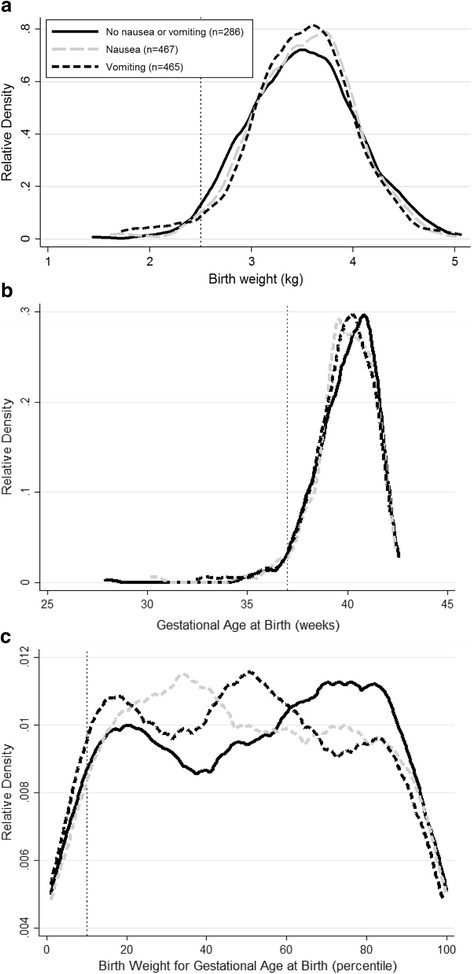
One thousand two hundred thirty-eight women in the prospective Cambridge Baby Growth Study filled in pregnancy questionnaires which included questions relating to adverse effects of pregnancy and drugs taken during that time. Ordinal logistic regression models, adjusted for parity, ethnicity, marital and smoking status were used to relate the risk of giving birth to low birth weight (< 2.5 kg) babies to nausea and/or vomiting in pregnancy that were not treated with anti-emetics and did not report suffering from hyperemesis gravidarum.
Only three women in the cohort reported having had hyperemesis gravidarum although a further 17 women reported taking anti-emetics during pregnancy. Of those 1218 women who did not take anti-emetics 286 (23.5%) did not experience nausea or vomiting, 467 (38.3%) experienced nausea but not vomiting and 465 experienced vomiting (38.2%). Vomiting during pregnancy was associated with higher risk of having a low birth weight baby (odds ratio 3.5 (1.2, 10.8), p = 0.03). The risk associated with vomiting was found in the first (p = 0.01) and second (p = 0.01) trimesters but not the third (p = 1.0). The higher risk was not evident in those women who only experienced nausea (odds ratio 1.0 (0.3, 4.0), p = 1.0).
Vomiting in early pregnancy, even when not perceived to be sufficiently severe to merit treatment, is associated with a higher risk of delivering a low birth weight baby. Early pregnancy vomiting might therefore be usable as a marker of higher risk of low birth weight in pregnancy. This may be of benefit in situations where routine ultrasound is not available to distinguish prematurity from fetal growth restriction, so low birth weight is used as an alternative.
低出生体重对母婴的短期和长期健康都有重要影响。此前已有研究表明,患有妊娠剧吐的孕妇所怀的胎儿发生低出生体重的风险更高。本研究旨在探究妊娠期间出现较轻程度的恶心和呕吐是否也会增加这种风险。
1238 名参加剑桥婴儿生长研究的孕妇填写了孕期问卷,其中包括与孕期不良反应和在此期间服用的药物相关的问题。采用有序逻辑回归模型,调整了产次、种族、婚姻状况和吸烟状况等因素,将未用止吐药治疗且未报告妊娠剧吐的孕期恶心和/或呕吐与低出生体重(<2.5kg)的风险相关联。
虽然有 17 名女性报告在孕期服用了止吐药,但队列中只有 3 名女性报告患有妊娠剧吐。在未服用止吐药的 1218 名女性中,286 名(23.5%)无恶心或呕吐,467 名(38.3%)有恶心但无呕吐,465 名(38.2%)有呕吐。孕期呕吐与低出生体重儿的发生风险增加相关(比值比 3.5(1.2,10.8),p=0.03)。这种相关性在孕早期(p=0.01)和孕中期(p=0.01)观察到,但在孕晚期(p=1.0)未观察到。仅出现恶心的女性(比值比 1.0(0.3,4.0),p=1.0),其风险无显著增加。
即使妊娠早期的呕吐没有严重到需要治疗的程度,也与低出生体重儿的发生风险增加相关。因此,妊娠早期的呕吐可能可作为预测妊娠低出生体重风险的指标。在无法常规进行超声检查来区分早产和胎儿生长受限的情况下,这种方法可能具有优势,此时可将低出生体重作为替代指标。