Division of Cell Biology, Department of Pediatrics, National Jewish Health, Denver, Colorado, USA.
Department of Pathology, Immunology and Laboratory Medicine, College of Medicine, University of Florida, Gainesville, Florida, USA.
Stem Cells Transl Med. 2018 Jul;7(7):551-558. doi: 10.1002/sctm.17-0200. Epub 2018 May 5.
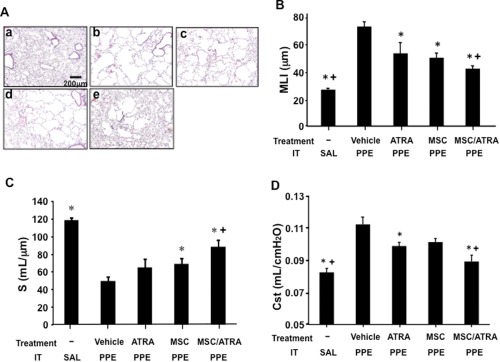
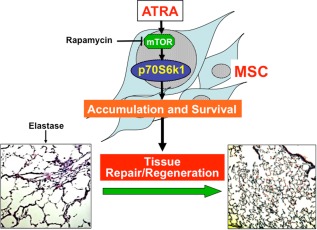
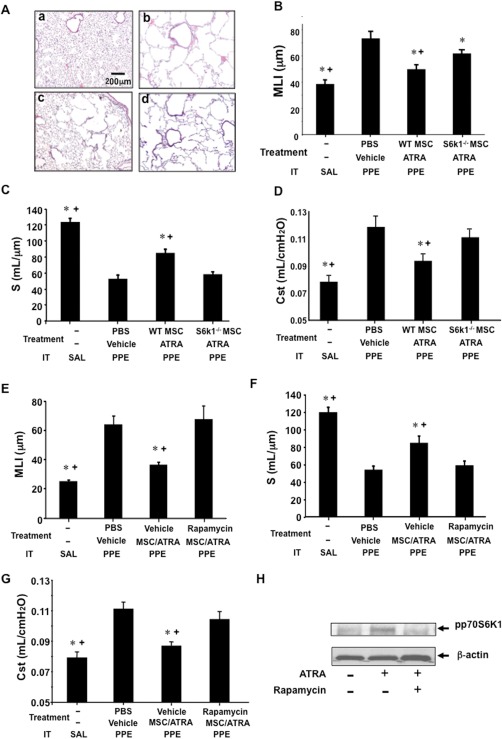
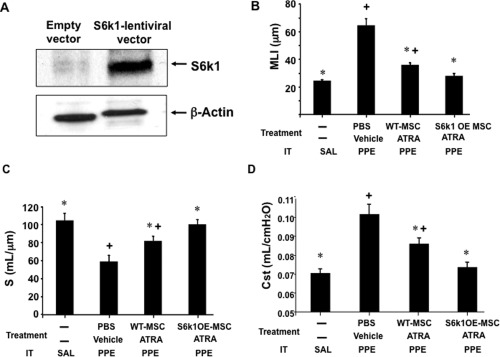
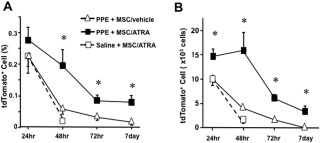
All-trans retinoic acid (ATRA) or mesenchymal stem cells (MSCs) have been shown to promote lung tissue regeneration in animal models of emphysema. However, the reparative effects of the combination of the two and the role of p70S6 kinase-1 (p70S6k1) activation in the repair process have not been defined. Twenty-one days after intratracheal instillation of porcine pancreatic elastase (PPE), MSC and/or 10 days of ATRA treatment was initiated. Thirty-two days later, static lung compliance (Cst), mean linear intercepts (MLIs), and alveolar surface area (S) were measured. After PPE, mice demonstrated increased values of Cst and MLI, and decreased S values. Both ATRA and MSC transfer were individually effective in improving these outcomes while the combination of ATRA and MSCs was even more effective. The combination of p70S6k1 MSCs transfer followed by ATRA demonstrated only modest effects, and rapamycin treatment of recipients with wild-type (WT) MSCs and ATRA failed to show any effect. However, transfer of p70S6k1 over-expressing-MSCs together with ATRA resulted in further improvements over those seen following WT MSCs together with ATRA. ATRA activated p70S6k1 in MSCs in vitro, which was completely inhibited by rapamycin. Tracking of transferred MSCs following ATRA revealed enhanced accumulation and extended survival of MSCs in recipient lungs following PPE but not vehicle instillation. These data suggest that in MSCs, p70S6k1 activation plays a critical role in ATRA-enhanced lung tissue repair, mediated in part by prolonged survival of transferred MSCs. p70S6k1-activated MSCs may represent a novel therapeutic approach to reverse the lung damage seen in emphysema. Stem Cells Translational Medicine 2018;7:551-558.
全反式视黄酸(ATRA)或间充质干细胞(MSCs)已被证明可促进肺气肿动物模型中的肺组织再生。然而,这两种方法的联合修复作用以及 p70S6 激酶-1(p70S6k1)激活在修复过程中的作用尚未确定。猪胰弹性蛋白酶(PPE)气管内滴注 21 天后,开始 MSC 和/或 10 天的 ATRA 治疗。32 天后,测量静态肺顺应性(Cst)、平均线性截距(MLI)和肺泡表面积(S)。PPE 后,小鼠的 Cst 和 MLI 值增加,S 值降低。ATRA 和 MSC 转移单独使用都能有效改善这些结果,而 ATRA 和 MSCs 的联合使用效果更显著。p70S6k1 MSC 转移后再给予 ATRA 显示出适度的效果,而 rapamycin 处理接受 WT MSC 和 ATRA 的受体则没有显示出任何效果。然而,p70S6k1 过表达 MSC 与 ATRA 一起转移导致的改善效果超过了 WT MSC 与 ATRA 一起转移的效果。ATRA 在体外激活了 MSC 中的 p70S6k1,这一过程被 rapamycin 完全抑制。在接受 PPE 但未接受载体处理的小鼠中,在给予 ATRA 后对转移的 MSC 进行追踪,发现 MSC 在受体肺中的积累增强且存活时间延长。这些数据表明,在 MSC 中,p70S6k1 的激活在 ATRA 增强的肺组织修复中起关键作用,部分是通过延长转移的 MSC 的存活来介导的。p70S6k1 激活的 MSC 可能代表一种治疗肺气肿中肺损伤的新方法。《干细胞转化医学》2018;7:551-558.