Zhu Bingying, Ju Shaoqing, Chu Haidan, Shen Xianjuan, Zhang Yan, Luo Xi, Cong Hui
Laboratory Medicine Center, Affiliated Hospital of Nantong University, Nantong, Jiangsu 226000, P.R. China.
Surgical Comprehensive Laboratory, Affiliated Hospital of Nantong University, Nantong, Jiangsu 226000, P.R. China.
Oncol Lett. 2018 May;15(5):6094-6106. doi: 10.3892/ol.2018.8157. Epub 2018 Mar 2.
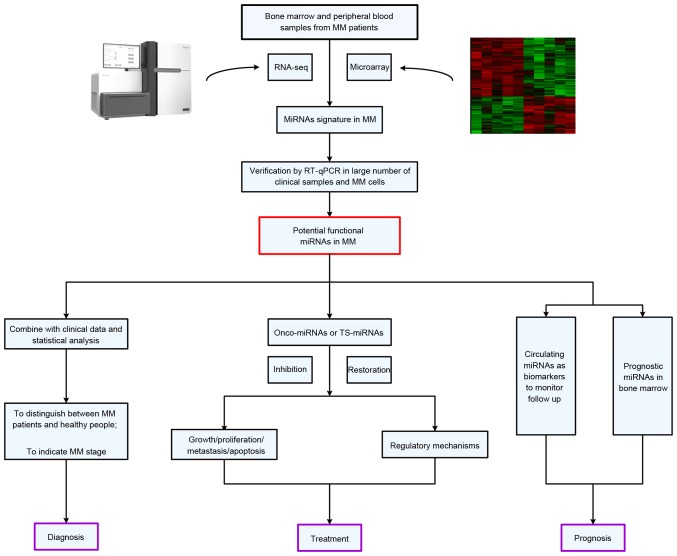
Multiple myeloma (MM), accounting for ~1% of all types of human cancer and 13% of all hematological malignancies, is characterized by the malignant proliferation of monoclonal plasma cells (PCs) in the bone marrow. MM leads to end stage organ impairment, including bone lesions, renal dysfunction, hypercalcemia and anemia. So far, the specific pathogenesis of MM remains unclear and no early-stage sensitive biomarker of MM has been well characterized. Furthermore, treating MM is difficult, as the majority of patients eventually relapse or become refractory following treatment using presently available methods. To date, a number of studies have demonstrated that microRNAs (miRNAs) may serve crucial functions in the progression of numerous cancers, including MM. During the tumorigenesis and pathogenesis of MM, there are multiple carcinogenic events that involve the pernicious transformation from normal to malignant PCs. miRNAs, as oncogenes or tumor suppressors, regulate MM progression-related signaling pathways. In the present review, the up-to-date preliminary basic studies and associated clinical works on the underlying mechanisms of aberrant miRNA profiling in MM have been summarized, including an evaluation of its value as a potential biomarker and a novel therapeutic strategy for MM.
多发性骨髓瘤(MM)占所有人类癌症类型的约1%,占所有血液系统恶性肿瘤的13%,其特征是骨髓中克隆性浆细胞(PCs)的恶性增殖。MM会导致终末期器官损害,包括骨病变、肾功能不全、高钙血症和贫血。到目前为止,MM的具体发病机制仍不清楚,且尚未很好地表征MM的早期敏感生物标志物。此外,治疗MM很困难,因为大多数患者在使用现有方法治疗后最终会复发或变得难治。迄今为止,多项研究表明,微小RNA(miRNAs)可能在包括MM在内的多种癌症进展中发挥关键作用。在MM的肿瘤发生和发病机制过程中,存在多种致癌事件,涉及从正常PCs到恶性PCs的有害转变。miRNAs作为癌基因或肿瘤抑制因子,调节MM进展相关的信号通路。在本综述中,总结了关于MM中异常miRNA谱潜在机制的最新初步基础研究和相关临床工作,包括评估其作为MM潜在生物标志物的价值以及一种新的治疗策略。