Institute for Health and Social Policy, McGill University, Montréal, QC, Canada; Department of Epidemiology, Biostatistics & Occupational Health, McGill University, Montréal, QC, Canada.
Civil and Environmental Engineering, Colorado State University, Fort Collins, CO, USA.
Environ Int. 2018 Aug;117:116-124. doi: 10.1016/j.envint.2018.04.048. Epub 2018 May 5.
Decades of intervention programs that replaced traditional biomass stoves with cleaner-burning technologies have failed to meet the World Health Organization (WHO) interim indoor air quality target of 35-μg m for PM. Many attribute these results to continued use of biomass stoves and poor outdoor air quality, though the relative impacts of these factors have not been empirically quantified.
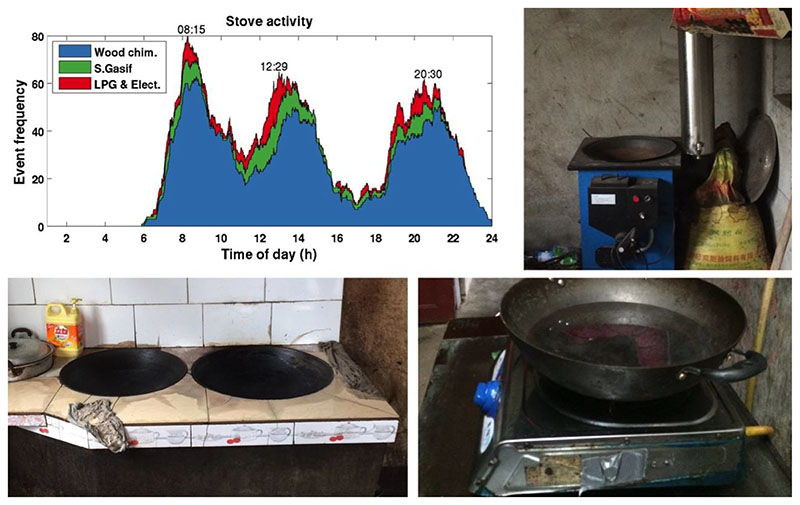
We measured 496 days of real-time stove use concurrently with outdoor and indoor air pollution (PM) in 150 rural households in Sichuan, China. The impacts of stove use patterns and outdoor air quality on indoor PM were quantified. We also estimated the potential avoided cardiovascular mortality in southwestern China associated with transition from traditional to clean fuel stoves using established exposure-response relationships.
Mean daily indoor PM was highest in homes using both wood and clean fuel stoves (122 μg m), followed by exclusive use of wood stoves (106 μg m) and clean fuel stoves (semi-gasifiers: 65 μg m; gas or electric: 55 μg m). Wood stoves emitted proportionally higher indoor PM during ignition, and longer stove use was not associated with higher indoor PM. Only 24% of days with exclusive use of clean fuel stoves met the WHO indoor air quality target, though this fraction rose to 73% after subtracting the outdoor PM contribution. Reduced PM exposure through exclusive use of gas or electric stoves was estimated to prevent 48,000 yearly premature deaths in southwestern China, with greater reductions if local outdoor PM is also reduced.
Clean stove and fuel interventions are not likely to reduce indoor PM to the WHO target unless their use is exclusive and outdoor air pollution is sufficiently low, but may still offer some cardiovascular benefits.
几十年来,用燃烧更清洁的技术替代传统生物质炉灶的干预计划未能达到世界卫生组织(WHO)35-μg/m 的室内空气质量临时目标。许多人将这些结果归因于继续使用生物质炉灶和较差的室外空气质量,尽管这些因素的相对影响尚未通过经验量化。
我们在中国四川省的 150 户农村家庭中同时测量了 496 天的实时炉灶使用情况以及室外和室内空气污染(PM)。量化了炉灶使用模式和室外空气质量对室内 PM 的影响。我们还使用已建立的暴露反应关系估计了中国西南部从传统燃料向清洁燃料炉灶过渡所避免的潜在心血管死亡率。
使用木柴和清洁燃料炉灶的家庭中,每日室内 PM 的平均值最高(122μg/m),其次是仅使用木柴炉灶(106μg/m)和清洁燃料炉灶(半气化炉:65μg/m;燃气或电:55μg/m)。在点火期间,木柴炉灶排放的室内 PM 比例更高,而较长时间使用炉灶与室内 PM 升高无关。仅在 24%的日子里,独家使用清洁燃料炉灶就达到了 WHO 的室内空气质量目标,但在扣除室外 PM 贡献后,这一比例上升到了 73%。通过独家使用燃气或电炉,估计可将每年在中国西南部的过早死亡人数减少 48,000 人,如果当地的室外 PM 也减少,减少的人数会更多。
除非清洁炉灶和燃料的使用是独家的,并且室外空气污染足够低,否则这些干预措施不太可能将室内 PM 降低到 WHO 的目标值,但仍可能带来一些心血管益处。