Hodzic Enisa
Clinic for Heart, Blood Vessel and Rheumatic Diseases. University Clinical Center Sarajevo, Sarajevo, Bosnia and Herzegovina.
Med Arch. 2018 Apr;72(2):94-98. doi: 10.5455/medarh.2018.72.94-98.
Ischemic heart disease (IHD) is clinical manifestation of chronic inflammatory progressive pathological process of atherosclerosis in coronary arteries. IHD is the leading cause of morbidity and mortality in the world. The question is whether it is possible to improve and direct the therapeutic treatment of IHD patients in the treatment of the inflammatory process in the atherosclerotic leasions.
A prospective, comparative, analytica,clinically applicable, open-type study was performed. The study was conducted on 80 subjects with controlled biohumoral markers: troponin, CK, CK MB, BNP; markers of atherogenesis: LDL and homocystein; inflammatory markers: CRP, amyloid, cytokines IL-2, IL-6,TNF-alpha. The experimental group of 38 respondents had in addition to the conventional IHD treatment with: ampicillin (which included organosulfur compounds), cyancobalamin, vitamin B complex (B1, B2 and B6) and folacin. A control group of 42 respondents did not have this additional treatment.
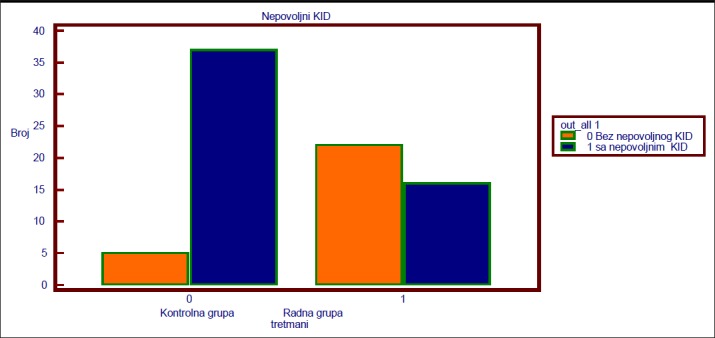
Major adverse cardic events (MACE) such as postinfarctic angina pectoris and repeated infarction, need for surgical interventions of myocardial revascularization, signs of cardiac insufficiency and death were observed during the one-year period. There was no correlation between the IL-2, IL-6 and TNF-alpha, as well as CK, CKMB and troponin and MACE in one-year follow-up. There was a strong positive correlation between MACE and CRP (p = 0,0002) and amyloid (p = 0,0005) as inflamatory markers; a strong positive correlation between MACE and homocysteine as an atherogenic marker (p = 0,0002, and amoderate positive correlation between MACE and BNP (p = 0.0403) as ischemic marker and marker of cardiac insufficiency. The echocardiographically monitored systolic function showed a moderate difference in the groups with average higher values in the experimantal group (p = 0.0282).
The applied treatment exhibited a moderate positive effect on the systolic function of LV and significantly reduced the MACE in the work compared to the control group (p <0.0001), and demonstrated a potential anti-inflammatory effect.
缺血性心脏病(IHD)是冠状动脉粥样硬化慢性炎症性进展病理过程的临床表现。IHD是全球发病和死亡的主要原因。问题在于,在治疗动脉粥样硬化病变中的炎症过程时,是否有可能改善并指导IHD患者的治疗。
进行了一项前瞻性、对比性、分析性、临床适用性开放型研究。该研究针对80名具有生物体液标志物(肌钙蛋白、肌酸激酶、肌酸激酶同工酶、脑钠肽)、动脉粥样硬化形成标志物(低密度脂蛋白和同型半胱氨酸)、炎症标志物(C反应蛋白、淀粉样蛋白、细胞因子白细胞介素-2、白细胞介素-6、肿瘤坏死因子-α)的受试者开展。38名受试对象组成的实验组除接受IHD常规治疗外还使用了氨苄青霉素(含有机硫化合物)、甲钴胺、复合维生素B(维生素B1、B2和B6)和叶酸。42名受试对象组成的对照组未接受这种额外治疗。
在一年期间观察到了主要不良心脏事件(MACE),如心肌梗死后心绞痛和再次梗死、心肌血运重建手术干预需求、心脏功能不全体征和死亡。在一年随访中,白细胞介素-2、白细胞介素-6和肿瘤坏死因子-α以及肌酸激酶、肌酸激酶同工酶和肌钙蛋白与MACE之间无相关性。作为炎症标志物,MACE与C反应蛋白(p = 0.0002)和淀粉样蛋白(p = 0.0005)之间存在强正相关;作为动脉粥样硬化形成标志物,MACE与同型半胱氨酸之间存在强正相关(p = 0.0002),作为缺血标志物和心脏功能不全标志物,MACE与脑钠肽之间存在中度正相关(p = 0.0403)。超声心动图监测的收缩功能显示,两组之间存在中度差异,实验组平均值较高(p = 0.0282)。
与对照组相比,所应用的治疗对左心室收缩功能表现出中度积极作用,并显著降低了工作中的MACE(p <0.0001),并显示出潜在的抗炎作用。