
一项比较平板电脑知情同意书与传统纸质方法用于骨质疏松症研究的实用性随机试验。
A pragmatic randomized trial comparing tablet computer informed consent to traditional paper-based methods for an osteoporosis study.
作者信息
Warriner A H, Foster P J, Mudano A, Wright N C, Melton M E, Sattui S E, Calmbach W, Curtis J R, Kilgore M, Lewis C E, Pace W, Saag K G
机构信息
Division of Endocrinology, Diabetes, and Metabolism, University of Alabama at Birmingham, United States.
Division of Clinical Immunology and Rheumatology, University of Alabama at Birmingham, United States.
出版信息
Contemp Clin Trials Commun. 2016 Feb 17;3:32-38. doi: 10.1016/j.conctc.2016.02.003. eCollection 2016 Aug 15.
OBJECTIVE
Methods to improve informed consent efficiency and effectiveness are needed for pragmatic clinical trials. We compared informed consent using a tablet computer to a paper approach to assess comprehension and satisfaction of patients and clinic staff for a future osteoporosis clinical trial.
METHODS
Nine community-based practices identified and recruited patients to compare the informed consent processes (tablet vs. paper) in a mock osteoporosis clinical trial. The tablet informed consent included an animation summarizing the trial, complete informed consent document, and questions to assess and reinforce comprehension of the study. Participants were women age ≥55 years with ≥1 year of alendronate use. We surveyed participants to assess comprehension and satisfaction and office staff for satisfaction and perceived time demands.
RESULTS
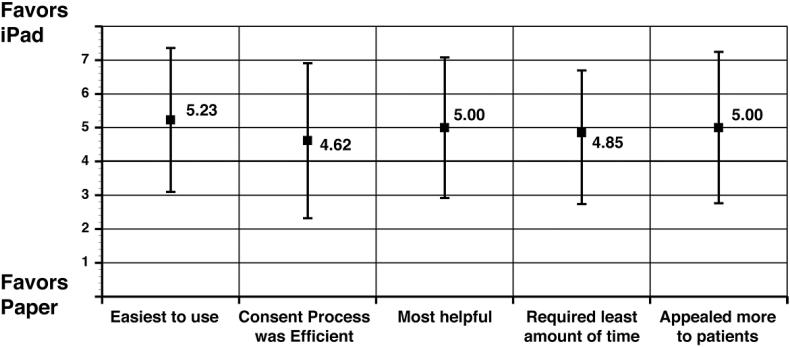
The nine practices enrolled 33 participants. There was not a significant difference in comprehension between the tablet vs. paper informed consent [mean (SD) tablet: 12.2 (1.0) vs. paper: 11.4 (1.7)]. Office staff preferred the tablet to the paper informed consent for identifying potential study participants (two-sided t-test p = 0.02) despite an increased perceived time spent to complete the tablet process [tablet: 28.3 min (SD 16.3) vs. paper: 19.0 min (SD 6.9); p = 0.08].
CONCLUSIONS
Although, there were no significant differences in participant satisfaction and comprehension with the tablet informed consent compared to a paper informed consent, patients and office staff trended towards greater satisfaction with the tablet informed consent. Larger studies are needed to further evaluate the utility of electronic informed consent in pragmatic clinical trials.
目的
务实的临床试验需要提高知情同意效率和效果的方法。我们比较了使用平板电脑进行知情同意与纸质方法,以评估患者和临床工作人员对未来骨质疏松症临床试验的理解和满意度。
方法
九家社区医疗机构识别并招募患者,在模拟骨质疏松症临床试验中比较知情同意过程(平板电脑与纸质)。平板电脑知情同意包括总结试验的动画、完整的知情同意文件以及评估和强化对研究理解的问题。参与者为年龄≥55岁且使用阿仑膦酸钠≥1年的女性。我们对参与者进行调查以评估理解和满意度,并对办公室工作人员进行满意度和感知时间需求调查。
结果
九家医疗机构招募了33名参与者。平板电脑与纸质知情同意在理解方面无显著差异[平均值(标准差)平板电脑:12.2(1.0)对纸质:11.4(1.7)]。办公室工作人员在识别潜在研究参与者方面更喜欢平板电脑知情同意而非纸质知情同意(双侧t检验p = 0.02),尽管完成平板电脑流程的感知时间增加了[平板电脑:28.3分钟(标准差16.3)对纸质:19.0分钟(标准差6.9);p = 0.08]。
结论
尽管与纸质知情同意相比,平板电脑知情同意在参与者满意度和理解方面无显著差异,但患者和办公室工作人员对平板电脑知情同意的满意度呈上升趋势。需要更大规模的研究来进一步评估电子知情同意在务实临床试验中的效用。


 Zotero 插件