Abujarad Fuad, Peduzzi Peter, Mun Sophia, Carlson Kristina, Edwards Chelsea, Dziura James, Brandt Cynthia, Alfano Sandra, Chupp Geoffrey
Department of Emergency Medicine, School of Medicine, Yale University, New Haven, CT, United States.
Department of Biostatistics, School of Public Health, Yale University, New Haven, CT, United States.
JMIR Form Res. 2021 Oct 19;5(10):e20458. doi: 10.2196/20458.
The traditional informed consent (IC) process rarely emphasizes research participants' comprehension of medical information, leaving them vulnerable to unknown risks and consequences associated with procedures or studies.
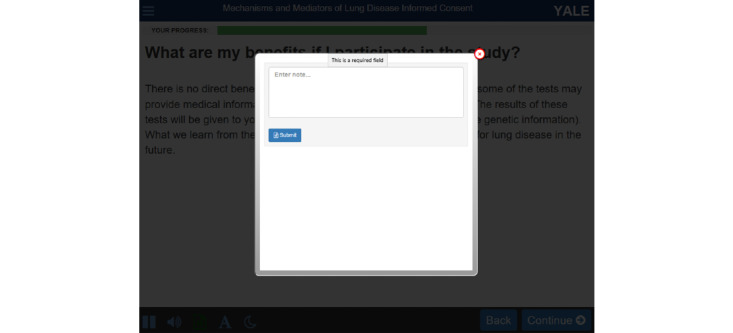
This paper explores how we evaluated the feasibility of a digital health tool called Virtual Multimedia Interactive Informed Consent (VIC) for advancing the IC process and compared the results with traditional paper-based methods of IC.
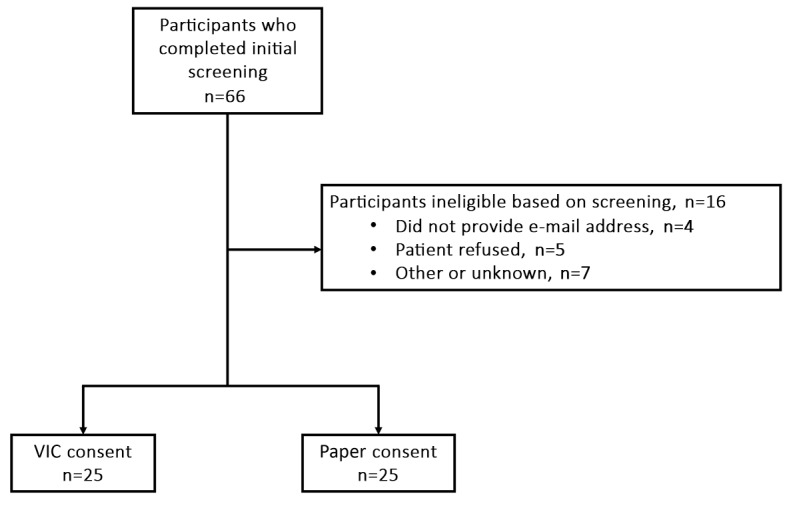
Using digital health and web-based coaching, we developed the VIC tool that uses multimedia and other digital features to improve the current IC process. The tool was developed on the basis of the user-centered design process and Mayer's cognitive theory of multimedia learning. This study is a randomized controlled trial that compares the feasibility of VIC with standard paper consent to understand the impact of interactive digital consent. Participants were recruited from the Winchester Chest Clinic at Yale New Haven Hospital in New Haven, Connecticut, and healthy individuals were recruited from the community using fliers. In this coordinator-assisted trial, participants were randomized to complete the IC process using VIC on the iPad or with traditional paper consent. The study was conducted at the Winchester Chest Clinic, and the outcomes were self-assessed through coordinator-administered questionnaires.
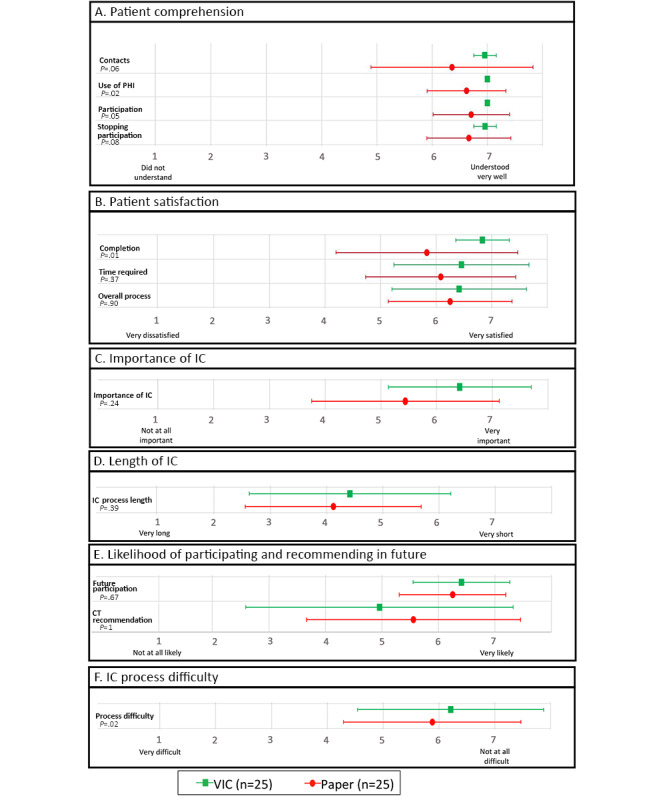
A total of 50 participants were recruited in the study (VIC, n=25; paper, n=25). The participants in both groups had high comprehension. VIC participants reported higher satisfaction, higher perceived ease of use, higher ability to complete the consent independently, and shorter perceived time to complete the consent process.
The use of dynamic, interactive audiovisual elements in VIC may improve participants' satisfaction and facilitate the IC process. We believe that using VIC in an ongoing, real-world study rather than a hypothetical study improved the reliability of our findings, which demonstrates VIC's potential to improve research participants' comprehension and the overall process of IC.
ClinicalTrials.gov NCT02537886; https://clinicaltrials.gov/ct2/show/NCT02537886.
传统的知情同意(IC)流程很少强调研究参与者对医学信息的理解,使他们容易受到与程序或研究相关的未知风险和后果的影响。
本文探讨了我们如何评估一种名为虚拟多媒体交互式知情同意(VIC)的数字健康工具推进IC流程的可行性,并将结果与传统的纸质IC方法进行比较。
利用数字健康和基于网络的指导,我们开发了VIC工具,该工具使用多媒体和其他数字功能来改进当前的IC流程。该工具是基于以用户为中心的设计流程和 Mayer 的多媒体学习认知理论开发的。本研究是一项随机对照试验,比较VIC与标准纸质同意书的可行性,以了解交互式数字同意的影响。参与者从康涅狄格州纽黑文市耶鲁纽黑文医院温彻斯特胸部诊所招募,健康个体通过传单从社区招募。在这项由协调员协助的试验中,参与者被随机分配使用iPad上的VIC或传统纸质同意书完成IC流程。研究在温彻斯特胸部诊所进行,结果通过协调员管理的问卷进行自我评估。
本研究共招募了50名参与者(VIC组,n = 25;纸质组,n = 25)。两组参与者的理解程度都很高。VIC组参与者报告了更高的满意度、更高的易用性感知、更高的独立完成同意书的能力以及更短的完成同意流程的感知时间。
VIC中使用动态、交互式视听元素可能会提高参与者满意度并促进IC流程。我们认为,在正在进行的真实世界研究而非假设性研究中使用VIC提高了我们研究结果的可靠性,这证明了VIC在提高研究参与者理解和IC整体流程方面的潜力。
ClinicalTrials.gov NCT02537886;https://clinicaltrials.gov/ct2/show/NCT02537886