Pilutti Lara A, Motl Robert W, Edwards Thomas A, Wilund Kenneth R
Department of Kinesiology and Community Health, University of Illinois at Urbana-Champaign, 906 S. Goodwin Ave., Urbana, IL 61801, USA.
Contemp Clin Trials Commun. 2016 May 15;3:147-152. doi: 10.1016/j.conctc.2016.05.005. eCollection 2016 Aug 15.
This randomized controlled trial (RCT) will examine the efficacy of supervised functional electrical stimulation (FES) cycling on walking performance and physiological function among persons with multiple sclerosis (MS) with severe mobility disability.
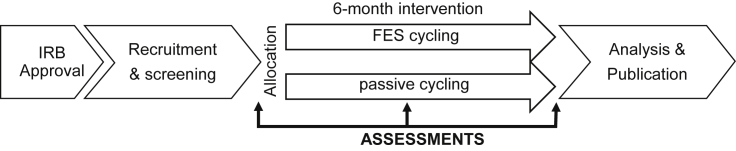
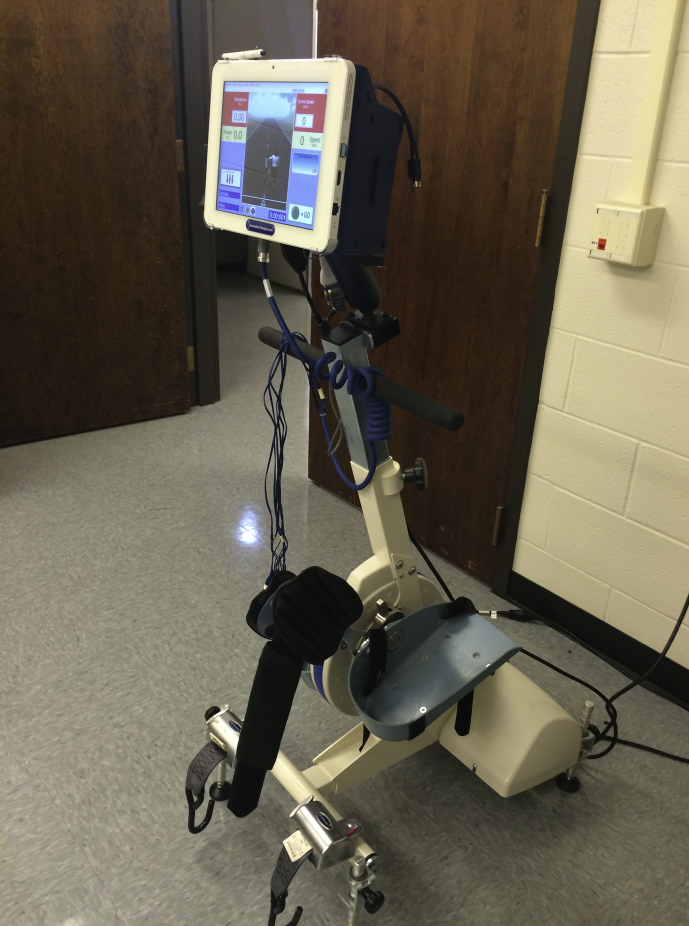
METHODS/DESIGN: This RCT will recruit 16 persons with MS that require unilateral or bilateral assistance for ambulation (i.e., Expanded Disability Status Scale (EDSS) score = 6.0-6.5). Participants will be randomized to one of two conditions: supervised FES cycling or passive cycling. The FES cycling condition will involve mild electrical stimulation that will generate an activation pattern that results in cycling the leg ergometer. The passive cycling condition will not provide any electrical stimulation, rather the movement of the pedals will be controlled by the electrical motor. Both conditions will be delivered 3 days/week for the same duration, over 6 months. Primary outcomes will include walking performance assessed as walking speed, endurance, and agility. Secondary outcomes will include physiological function assessed as cardiorespiratory fitness, muscular strength, and balance. Assessments will take place at baseline, mid-point (3-months), and immediately following the intervention (6-months).
This study will lay the foundation for the design of a future RCT by: (1) providing effect sizes that can be included in a power analysis for optimal sample size estimation; and (2) identifying cardiorespiratory fitness, muscular strength, and balance (i.e., physiological function) as mechanisms for the beneficial effects of FES cycling on walking performance. This trial will provide important information on a novel exercise rehabilitation therapy for managing walking impairment in persons with severe MS.
这项随机对照试验(RCT)将研究在有严重行动障碍的多发性硬化症(MS)患者中,监督下的功能性电刺激(FES)骑行对步行能力和生理功能的疗效。
方法/设计:本RCT将招募16名需要单侧或双侧辅助行走的MS患者(即扩展残疾状态量表(EDSS)评分 = 6.0 - 6.5)。参与者将被随机分配到两种情况之一:监督下的FES骑行或被动骑行。FES骑行组将进行轻度电刺激,产生一种激活模式,从而带动腿部测力计进行骑行。被动骑行组不提供任何电刺激,而是由电动马达控制踏板的运动。两种情况均每周进行3天,持续相同时间,为期6个月。主要结局将包括以步行速度、耐力和敏捷性评估的步行能力。次要结局将包括以心肺适能、肌肉力量和平衡评估的生理功能。评估将在基线、中期(3个月)和干预结束后立即(6个月)进行。
本研究将通过以下方式为未来RCT的设计奠定基础:(1)提供可纳入功效分析以进行最佳样本量估计的效应量;(2)确定心肺适能、肌肉力量和平衡(即生理功能)是FES骑行对步行能力产生有益影响的机制。该试验将为一种新型运动康复疗法提供重要信息,用于管理重度MS患者的步行障碍。