Center for Stem Cell and Regenerative Medicine, Tokyo Medical and Dental University, 1-5-45 Yushima, Bunkyo-ku, Tokyo 113-8510, Japan.
Department of Cartilage Regeneration, Tokyo Medical and Dental University, Tokyo, Japan.
J Orthop Res. 2019 Jun;37(6):1350-1357. doi: 10.1002/jor.24042. Epub 2018 Jun 13.
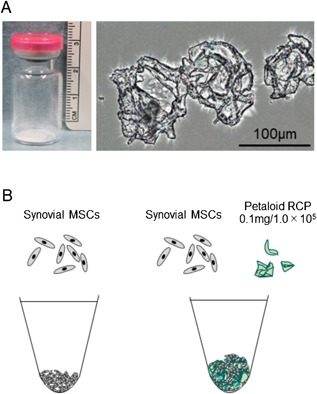
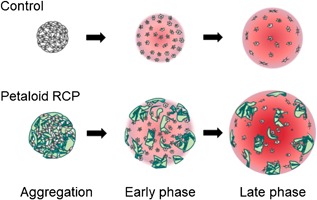
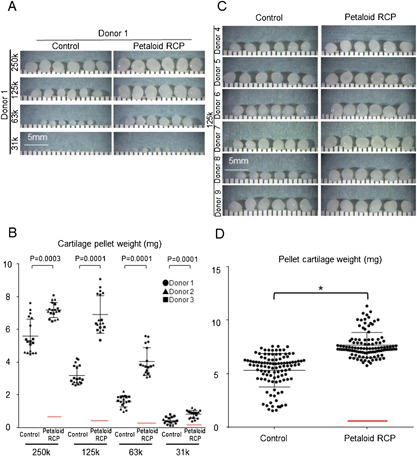
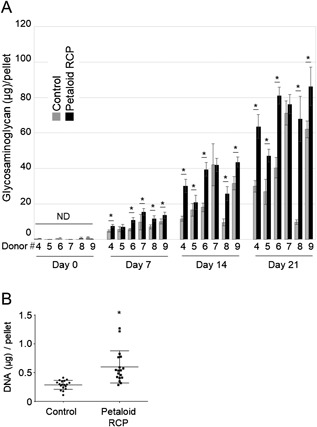
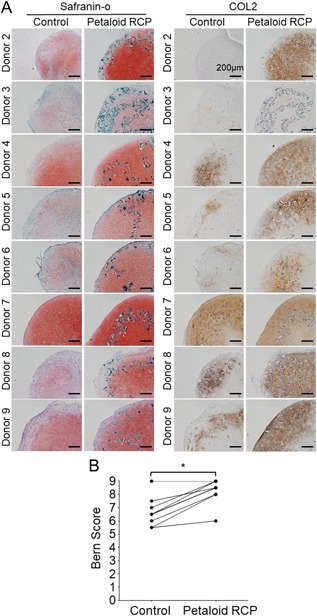
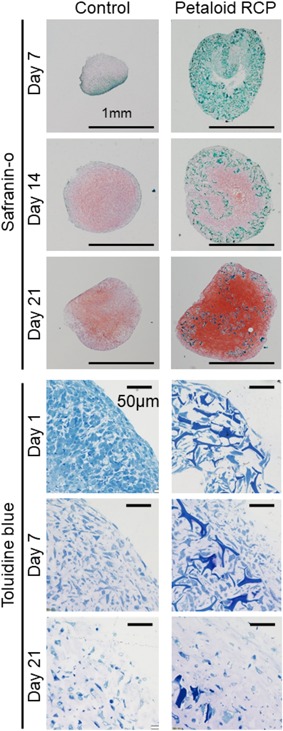
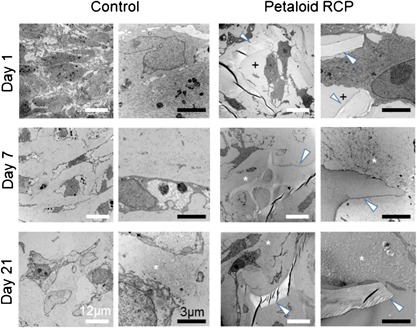
In vitro chondrogenesis of mesenchymal stem cells (MSCs) mimics in vivo chondrogenesis of MSCs. However, the size of the cartilage pellets that can be attained in vitro is limited by current methods; therefore, some modifications are required to obtain larger pellets. Petaloid pieces of recombinant peptide (petaloid RCP) have the advantage of creating spaces between cells in culture. The RCP used here is based on the alpha-1 sequence of human collagen type I and contains 12 Arg-Gly-Asp motifs. We examined the effect and mechanisms of adding petaloid RCP on the in vitro chondrogenesis of human synovial MSCs by culturing 125k cells with or without 0.125 mg petaloid RCP in chondrogenic medium for 21 days. The cartilage pellets were sequentially analyzed by weight, sulfated glycosaminoglycan content, DNA retention, and histology. Petaloid RCP significantly increased the weight of the cartilage pellets: The petaloid RCP group weighed 7.7 ± 1.2 mg (n = 108), whereas the control group weighed 5.3 ± 1.6 mg. Sulfated glycosaminoglycan and DNA contents were significantly higher in the petaloid RCP group than in the control group. Light and transmission electron microscopy images showed that the petaloid RCP formed the framework of the pellet at day 1, the framework was broken by production of cartilage matrix by the synovial MSCs at day 7, and the cartilage pellet grew larger, with diffuse petaloid RCP remaining, at day 21. Therefore, petaloid RCP formed a framework for the pellet, maintained a higher cell number, and promoted in vitro cartilage formation of synovial MSCs. © 2018 The Authors. Journal of Orthopaedic Research® Published by Wiley Periodicals, Inc. J Orthop Res 37:1350-1357, 2019.
体外间充质干细胞(MSCs)软骨生成模拟体内 MSC 的软骨生成。然而,目前的方法所获得的软骨小球的大小是有限的;因此,需要进行一些修改以获得更大的小球。花瓣状重组肽(花瓣状 RCP)的优点是可以在培养物中的细胞之间产生空间。这里使用的 RCP 基于人胶原蛋白 I 的α-1 序列,包含 12 个 Arg-Gly-Asp 基序。我们通过在软骨形成培养基中培养 125k 个细胞,有无 0.125mg 花瓣状 RCP,研究添加花瓣状 RCP 对人滑膜 MSCs 体外软骨生成的影响和机制,培养 21 天。通过重量、硫酸软骨素糖胺聚糖含量、DNA 保留和组织学顺序分析软骨小球。花瓣状 RCP 显著增加了软骨小球的重量:花瓣状 RCP 组重 7.7±1.2mg(n=108),而对照组重 5.3±1.6mg。花瓣状 RCP 组的硫酸软骨素糖胺聚糖和 DNA 含量明显高于对照组。光镜和透射电镜图像显示,花瓣状 RCP 在第 1 天形成了小球的框架,在第 7 天滑膜 MSCs 产生软骨基质后,框架被破坏,软骨小球变大,仍有弥漫的花瓣状 RCP 残留,在第 21 天。因此,花瓣状 RCP 为小球形成了一个框架,保持了较高的细胞数量,并促进了滑膜 MSCs 的体外软骨形成。