Arthritis National Pain Centre, School of Life Sciences, University of Nottingham, Nottingham, NG7 2UH, United Kingdom.
Sci Rep. 2018 May 8;8(1):7122. doi: 10.1038/s41598-018-25581-8.
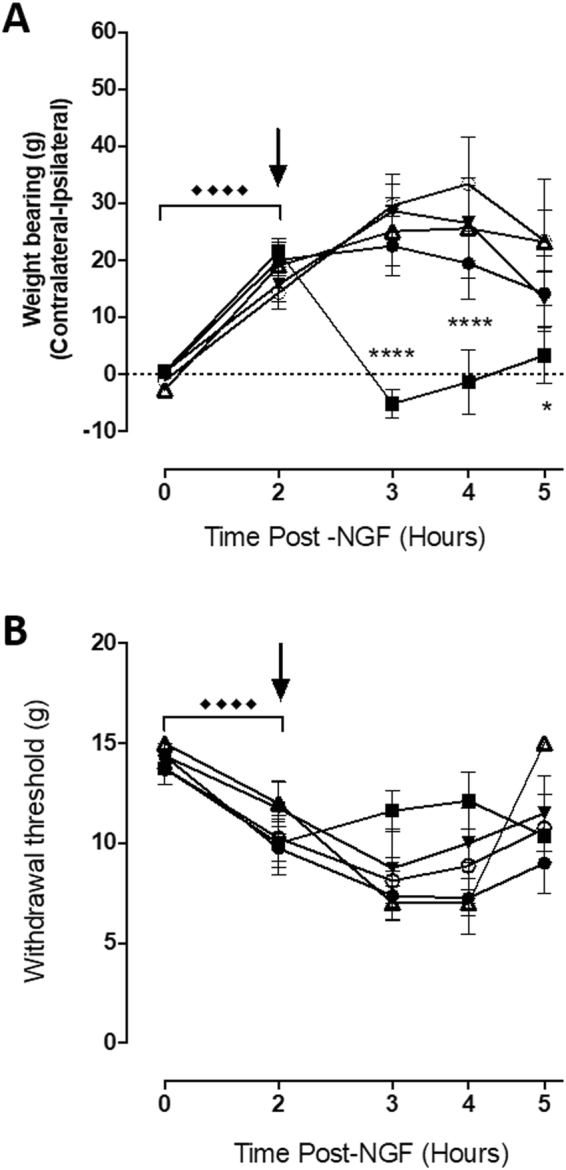
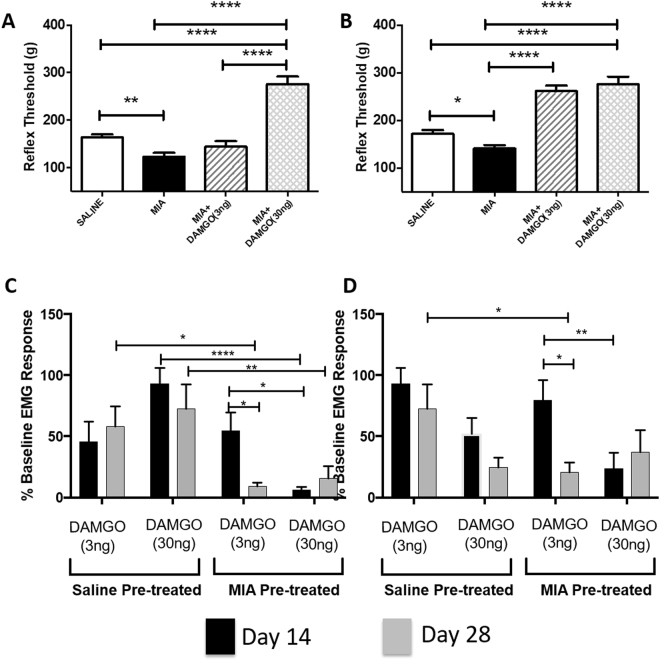
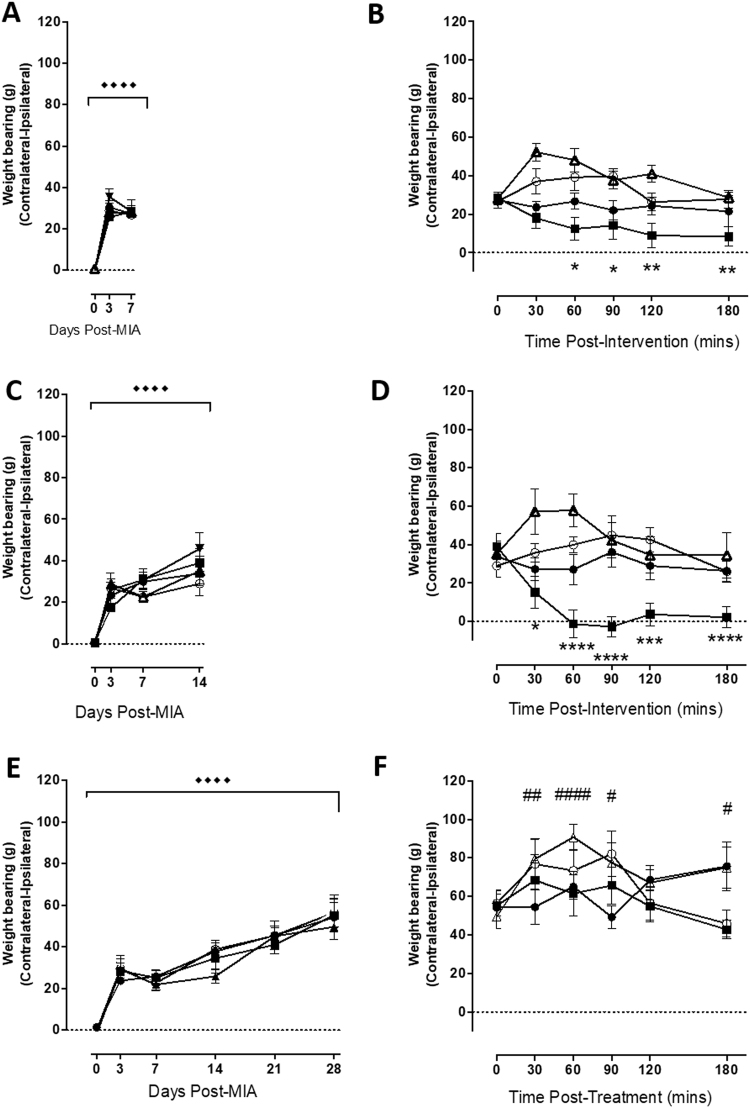
The mechanisms underlying the transition from acute nociceptive pain to centrally maintained chronic pain are not clear. We have studied the contributions of the peripheral and central nervous systems during the development of osteoarthritis (OA) pain. Male Sprague-Dawley rats received unilateral intra-articular injections of monosodium iodoacetate (MIA 1 mg) or saline, and weight-bearing (WB) asymmetry and distal allodynia measured. Subgroups of rats received intra-articular injections of, QX-314 (membrane impermeable local anaesthetic) + capsaicin, QX-314, capsaicin or vehicle on days 7, 14 or 28 post-MIA and WB and PWT remeasured. On days 7&14 post-MIA, but not day 28, QX-314 + capsaicin signficantly attenuated changes in WB induced by MIA, illustrating a crucial role for TRPV1 expressing nociceptors in early OA pain. The role of top-down control of spinal excitability was investigated. The mu-opioid receptor agonist DAMGO was microinjected into the rostroventral medulla, to activate endogenous pain modulatory systems, in MIA and control rats and reflex excitability measured using electromyography. DAMGO (3 ng) had a significantly larger inhibitory effect in MIA treated rats than in controls. These data show distinct temporal contribtuions of TRPV1 expressing nociceptors and opioidergic pain control systems at later timepoints.
导致急性痛觉性疼痛向中枢维持性慢性疼痛转变的机制尚不清楚。我们研究了在骨关节炎(OA)疼痛发展过程中,外周和中枢神经系统的作用。雄性 Sprague-Dawley 大鼠接受单侧关节内注射单碘乙酸盐(MIA 1mg)或盐水,并测量体重(WB)不对称和远端触诱发痛。在 MIA 后第 7、14 或 28 天,部分大鼠接受关节内注射 QX-314(不可渗透膜的局部麻醉剂)+辣椒素、QX-314、辣椒素或载体,并重新测量 WB 和 PWT。在 MIA 后第 7 和 14 天,但不在第 28 天,QX-314+辣椒素显著减弱了 MIA 引起的 WB 变化,表明 TRPV1 表达的伤害感受器在早期 OA 疼痛中起关键作用。还研究了脊髓兴奋性的下行控制作用。在 MIA 和对照大鼠中,将 μ-阿片受体激动剂 DAMGO 注入延髓腹侧前部,激活内源性疼痛调节系统,并用电肌图测量反射兴奋性。DAMGO(3ng)在 MIA 处理的大鼠中比在对照组中具有更大的抑制作用。这些数据表明在稍后时间点,TRPV1 表达的伤害感受器和阿片能性疼痛控制系统具有明显的时间贡献。