Department of Anesthesiology, the First Affiliated Hospital of Chongqing Medical University, Friendship Road 1#, Yuan Jia Gang, Chongqing, 400016, China.
Department of Anesthesiology, the People's Hospital of Jianyang City, Chengdu, Sichuan, China.
BMC Geriatr. 2018 May 9;18(1):110. doi: 10.1186/s12877-018-0796-1.
Peripheral neuromuscular dysfunctions were found in elderly individuals, and spinal microglia/monocyte plays an important role on this process. This study aims to test whether the glial cell line-derived neurotrophic factor (GDNF) could attenuate age-related neuromuscular dysfunction by inhibiting the activation of spinal microglia/monocyte.
Male Sprague-Dawley rats were divided into an adult group and an aged group. The aged rats were intrathecally injected with normal saline (NS) and GDNF. All the rats were harvested 5 days after each injection. The muscular function was tested by compound muscle action potential, and the activation of microglia/monocyte was detected by immunofluorescence staining; cytokines were assayed by enzyme-linked immunosorbent assay; the expression level of GDNF and its known receptor GFR-α in the spinal cord, the expression level of neuregulin-1 (NRG-1) in the sciatic nerve, and the expression level of γ- and α7- ε-nicotinic acetylcholine receptors in the tibialis anterior muscle were measured by western blotting.
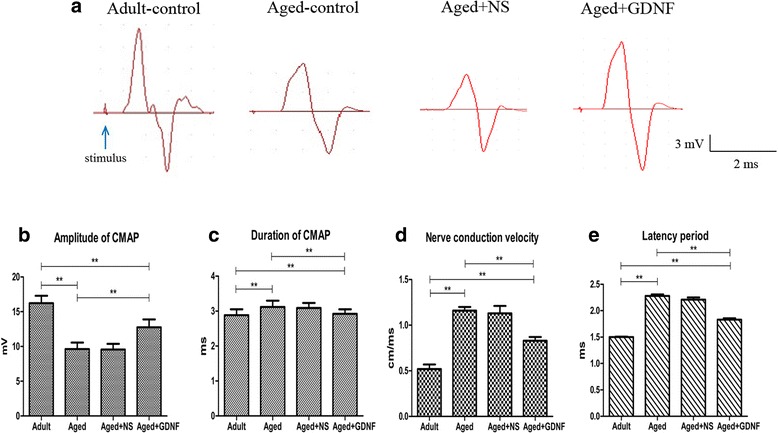
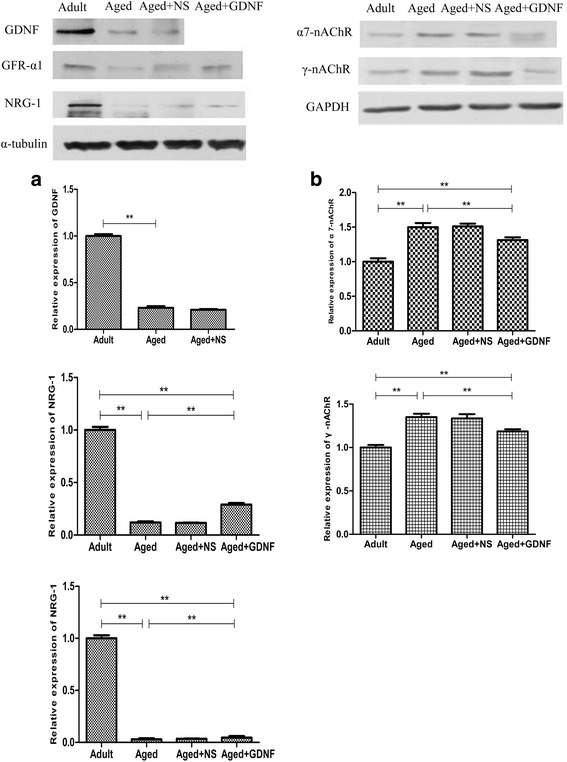
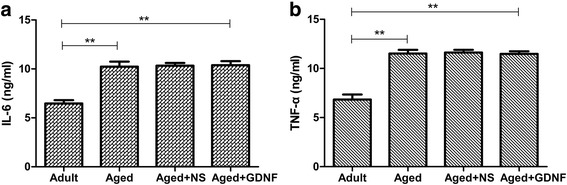
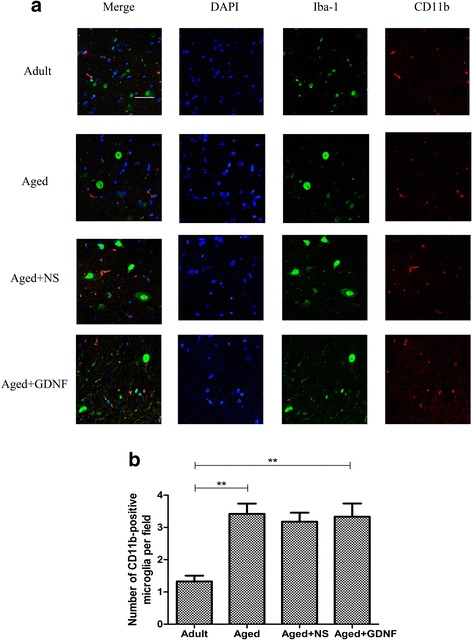
The activated microglia/monocyte was found in the aged rats compared to the adult rats. The aged rats showed a significant neuromuscular dysfunction and cytokine release as well as increased expression of γ- and α7-nAChR. The protein expression of GDNF, GFR-α, and NRG-1 in the aged rats were significantly lower than that in the adult rats. However, the exogenous injection of GDNF could alleviate the neuromuscular dysfunction but not inhibit the activation of spinal microglia/monocyte. Furthermore, the levels of GFR-α and NRG-1 also increased after GDNF treatment.
The GDNF could attenuate the age-related peripheral neuromuscular dysfunction without inhibiting the activation of microglia/monocyte in the spinal cord.
外周神经肌肉功能障碍在老年人中被发现,而脊髓小胶质细胞/单核细胞在这个过程中起着重要作用。本研究旨在通过抑制脊髓小胶质细胞/单核细胞的激活,测试胶质细胞源性神经营养因子(GDNF)是否可以减轻与年龄相关的神经肌肉功能障碍。
雄性 Sprague-Dawley 大鼠分为成年组和老年组。老年大鼠鞘内注射生理盐水(NS)和 GDNF。每次注射后 5 天收获所有大鼠。通过复合肌肉动作电位测试肌肉功能,通过免疫荧光染色检测小胶质细胞/单核细胞的激活;通过酶联免疫吸附试验测定细胞因子;通过 Western blot 测定脊髓中 GDNF 及其已知受体 GFR-α的表达水平、坐骨神经中神经调节蛋白 1(NRG-1)的表达水平、以及前胫骨肌中γ-和α7-烟碱型乙酰胆碱受体的表达水平。
与成年大鼠相比,老年大鼠脊髓中发现了激活的小胶质细胞/单核细胞。老年大鼠表现出明显的神经肌肉功能障碍和细胞因子释放,以及γ-和α7-nAChR 表达增加。老年大鼠脊髓中 GDNF、GFR-α 和 NRG-1 的蛋白表达明显低于成年大鼠。然而,外源性 GDNF 注射可以缓解神经肌肉功能障碍,但不能抑制脊髓中小胶质细胞/单核细胞的激活。此外,GDNF 治疗后 GFR-α 和 NRG-1 的水平也增加。
GDNF 可以减轻与年龄相关的周围神经肌肉功能障碍,而不抑制脊髓中小胶质细胞/单核细胞的激活。