Zhou Hang, Wang Bin, Sun Hao, Xu Xingshun, Wang Yongxiang
Department of Neurology, The Second Affiliated Hospital of Soochow University, Suzhou, China.
Institute of Neuroscience, Soochow University, Suzhou, China.
Stem Cells Int. 2018 Mar 18;2018:6087143. doi: 10.1155/2018/6087143. eCollection 2018.
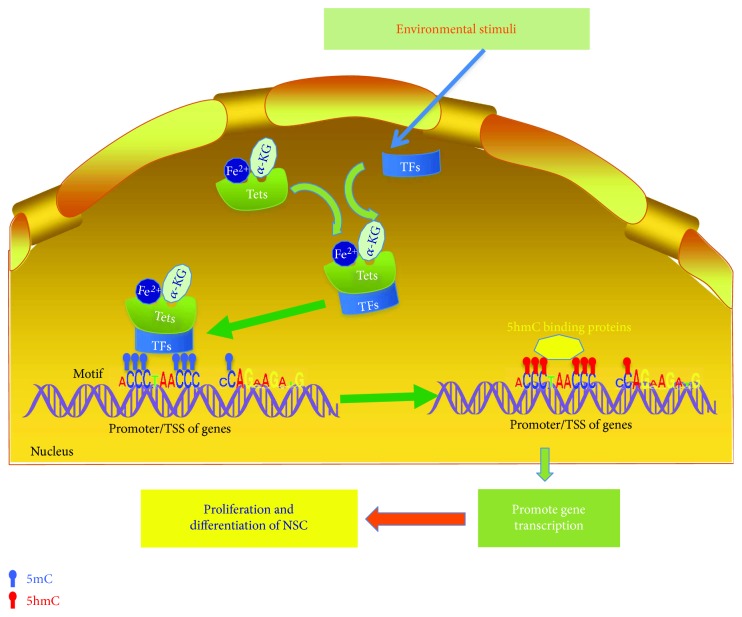
Among the regulatory mechanisms of the renewal and differentiation of neural stem cells, recent evidences support that epigenetic modifications such as DNA methylation, histone modification, and noncoding RNAs play critical roles in the regulation on the proliferation and differentiation of neural stem cells. In this review, we discussed recent advances of DNA modifications on the regulative mechanisms of neural stem cells. Among these epigenetic modifications, DNA 5-hydroxymethylcytosine (5hmC) modification is emerging as an important modulator on the proliferation and differentiation of neural stem cells. At the same time, Ten-eleven translocation (Tet) methylcytosine dioxygenases, the rate-limiting enzyme for the 5-hydroxymethylation reaction from 5-methylcytosine to 5-hydroxymethylcytosine, play a critical role in the tumorigenesis and the proliferation and differentiation of stem cells. The functions of 5hmC and TET proteins on neural stem cells and their roles in neurological diseases are discussed.
在神经干细胞更新和分化的调控机制中,最近的证据支持DNA甲基化、组蛋白修饰和非编码RNA等表观遗传修饰在神经干细胞增殖和分化的调控中发挥关键作用。在本综述中,我们讨论了DNA修饰在神经干细胞调控机制方面的最新进展。在这些表观遗传修饰中,DNA 5-羟甲基胞嘧啶(5hmC)修饰正成为神经干细胞增殖和分化的重要调节因子。同时,10-11易位(Tet)甲基胞嘧啶双加氧酶作为从5-甲基胞嘧啶到5-羟甲基胞嘧啶的5-羟甲基化反应的限速酶,在肿瘤发生以及干细胞的增殖和分化中起关键作用。本文讨论了5hmC和TET蛋白在神经干细胞上的功能及其在神经疾病中的作用。