Department of Obstetrics and Gynecology, Division of Global Women's Health, University of North Carolina at Chapel Hill, Chapel Hill, NC, United States of America.
Department of Obstetrics and Gynecology, Women and Newborn Hospital, Lusaka Zambia, Lusaka, Zambia.
PLoS One. 2018 May 10;13(5):e0196985. doi: 10.1371/journal.pone.0196985. eCollection 2018.
Long delays to diagnosis is a major cause of late presentation of breast diseases in sub-Saharan Africa.
We designed and implemented a single-visit breast care algorithm that overcomes health system-related barriers to timely diagnosis of breast diseases.
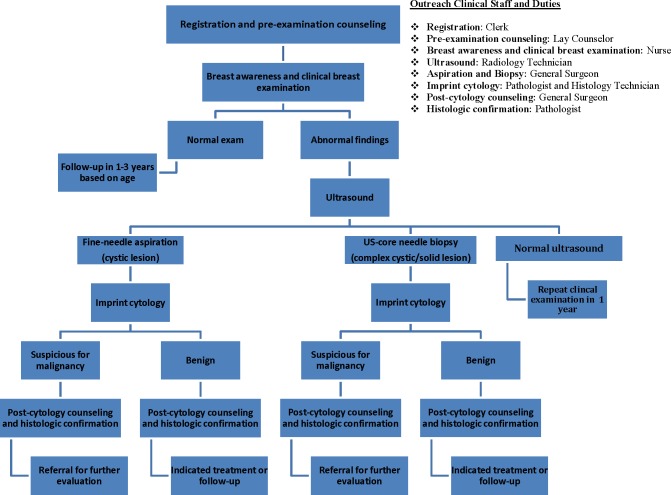
A multidisciplinary team of Zambian healthcare experts trained a team of mid- and high-level Zambian healthcare practitioners how to evaluate women for breast diseases, and train trainers to do likewise. Working collaboratively, the two teams then designed a clinical platform that provides multiple breast care services within a single visit. The service platform was implemented using a breast outreach camp format, during which breast self-awareness, psychosocial counseling, clinical breast examination, breast ultrasound, ultrasound-guided biopsy, imprint cytology of biopsy specimens and surgical treatment or referral, were offered within a single visit.
Eleven hundred and twenty-nine (1129) women attended the camps for breast care. Mean age was 35.9 years. The majority were multiparous (79.4%), breast-fed (76.0%), and reported hormone use (50.4%). Abnormalities were detected on clinical breast examination in 122 (10.8%) women, 114 of whom required ultrasound. Of the 114 who underwent ultrasound, 48 had identifiable lesions and were evaluated with ultrasound-guided core needle biopsy (39) or fine-needle aspiration (9). The concordance between imprint cytology and histopathology was 100%, when breast specimens were classified as either benign or malignant. However, when specimens were classified by histopathologic subtype, the concordance between imprint cytology and histology was 85.7% for benign and 100% for malignant lesions. Six (6) women were diagnosed with invasive cancer. Eighteen (18) women with symptomatic breast lesions had next-day surgery.
Similar to its impact on cervical cancer prevention services, a single visit breast care algorithm has the potential to overcome health system-related barriers to timely diagnosis of breast diseases, including cancer, in rural African settings.
在撒哈拉以南非洲地区,导致乳腺疾病晚期就诊的主要原因是诊断时间过长。
我们设计并实施了一种单次就诊乳腺护理算法,以克服与卫生系统相关的障碍,实现乳腺疾病的及时诊断。
由赞比亚医疗保健专家组成的多学科团队培训了一组中高级赞比亚医疗保健从业者,如何评估女性的乳腺疾病,并培训培训师进行同样的培训。两个团队合作设计了一个临床平台,该平台可在单次就诊时提供多种乳腺护理服务。该服务平台采用乳腺外展营的形式实施,在此期间,提供了乳腺癌自我意识、社会心理咨询、临床乳腺检查、乳腺超声、超声引导活检、活检标本印片细胞学以及手术治疗或转诊。
1129 名女性参加了乳腺保健营地。平均年龄为 35.9 岁。大多数为多产妇(79.4%)、母乳喂养(76.0%),并报告使用激素(50.4%)。在 122 名(10.8%)女性的临床乳腺检查中发现异常,其中 114 名需要进行超声检查。在 114 名接受超声检查的患者中,48 名有可识别的病变,并进行了超声引导下的核心针活检(39 例)或细针抽吸活检(9 例)。当乳腺标本被归类为良性或恶性时,印片细胞学与组织病理学的一致性为 100%。然而,当标本按组织病理学亚型分类时,印片细胞学与组织学的一致性为良性病变 85.7%,恶性病变 100%。6 名(6%)女性被诊断为浸润性癌。18 名有症状的乳腺病变女性次日进行了手术。
与对宫颈癌预防服务的影响类似,单次就诊乳腺护理算法有可能克服与卫生系统相关的障碍,及时诊断农村非洲地区的乳腺疾病,包括癌症。