The Roslin Institute and R(D)SVS, The University of Edinburgh, Edinburgh, UK.
Genus-PIC, Ratsteich 31, 24837, Schleswig, Germany.
Genet Sel Evol. 2018 May 10;50(1):24. doi: 10.1186/s12711-018-0392-z.
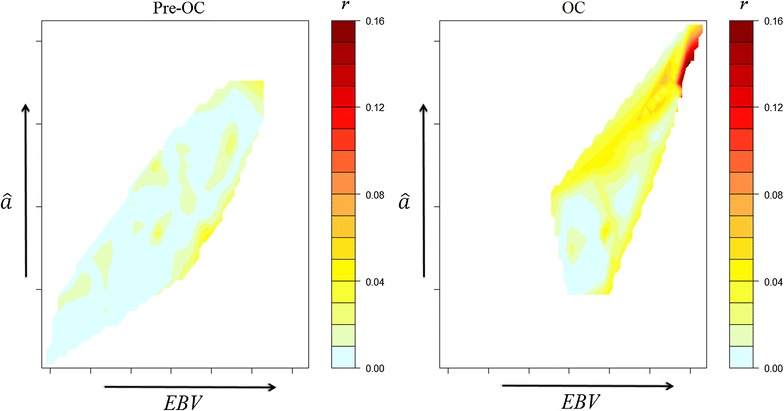
Optimal contributions selection (OCS) provides animal breeders with a framework for maximising genetic gain for a predefined rate of inbreeding. Simulation studies have indicated that the source of the selective advantage of OCS is derived from breeding decisions being more closely aligned with estimates of Mendelian sampling terms ([Formula: see text]) of selection candidates, rather than estimated breeding values (EBV). This study represents the first attempt to assess the source of the selective advantage provided by OCS using a commercial pig population and by testing three hypotheses: (1) OCS places more emphasis on [Formula: see text] compared to EBV for determining which animals were selected as parents, (2) OCS places more emphasis on [Formula: see text] compared to EBV for determining which of those parents were selected to make a long-term genetic contribution (r), and (3) OCS places more emphasis on [Formula: see text] compared to EBV for determining the magnitude of r. The population studied also provided an opportunity to investigate the convergence of r over time.
Selection intensity limited the number of males available for analysis, but females provided some evidence that the selective advantage derived from applying an OCS algorithm resulted from greater weighting being placed on [Formula: see text] during the process of decision-making. Male r were found to converge initially at a faster rate than female r, with approximately 90% convergence achieved within seven generations across both sexes.
This study of commercial data provides some support to results from theoretical and simulation studies that the source of selective advantage from OCS comes from [Formula: see text]. The implication that genomic selection (GS) improves estimation of [Formula: see text] should allow for even greater genetic gains for a predefined rate of inbreeding, once the synergistic benefits of combining OCS and GS are realised.
最优贡献选择(OCS)为动物育种者提供了一个框架,可在预设的近交率下最大化遗传增益。模拟研究表明,OCS 的选择优势源自于育种决策与选择候选者的孟德尔抽样项 ([Formula: see text]) 的估计更为吻合,而不是估计的育种值(EBV)。本研究首次尝试使用商业猪群评估 OCS 提供的选择优势的来源,并通过检验三个假设来实现:(1)OCS 在确定哪些动物被选为亲本时,相对于 EBV,更强调 [Formula: see text];(2)OCS 在确定那些父母中哪些被选中做出长期遗传贡献 (r) 时,相对于 EBV,更强调 [Formula: see text];(3)OCS 在确定 r 的大小时,相对于 EBV,更强调 [Formula: see text]。所研究的群体还提供了一个机会来研究 r 随时间的收敛性。
选择强度限制了可供分析的雄性数量,但雌性提供了一些证据表明,应用 OCS 算法的选择优势源于在决策过程中对 [Formula: see text] 的更大重视。雄性 r 最初的收敛速度比雌性 r 快,大约在七代内,两性的 r 都达到了 90%的收敛。
本研究对商业数据的研究为理论和模拟研究的结果提供了一些支持,即 OCS 的选择优势源自 [Formula: see text]。基因组选择 (GS) 提高 [Formula: see text] 估计的含义应该允许在预设的近交率下实现更大的遗传增益,一旦实现了 OCS 和 GS 结合的协同效益。