Tucci Marco, Mannavola Francesco, Passarelli Anna, Stucci Luigia Stefania, Cives Mauro, Silvestris Franco
Department of Biomedical Sciences and Human Oncology, University of Bari Aldo Moro, Bari, Italy.
Oncotarget. 2018 Apr 17;9(29):20826-20837. doi: 10.18632/oncotarget.24846.
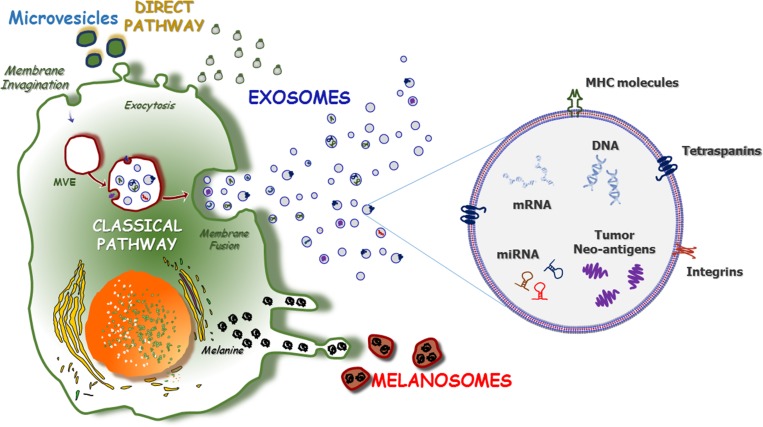
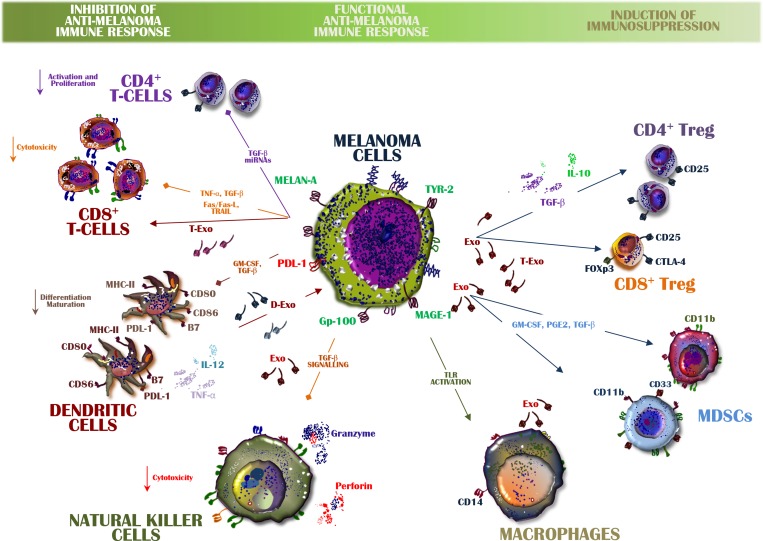
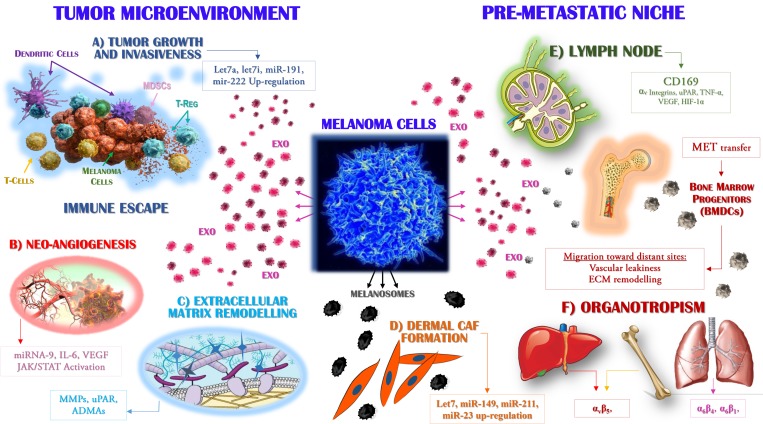
Exosomes (Exo) are small vesicles produced by melanoma cells and the accessory cells of the tumor microenvironment. They emerge via both classical and direct pathways and actively participate in tumor colonisation of distant tissues. The proteins, nucleic acids, cytokines and growth factors engulfed by Exo are transferred to recipient cells, where they drive numerous functions required for the tumor escape from immune system control and tumor progression. By positively or negatively modulating immune cell properties, Exo provoke immune suppression and, in turn, defective dendritic cell (DC) functions. Together, these effects limit the cytotoxicity of T-cells and expand both T-regulatory and myeloid-derived suppressor populations. They also hinder perforin and granzyme production by natural killer cells. Finally, Exo also control the organotropism of melanoma cells. The distinct phenotypic properties of Exo can be exploited both for diagnostic purposes and in the early identification of melanoma patients likely to respond to immunotherapy. The potential therapeutic application of Exo derived from DCs has been demonstrated in vaccination trials, which showed an increase in anti-melanoma activity with respect to circulating tumor cells. However, additional studies are required before Exo can be effectively used in diagnostic and therapeutic applications in melanoma.
外泌体(Exo)是由黑色素瘤细胞和肿瘤微环境中的辅助细胞产生的小囊泡。它们通过经典途径和直接途径产生,并积极参与远处组织的肿瘤定植。外泌体所包裹的蛋白质、核酸、细胞因子和生长因子会转移至受体细胞,在那里驱动肿瘤逃避免疫系统控制及肿瘤进展所需的多种功能。通过正向或负向调节免疫细胞特性,外泌体引发免疫抑制,进而导致树突状细胞(DC)功能缺陷。这些效应共同限制了T细胞的细胞毒性,并扩大了调节性T细胞和髓源性抑制细胞群体。它们还会阻碍自然杀伤细胞产生穿孔素和颗粒酶。最后,外泌体还控制黑色素瘤细胞的器官趋向性。外泌体独特的表型特性可用于诊断目的以及早期识别可能对免疫疗法有反应的黑色素瘤患者。源自树突状细胞的外泌体的潜在治疗应用已在疫苗试验中得到证实,该试验显示相对于循环肿瘤细胞,抗黑色素瘤活性有所增加。然而,在外泌体能够有效用于黑色素瘤的诊断和治疗应用之前,还需要进行更多研究。