Department of Neurology The East Area of the First Affiliated Hospital Sun Yat-Sen University Guangzhou China.
Department of Neurology The First Affiliated Hospital Sun Yat-Sen University Guangzhou China.
Brain Behav. 2018 Apr 14;8(5):e00930. doi: 10.1002/brb3.930. eCollection 2018 May.
To investigate the cause of the motor asymmetry in Wilson's disease (WD) patients using functional MRI.
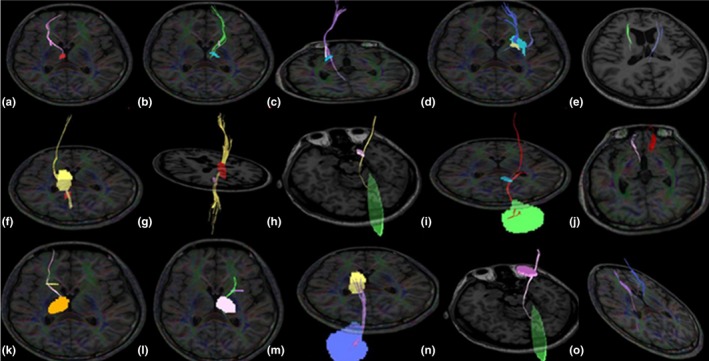
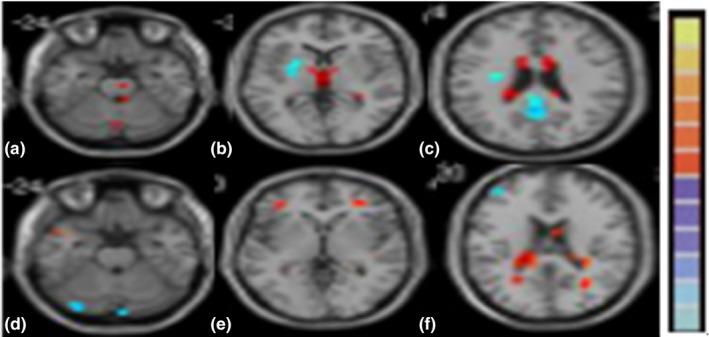
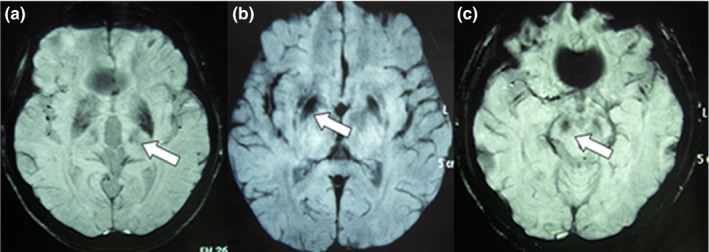
Fifty patients with WD and 20 age-matched healthy controls were enrolled. Neurological symptoms were scored using the modified Young Scale. All study subjects underwent diffusion tensor imaging (DTI), susceptibility-weighted imaging (SWI), and resting-state functional MRI (rs-fMRI) of the brain. Six regions of interest (ROI) were chosen. Fiber volumes between ROIs on DTI, corrected phase (CP) values on SWI, amplitude of low-frequency fluctuation (ALFF), and regional homogeneity (REHO) values on rs-fMRI were determined. Asymmetry index (right or left value/left or right value) was evaluated.
Asymmetry of rigidity, tremor, choreic movement, and gait abnormality (asymmetry index = 1.33, 1.39, 1.36, 1.40), fiber tracts between the GP and substantia nigra (SN), GP and PU, SN and thalamus (TH), SN and cerebellum, head of the caudate nucleus (CA) and SN, PU and CA, CA and TH, TH and cerebellum (asymmetry index = 1.233, 1.260, 1.269, 1.437, 1.503, 1.138, 1.145, 1.279), CP values in the TH, SN (asymmetry index = 1.327, 1.166), ALFF values, and REHO values of the TH (asymmetry index = 1.192, 1.233) were found. Positive correlation between asymmetry index of rigidity and fiber volumes between the GP and SN, SN and TH ( = .221, .133, = .043, .036), and tremor and fiber volumes between the CA and TH ( = .045, = .040) was found.
The neurological symptoms of patients with WD were asymmetry. The asymmetry of fiber projections may be the main cause of motor asymmetry in patients with WD.
使用功能磁共振成像(fMRI)研究 Wilson 病(WD)患者运动不对称的原因。
纳入 50 例 WD 患者和 20 例年龄匹配的健康对照者。使用改良 Young 量表对神经症状进行评分。所有研究对象均接受弥散张量成像(DTI)、磁敏感加权成像(SWI)和脑静息态功能磁共振(rs-fMRI)检查。选择 6 个感兴趣区(ROI)。确定 DTI 上 ROI 之间的纤维体积、SWI 上校正相位(CP)值、低频波动幅度(ALFF)和 rs-fMRI 上区域同质性(REHO)值。评估不对称指数(右侧或左侧值/左侧或右侧值)。
僵硬、震颤、舞蹈运动和步态异常的不对称性(不对称指数=1.33、1.39、1.36、1.40),苍白球(GP)与黑质(SN)、GP 与壳核(PU)、SN 与丘脑(TH)、SN 与小脑、尾状核头部(CA)与 SN、PU 与 CA、CA 与 TH、TH 与小脑之间的纤维束(不对称指数=1.233、1.260、1.269、1.437、1.503、1.138、1.145、1.279),TH、SN 中的 CP 值(不对称指数=1.327、1.166)、ALFF 值和 TH 的 REHO 值(不对称指数=1.192、1.233)。僵硬的不对称指数与 GP 和 SN、SN 和 TH 之间的纤维体积呈正相关(r=0.221、0.133),震颤与 CA 和 TH 之间的纤维体积呈正相关(r=0.045、0.040)。
WD 患者的神经症状为不对称性。纤维投射的不对称性可能是 WD 患者运动不对称的主要原因。