Theoretical Quantum Physics Laboratory, RIKEN Cluster for Pioneering Research, Wako-shi, 351-0198, Saitama, Japan.
Department of Physics, University of Michigan, Ann Arbor, MI, 48109-1040, USA.
Nat Commun. 2018 May 15;9(1):1924. doi: 10.1038/s41467-018-04339-w.
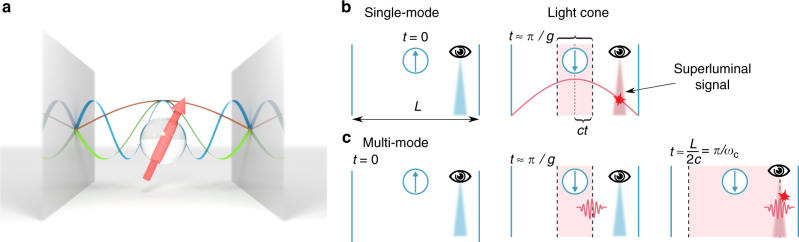
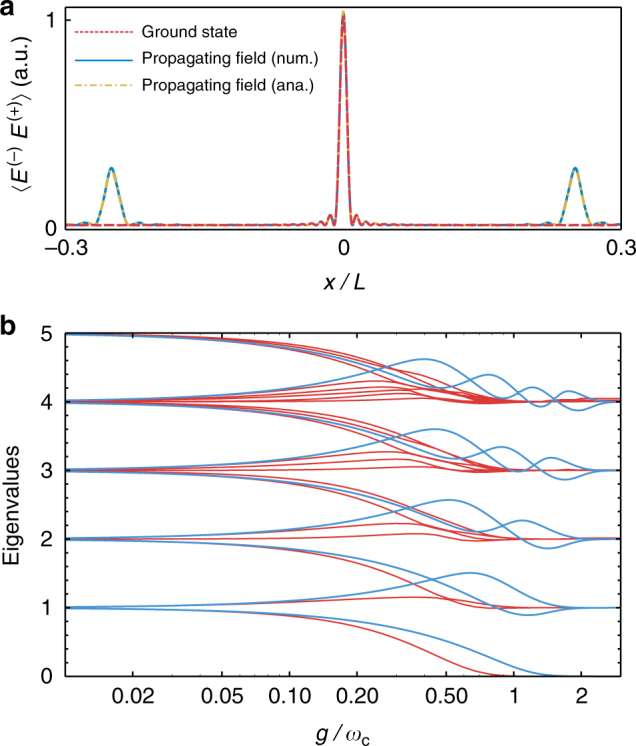
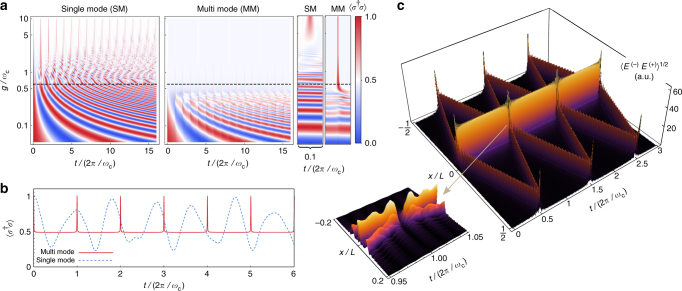
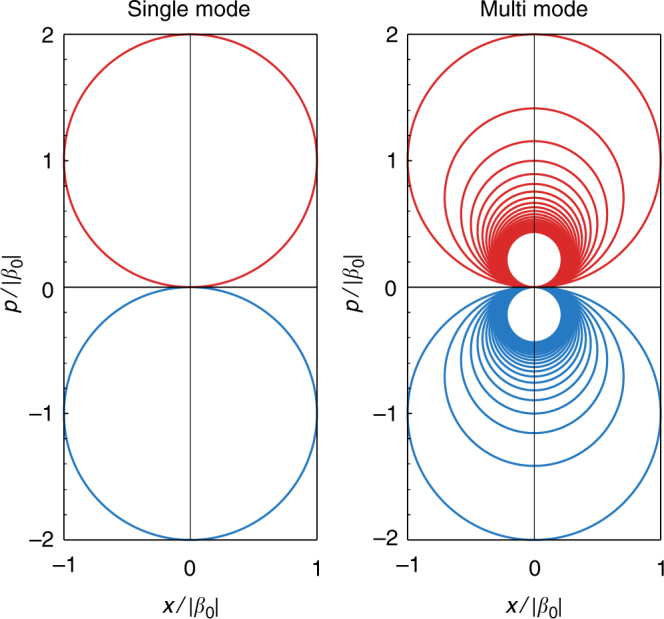
Recent technological developments have made it increasingly easy to access the non-perturbative regimes of cavity quantum electrodynamics known as ultrastrong or deep strong coupling, where the light-matter coupling becomes comparable to the bare modal frequencies. In this work, we address the adequacy of the broadly used single-mode cavity approximation to describe such regimes. We demonstrate that, in the non-perturbative light-matter coupling regimes, the single-mode models become unphysical, allowing for superluminal signalling. Moreover, considering the specific example of the quantum Rabi model, we show that the multi-mode description of the electromagnetic field, necessary to account for light propagation at finite speed, yields physical observables that differ radically from their single-mode counterparts already for moderate values of the coupling. Our multi-mode analysis also reveals phenomena of fundamental interest on the dynamics of the intracavity electric field, where a free photonic wavefront and a bound state of virtual photons are shown to coexist.
最近的技术发展使得越来越容易进入被称为超强或深强耦合的腔量子电动力学的非微扰区域,其中光物质耦合变得可与基本模态频率相媲美。在这项工作中,我们探讨了广泛使用的单模腔近似来描述这些区域的充分性。我们证明,在非微扰光物质耦合区域,单模模型变得不切实际,允许超光速信号传递。此外,考虑到量子拉比模型的具体例子,我们表明,为了考虑有限速度下的光传播,需要对电磁场进行多模描述,这会导致物理可观测量与单模对应物有很大的不同,即使在中等耦合强度下也是如此。我们的多模分析还揭示了腔内电场动力学中的一些基本有趣的现象,其中自由光子波前和虚拟光子的束缚态被证明可以共存。