Lambert Neill, Ahmed Shahnawaz, Cirio Mauro, Nori Franco
Theoretical Quantum Physics Laboratory, RIKEN Cluster for Pioneering Research, Wako-shi, Saitama, 351-0198, Japan.
Wallenberg Centre for Quantum Technology, Department of Microtechnology and Nanoscience, Chalmers University of Technology, 412 96, Gothenburg, Sweden.
Nat Commun. 2019 Aug 19;10(1):3721. doi: 10.1038/s41467-019-11656-1.
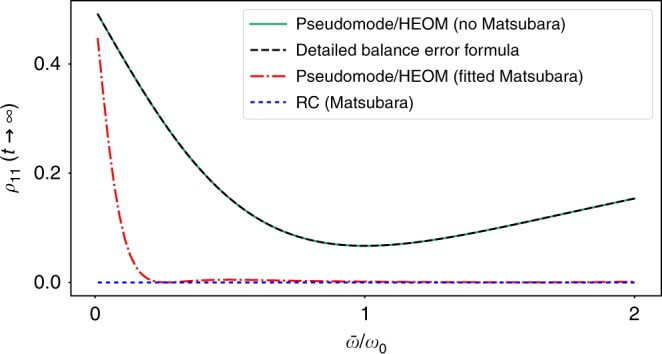
A quantum system weakly coupled to a zero-temperature environment will relax, via spontaneous emission, to its ground-state. However, when the coupling to the environment is ultra-strong the ground-state is expected to become dressed with virtual excitations. This regime is difficult to capture with some traditional methods because of the explosion in the number of Matsubara frequencies, i.e., exponential terms in the free-bath correlation function. To access this regime we generalize both the hierarchical equations of motion and pseudomode methods, taking into account this explosion using only a biexponential fitting function. We compare these methods to the reaction coordinate mapping, which helps show how these sometimes neglected Matsubara terms are important to regulate detailed balance and prevent the unphysical emission of virtual excitations. For the pseudomode method, we present a general proof of validity for the use of superficially unphysical Matsubara-modes, which mirror the mathematical essence of the Matsubara frequencies.
一个与零温度环境弱耦合的量子系统会通过自发辐射弛豫到其基态。然而,当与环境的耦合极强时,预计基态会被虚激发所修饰。由于马氏频率数量的激增,即自由浴关联函数中的指数项,用一些传统方法很难捕捉到这种情况。为了研究这种情况,我们推广了运动方程分层法和赝模方法,仅使用双指数拟合函数来考虑这种激增。我们将这些方法与反应坐标映射进行比较,这有助于说明这些有时被忽视的马氏项对于调节细致平衡以及防止虚激发的非物理发射是多么重要。对于赝模方法,我们给出了使用表面上非物理的马氏模有效性的一般证明,这些马氏模反映了马氏频率的数学本质。