Department of Physiology and Pharmacology, University of Western Ontario, London ON N6A 5B7, Canada.
Graduate Program in Neuroscience, University of Western Ontario, London ON N6A 5B7, Canada.
eNeuro. 2018 Apr 17;5(2). doi: 10.1523/ENEURO.0024-18.2018. eCollection 2018 Mar-Apr.
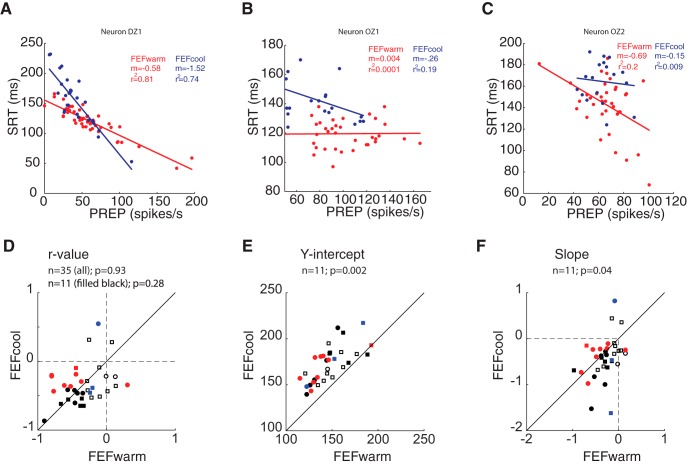
A neural correlate for saccadic reaction times (SRTs) in the gap saccade task is the level of low-frequency activity in the intermediate layers of the superior colliculus (iSC) just before visual target onset: greater levels of such iSC low-frequency activity precede shorter SRTs. The frontal eye fields (FEFs) are one likely source of iSC preparatory activity, since FEF preparatory activity is also inversely related to SRT. To better understand the FEF's role in saccade preparation, and the way in which such preparation relates to SRT, in two male rhesus monkeys, we compared iSC preparatory activity across unilateral reversible cryogenic inactivation of the FEF. FEF inactivation increased contralesional SRTs, and lowered ipsilesional iSC preparatory activity. FEF inactivation also reduced rostral iSC activity during the gap period. Importantly, the distributions of SRTs generated with or without FEF inactivation overlapped, enabling us to conduct a novel population-level analyses examining iSC preparatory activity just before generation of SRT-matched saccades. When matched for SRTs, we observed no change during FEF inactivation in the relationship between iSC preparatory activity and SRT-matched saccades across a range of SRTs, even for the occasional express saccade. Thus, while our results emphasize that the FEF has an overall excitatory influence on preparatory activity in the iSC, the communication between the iSC and downstream oculomotor brainstem is unaltered for SRT-matched saccades.
在扫视反应时间(SRT)的神经相关性中,在中间层水平的低频活动在高级视丘(iSC)中在视觉目标出现之前是一个很好的指标:这种 iSC 低频活动的水平越高,SRT 越短。额眼区(FEF)是 iSC 预备活动的一个可能来源,因为 FEF 预备活动与 SRT 呈反比。为了更好地理解 FEF 在扫视准备中的作用,以及这种准备与 SRT 的关系,我们在两只雄性恒河猴中进行了比较,比较了单侧可逆冷冻消融 FEF 时 iSC 的预备活动。FEF 失活增加了对侧 SRT,并降低了同侧 iSC 的预备活动。FEF 失活还减少了 gap 期间的 iSC 活动。重要的是,有无 FEF 失活生成的 SRT 分布重叠,使我们能够进行一项新的群体水平分析,检查 SRT 匹配扫视之前的 iSC 预备活动。当匹配 SRT 时,我们在 FEF 失活期间观察到,即使是偶尔的快速扫视,在 iSC 预备活动与 SRT 匹配扫视之间的关系中,也没有改变。因此,尽管我们的结果强调了 FEF 对 iSC 预备活动有整体的兴奋作用,但对于 SRT 匹配的扫视,iSC 和下游眼球运动脑干之间的通讯并没有改变。